
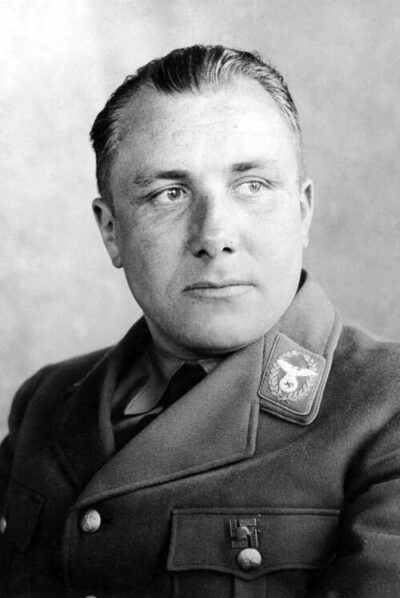
Martin Bormann
Martin Bormann was a German Nazi Party official and head of the Nazi Party Chancellery. Born June 17, 1900, in Halberstadt. Died May 2, 1945, in Berlin. Positions held include member of the Reichstag of Nazi Germany. Awards include Golden Party Badge, Blood Order and Nazi Party Long Service Award.
Facts
28 facts · 2 confirmed by two sources · 8 cited · 18 from one source
What’s different
- Born: we show June 17, 1900 (Confirmed). Wikidata also lists July 17, 1900
Where this comes from
Papalocal keeps its own record. It started from these sources; what each one said is kept here as it was copied, so a change on their side never changes this page by itself. Tap one to read its version.
What Wikidata says · copied November 16, 2026 · revision 2567933849
- Described as
- German Nazi Party official and head of the Nazi Party Chancellery (1900–1945)
- Other names
- Martin Ludwig Bormann
- Born
- June 17, 1900 · 11 references; July 17, 1900 · 1 reference
- Died
- May 2, 1945 · 7 references
- Born in
- Halberstadt · 1 reference
- Died in
- Berlin · 2 references
- Citizen of
- Nazi Germany; Weimar Republic; German Empire; Germany · 1 reference
- Occupation
- politician · 2 references; farmer · 2 references; Nazi; soldier · 2 references; Holocaust perpetrator · 1 reference
- Positions held
- member of the Reichstag of Nazi Germany
- Political party
- Nazi Party · 1 reference
- Member of
- Schutzstaffel
- Awards
- Golden Party Badge; Blood Order; Nazi Party Long Service Award; Reichsführer-SS; Honour Chevron for the Old Guard; SS-Ehrenring
- Spouse
- Gerda Bormann (1929–)
- Children
- Martin Adolf Bormann · 1 reference
- Siblings
- Albert Bormann
- Military branch
- Schutzstaffel · 1 reference; Wehrmacht · 1 reference
- Military rank
- Obergruppenführer
- Wikipedias with a page
- 79
Wikidata item Q76367 (wikidata.org/wiki/Q76367), public domain (CC0). Copied November 16, 2026.
What Wikipedia says · copied November 16, 2026 · revision 1382679525
Martin Ludwig Bormann (17 June 1900 – 2 May 1945) was a German Nazi Party official, head of the Nazi Party Chancellery, and private secretary to Adolf Hitler. Bormann gained immense power by using his position as Hitler's private secretary to control the flow of information and access to Hitler. He used his position to create an extensive bureaucracy and involve himself as much as possible in decision-making.
Born in Wegeleben, Bormann joined a paramilitary Freikorps organisation in 1922 while working as manager of a large estate. He served nearly a year in prison as an accomplice to his friend Rudolf Höss (later commandant of Auschwitz concentration camp) in the murder of school teacher Walther Kadow. Bormann joined the Nazi Party in 1927 and the Schutzstaffel (SS) in 1937. He initially worked in the party's insurance service, and transferred in July 1933 to the office of Deputy Führer Rudolf Hess, where he served as chief of staff.
Bormann gained acceptance into Hitler's inner circle and accompanied him everywhere, providing briefings and summaries of events and requests. He was appointed Hitler's personal secretary on 12 April 1943. After Hess's solo flight to Britain on 10 May 1941 to seek peace negotiations with the British government, Bormann assumed Hess's former duties, with the title of Head of the Parteikanzlei (Party Chancellery). He had final approval over civil service appointments, and helped review and approve legislation. He was a leading proponent of reducing the influence of Christian churches and favoured harsh treatment of Jews and Slavs in the areas conquered by Germany during World War II.
Bormann returned with Hitler to the Führerbunker in Berlin on 16 January 1945 as the Red Army approached the city. After Hitler committed suicide, Bormann and others attempted to flee Berlin on 2 May to avoid capture by the Soviets. Bormann likely committed suicide on a bridge near Lehrter station. His body was buried nearby on 8 May 1945, but remained unfound for decades. The missing Bormann was tried in absentia by the International Military Tribunal in the Nuremberg trials of 1945 and 1946, where he was convicted of war crimes and crimes against humanity and sentenced to death by hanging. Bormann's body was found in 1972 and confirmed as his in 1973; the identification was reaffirmed in 1998 by DNA tests.
- Born, in its opening lines
- June 17, 1900
- Died, in its opening lines
- May 2, 1945
From the Wikipedia article “Martin Bormann” (en.wikipedia.org/wiki/Martin_Bormann), by its contributors, under CC BY-SA 4.0 (creativecommons.org/licenses/by-sa/4.0/). Copied November 16, 2026; not changed.
Confirmed Two sources agree. Cited One source, and it names where it got it. One source One source, without a reference of its own. Sources disagree The sources disagree. We show the best-supported value and keep theirs below.
