
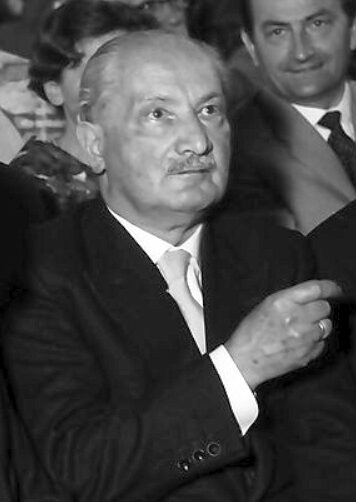
Martin Heidegger
Martin Heidegger was a German philosopher. Born September 26, 1889, in Meßkirch. Died May 26, 1976, in Freiburg im Breisgau. Known for Being and Time, Letter on Humanism and Introduction to Metaphysics. Educated at University of Freiburg. Awards include Johann-Peter-Hebel-Preis.
Facts
32 facts · 2 confirmed by two sources · 12 cited · 18 from one source
Where this comes from
Papalocal keeps its own record. It started from these sources; what each one said is kept here as it was copied, so a change on their side never changes this page by itself. Tap one to read its version.
What Wikidata says · copied November 16, 2026 · revision 2569874463
- Described as
- German philosopher (1889–1976)
- Other names
- Heidegger
- Born
- September 26, 1889 · 17 references
- Died
- May 26, 1976 · 17 references
- Born in
- Meßkirch · 3 references
- Died in
- Freiburg im Breisgau · 3 references
- Buried in
- Meßkirch
- Cause of death
- infectious disease
- Name at birth
- Martin Heidegger
- Citizen of
- Weimar Republic; Nazi Germany; West Germany; Germany · 1 reference
- Occupation
- philosopher · 3 references; poet; university teacher · 1 reference; scientist · 1 reference
- Political party
- Nazi Party (1933–1945) · 2 references
- Worked for
- University of Marburg (1923–1928); University of Freiburg (2 times) (1915–1958)
- Education
- University of Freiburg (–1916)
- Member of
- Heidelberg Academy of Sciences and Humanities (1958–) · 1 reference; Bavarian Academy of Fine Arts
- Known for
- Being and Time; Letter on Humanism; Introduction to Metaphysics; Black Notebooks
- Awards
- Johann-Peter-Hebel-Preis (1960) · 1 reference
- Field
- philosophy; phenomenology · 1 reference
- Spouse
- Elfride Heidegger · 1 reference
- Children
- Hermann Heidegger · 1 reference; Jörg Heidegger · 1 reference
- Siblings
- Fritz Heidegger · 1 reference
- Wikipedias with a page
- 150
Wikidata item Q48301 (wikidata.org/wiki/Q48301), public domain (CC0). Copied November 16, 2026.
What Wikipedia says · copied November 16, 2026 · revision 1385902594
Martin Heidegger (26 September 1889 – 26 May 1976) was a German philosopher whose work was central to the development of phenomenology, hermeneutics, and existentialism. He has had significant influence within subsequent philosophy, social sciences and humanities, and theology.
Heidegger's magnum opus, Being and Time (1927), is widely considered one of the most significant works of modern philosophy. In it, he introduced the concept of Dasein ("being-there") to describe the distinctive character of human existence, arguing that humans possess a "pre-ontological" understanding of being that shapes how they live and act, which he analyzed in terms of the unitary structure of "being-in-the-world". Through his analysis of Dasein, Heidegger sought to reawaken what he called "the question of being": the fundamental inquiry into what makes entities intelligible as the entities they are. In other words, Heidegger's governing "question of being" is concerned with what makes beings intelligible as beings. This question, he believed, had been neglected or obscured throughout the history of Western philosophy since the ancient Greeks.
His later work turned increasingly to questions of technology, language, art, and poetry, developing themes of human "dwelling" in the world and critiquing what he saw as the nihilistic trajectory of modern technological civilisation. Thinkers as varied as Jean-Paul Sartre, Hans-Georg Gadamer, Hannah Arendt, Jacques Derrida, Michel Foucault, Emmanuel Levinas, and Richard Rorty were substantially shaped by engagement with his thought, whether in agreement or opposition.
Heidegger's legacy has been complicated and shadowed by his involvement with Nazism. In April 1933, he was elected rector of the University of Freiburg and joined the Nazi Party, a membership he retained until 1945. The nature and extent of his commitment to Nazism, and the question of whether his philosophy is inherently connected to his political choices, remain subjects of significant scholarly controversy. After the war, he was banned from teaching following denazification proceedings, a ban later lifted in 1949, after which he returned to lecturing at the University of Freiburg. During this period of enforced withdrawal, he nevertheless continued to exert influence through private seminars and audiences at his home. His refusal to publicly repudiate his Nazi involvements or express remorse in unambiguous terms has continued to trouble interpreters of his work.
- Born, in its opening lines
- September 26, 1889
- Died, in its opening lines
- May 26, 1976
From the Wikipedia article “Martin Heidegger” (en.wikipedia.org/wiki/Martin_Heidegger), by its contributors, under CC BY-SA 4.0 (creativecommons.org/licenses/by-sa/4.0/). Copied November 16, 2026; not changed.
Confirmed Two sources agree. Cited One source, and it names where it got it. One source One source, without a reference of its own. Sources disagree The sources disagree. We show the best-supported value and keep theirs below.
