
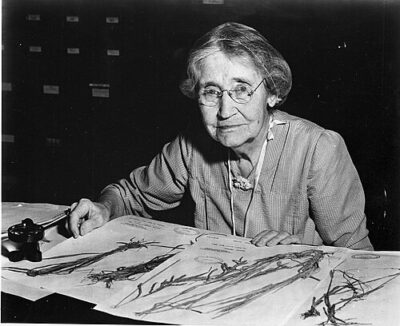
Mary Agnes Chase
Mary Agnes Chase was an U.S. botanist, botanical collector and scientific illustrator. Born April 29, 1869, in Iroquois County. Died September 24, 1963, in Bethesda. Known for First book of grasses; the structure of grasses explained for beginners. Educated at University of Chicago. Awards include Fellow of the Linnean Society of London and honorary doctor of the University of Illinois system.
Facts
30 facts · 2 confirmed by two sources · 27 cited · 1 from one source
Where this comes from
Papalocal keeps its own record. It started from these sources; what each one said is kept here as it was copied, so a change on their side never changes this page by itself. Tap one to read its version.
What Wikidata says · copied November 16, 2026 · revision 2566119991
- Described as
- U.S. botanist, botanical collector and scientific illustrator (1869–1963)
- Other names
- Chase, Agnes Chase, Mary Agnes Merrill, M. A. Chase, Mary Agnes Meara Chase, A. Chase, Mary Agnes Meara, W. I. Chase, Mrs W. I. Chase, Mary Agnes Mera, M. Agnes Chase
- Born
- April 29, 1869 · 1 reference
- Died
- September 24, 1963 · 3 references
- Born in
- Iroquois County · 2 references
- Died in
- Bethesda · 2 references
- Buried in
- Rosehill Cemetery · 1 reference
- Name at birth
- Mary Agnes Meara · 1 reference
- Citizen of
- United States · 1 reference
- Occupation
- botanist · 2 references; agrostologist · 1 reference; botanical collector · 8 references; suffragist · 1 reference; scientific illustrator · 1 reference; botanical illustrator · 1 reference; illustrator · 1 reference; scientific collector · 1 reference
- Worked for
- Smithsonian Institution · 1 reference; United States Department of Agriculture (1903–) · 1 reference; Field Museum of Natural History (1901–) · 1 reference; United States National Museum (1944–1946) · 1 reference
- Education
- University of Chicago · 1 reference
- Member of
- Silent Sentinels · 1 reference; NAACP · 1 reference; National Woman's Party · 1 reference; Graduate Women in Science
- Known for
- First book of grasses; the structure of grasses explained for beginners · 1 reference
- Awards
- Fellow of the Linnean Society of London (1961) · 1 reference; honorary doctor of the University of Illinois system (1958) · 1 reference
- Field
- botany · 3 references; grass · 1 reference
- Spouse
- William Ingraham Chase · 1 reference
- Wikipedias with a page
- 23
Wikidata item Q3822242 (wikidata.org/wiki/Q3822242), public domain (CC0). Copied November 16, 2026.
What Wikipedia says · copied November 16, 2026 · revision 1384372271
Mary Agnes Chase (April 29, 1869 – September 24, 1963) was an American botanist who specialized in agrostology, the study of grasses. Although lacking formal education past elementary school, Chase was able to rise through the ranks as a botanist at the United States Department of Agriculture, beginning as an illustrator under the tutelage of Albert Spear Hitchcock, and eventually becoming a senior botanist, overseeing the USDA's Systematic Agrostology department. Chase conducted fieldwork abroad in Europe and South America and published several books, including the First Book of Grasses: The Structure of Grasses Explained for Beginners, which was later translated into Spanish and Portuguese. Chase was recognized for her work as an agrostologist with numerous awards, including a Certificate of Merit issued by the Botanical Society of America in 1956. An active suffragist, she took part in demonstrations organized by the Silent Sentinels, a group established by members of the National Woman's Party. Although Chase's participation in this movement was not always well received by her peers in the scientific community, she remained committed to the cause of women's suffrage.
- Born, in its opening lines
- April 29, 1869
- Died, in its opening lines
- September 24, 1963
From the Wikipedia article “Mary Agnes Chase” (en.wikipedia.org/wiki/Mary_Agnes_Chase), by its contributors, under CC BY-SA 4.0 (creativecommons.org/licenses/by-sa/4.0/). Copied November 16, 2026; not changed.
Confirmed Two sources agree. Cited One source, and it names where it got it. One source One source, without a reference of its own. Sources disagree The sources disagree. We show the best-supported value and keep theirs below.
