
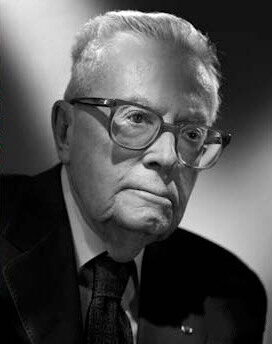
Maurice Allais
Maurice Allais was a French economist. Born May 31, 1911, in 14th arrondissement of Paris. Died October 9, 2010, in Saint-Cloud. Positions held include Director of Research at CNRS and director (1943–1970). Educated at Lycée Henri-IV and École polytechnique. Awards include Grand Cross of the Legion of Honour, Grand Cross of the National Order of Merit and Officer of the French Order of Academic Palms.
Facts
40 facts · 2 confirmed by two sources · 16 cited · 22 from one source
Where this comes from
Papalocal keeps its own record. It started from these sources; what each one said is kept here as it was copied, so a change on their side never changes this page by itself. Tap one to read its version.
What Wikidata says · copied November 16, 2026 · revision 2567375004
- Described as
- French economist (1911–2010)
- Other names
- Maurice Félix Charles Allais
- Born
- May 31, 1911 · 12 references
- Died
- October 9, 2010 · 15 references
- Born in
- 14th arrondissement of Paris · 4 references
- Died in
- Saint-Cloud · 4 references
- Buried in
- Saint-Cloud cemetery
- Name at birth
- Maurice Félix Charles Allais · 1 reference
- Citizen of
- France · 3 references
- Occupation
- economist · 1 reference; physicist · 3 references; engineer · 1 reference; researcher · 1 reference
- Positions held
- Director of Research at CNRS; director (1943–1970)
- Worked for
- Paris Nanterre University
- Education
- Lycée Henri-IV; École polytechnique · 1 reference; Lycée Lakanal; Mines ParisTech · 1 reference; Science Faculty of Paris; University of Toronto Mississauga
- Member of
- National Academy of Sciences (1990–) · 1 reference; Académie des Sciences Morales et Politiques; Russian Academy of Sciences; French Academy of Sciences · 1 reference; Econometric Society (1949–) · 1 reference; Accademia Nazionale dei Lincei (1991–) · 1 reference
- Awards
- Grand Cross of the Legion of Honour; Grand Cross of the National Order of Merit; Officer of the French Order of Academic Palms; CNRS Gold medal (1978) · 2 references; Prize in Economic Sciences in Memory of Alfred Nobel (1988) · 2 references; Honorary doctor of the University of Mons (1992); Honorary doctor of the University of Groningen; Fellow of the Econometric Society (1949) · 1 reference; Frederick W. Lanchester Prize (1957); honorary doctor of the University of Lisbon; Zerilli-Marimò Prize (1984); Ordre de l'Économie nationale (1962)
- Spouse
- Jacqueline Allais
- Website
- http://allais.maurice.free.fr
- Wikipedias with a page
- 69
Wikidata item Q105962 (wikidata.org/wiki/Q105962), public domain (CC0). Copied November 16, 2026.
What Wikipedia says · copied November 16, 2026 · revision 1383245190
Maurice Félix Charles Allais (French pronunciation: [mɔʁis feliks ʃaʁl alɛ]; 31 May 1911 – 9 October 2010) was a French physicist and economist, the 1988 winner of the Nobel Memorial Prize in Economic Sciences "for his pioneering contributions to the theory of markets and efficient utilization of resources", along with John Hicks (Value and Capital, 1939) and Paul Samuelson (The Foundations of Economic Analysis, 1947), to neoclassical synthesis. They formalize the self-regulation of markets, which Keynes refuted but reiterated some of Allais's ideas.
Born in Paris, France, Allais attended the Lycée Lakanal, graduated from the École Polytechnique in Paris and studied at the École nationale supérieure des mines de Paris. His academic and other posts have included being Professor of Economics at the École Nationale Supérieure des Mines de Paris (since 1944) and Director of its Economic Analysis Centre (since 1946). In 1949, he received the title of doctor-engineer from the University of Paris, Faculty of Science. He also held teaching positions at various institutions, including at the university of Paris X–Nanterre. His first works oriented him towards the sciences of the concrete and the experiments of fundamental physics, on which he will also publish numerous works, notably on pendular oscillations and the laws of gravitation. It's after a trip in 1933 to the United States during the Great Depression, that he decides to make the economy. Allais died at his home in Saint-Cloud, near Paris, at the age of 99.
Allais considered Léon Walras, Wilfredo Pareto, and Irving Fisher to be his primary influences. He was reluctant to write in or translate his work into English, and many of his major contributions became known to the dominant community only when they were independently rediscovered or popularized by English-speaking economists. At the same time, he claimed Keynes's liberalism and declared himself in favor of an important public sector. Allais attended the inaugural meeting of the Mont Pelerin Society, but he was alone among the attendees to refuse to sign the statement of aims because of a disagreement over the extent of property rights. He exerted an important influence, at the end of the war, on French economists such as Gérard Debreu, Jacques Lesourne, Edmond Malinvaud and Marcel Boiteux.
Paul Samuelson said "Had Allais earliest writings been in English, a generation of economic theory would have taken a different course", and felt the Nobel Prize should have been awarded to him much earlier. Assar Lindbeck, the chairman of the selection committee, considered Allais as "a giant within the world of economic analysis".
- Born, in its opening lines
- May 31, 1911
- Died, in its opening lines
- October 9, 2010
From the Wikipedia article “Maurice Allais” (en.wikipedia.org/wiki/Maurice_Allais), by its contributors, under CC BY-SA 4.0 (creativecommons.org/licenses/by-sa/4.0/). Copied November 16, 2026; not changed.
Confirmed Two sources agree. Cited One source, and it names where it got it. One source One source, without a reference of its own. Sources disagree The sources disagree. We show the best-supported value and keep theirs below.
