
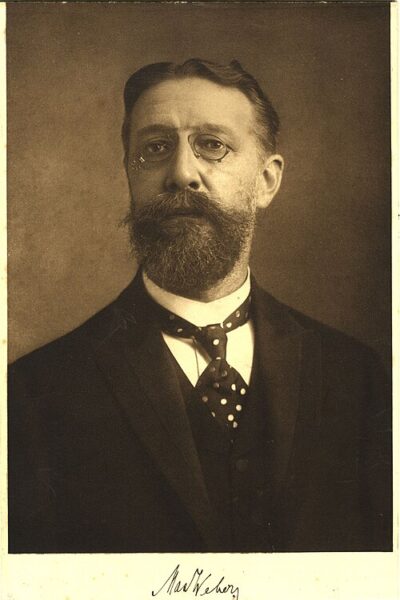
Max Wilhelm Carl Weber
Max Wilhelm Carl Weber was a German-Dutch zoologist. Born December 5, 1852, in Bonn. Died February 7, 1937, in Eerbeek. Educated at University of Bonn. Awards include Alexander Agassiz Medal, Foreign Member of the Royal Society and Swammerdam Medal.
Facts
23 facts · 2 confirmed by two sources · 10 cited · 11 from one source
Where this comes from
Papalocal keeps its own record. It started from these sources; what each one said is kept here as it was copied, so a change on their side never changes this page by itself. Tap one to read its version.
What Wikidata says · copied November 18, 2026 · revision 2568888625
- Described as
- German-Dutch zoologist (1852–1937)
- Other names
- Max Carl Wilhelm Weber, Max Weber, Weber, M.W.C. Weber, Max Carl Wilhelm Weber van Bosse, M. Weber
- Born
- December 5, 1852 · 3 references
- Died
- February 7, 1937 · 4 references
- Born in
- Bonn · 2 references
- Died in
- Eerbeek · 1 reference
- Citizen of
- Kingdom of Prussia; German Reich; Kingdom of the Netherlands (1887–) · 1 reference
- Occupation
- zoologist · 1 reference; ichthyologist; university teacher; scientific collector · 1 reference
- Worked for
- University of Amsterdam (1883–1922) · 1 reference
- Education
- University of Bonn
- Member of
- Royal Society of London (1935–); Royal Swedish Academy of Sciences; Royal Netherlands Academy of Arts and Sciences; Bavarian Academy of Sciences and Humanities
- Awards
- Alexander Agassiz Medal (1927) · 1 reference; Foreign Member of the Royal Society (1935) · 1 reference; Swammerdam Medal (1920) · 1 reference
- Spouse
- Anna Weber-van Bosse · 1 reference
- Lived in
- Netherlands · 1 reference; Prof. Weberlaan 1 · 1 reference
- Wikipedias with a page
- 23
Wikidata item Q63149 (wikidata.org/wiki/Q63149), public domain (CC0). Copied November 18, 2026.
What Wikipedia says · copied November 18, 2026 · revision 1342217371
Max Carl Wilhelm Weber van Bosse or Max Wilhelm Carl Weber (5 December 1852 – 7 February 1937) was a German-Dutch zoologist and biogeographer.
Weber studied at the University of Bonn, then at the Humboldt University in Berlin with the zoologist Eduard Carl von Martens (1831–1904). He obtained his doctorate in 1877. Weber taught at the University of Utrecht then participated in an expedition to the Barents Sea. He became Professor of Zoology, Anatomy and Physiology at the University of Amsterdam in 1883. In the same year he received naturalised Dutch citizenship.
His discoveries as leader of the Siboga Expedition led him to conclude that Wallace's Line was placed too far to the west. His studies, along with others, led to a series of alternative lines to be proposed to delimit two major biogeographic realms, the Australasian realm and the Indomalayan realm. These lines were based on the fauna and flora in general, including the mammalian fauna. Later, Pelseneer published an influential paper on this topic, in which he proposed to call his preferred limit Weber's Line, to honour Weber's contributions in that field. As is the case with plant species, faunal surveys revealed that for mollusks and most vertebrate groups Wallace’s line was not the most significant biogeographic boundary. The Tanimbar Island group, and not the boundary between Bali and Lombok, appears to be the major interface between the Oriental and Australasian regions for mammals and other terrestrial vertebrate groups.
With G.A.F. Molengraaff, Weber gave names to the Sahul Shelf and the Sunda Shelf in 1919.
Weber became member of the Royal Netherlands Academy of Arts and Sciences in 1887.
Weber is commemorated in the scientific names of three species of reptiles: Anomochilus weberi, Hydrosaurus weberi, and Pachydactylus weberi. Two species of mammal are also named after him: Prosciurillus weberi and Myotis weberi.
- Born, in its opening lines
- December 5, 1852
- Died, in its opening lines
- February 7, 1937
From the Wikipedia article “Max Carl Wilhelm Weber” (en.wikipedia.org/wiki/Max_Carl_Wilhelm_Weber), by its contributors, under CC BY-SA 4.0 (creativecommons.org/licenses/by-sa/4.0/). Copied November 18, 2026; not changed.
Confirmed Two sources agree. Cited One source, and it names where it got it. One source One source, without a reference of its own. Sources disagree The sources disagree. We show the best-supported value and keep theirs below.
