
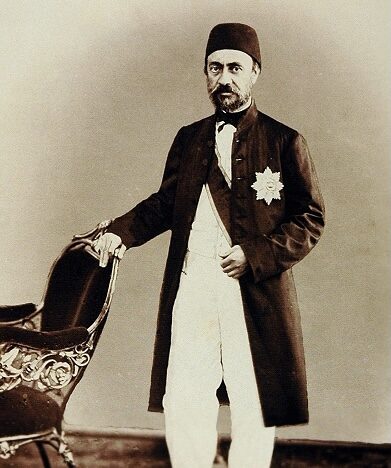
Mehmed Emin Âli Paşa
Mehmed Emin Âli Paşa was an Ottoman statesman and Grand Vizier. Born March 5, 1815, in Istanbul. Died September 7, 1871, in Istanbul. Positions held include grand vizier of the Ottoman Empire (1852), grand vizier (4 times) (1855–1871) and ambassador.
Facts
17 facts · 2 confirmed by two sources · 5 cited · 10 from one source
Where this comes from
Papalocal keeps its own record. It started from these sources; what each one said is kept here as it was copied, so a change on their side never changes this page by itself. Tap one to read its version.
What Wikidata says · copied November 16, 2026 · revision 2562752322
- Described as
- Ottoman statesman and Grand Vizier (1815–1871)
- Other names
- Aali Pasha, Mehmed Emin Ali Paşa
- Born
- March 5, 1815 · 3 references
- Died
- September 7, 1871 · 2 references
- Born in
- Istanbul
- Died in
- Istanbul
- Buried in
- Istanbul
- Cause of death
- tuberculosis
- Citizen of
- Ottoman Empire · 1 reference
- Occupation
- diplomat; politician · 1 reference; writer · 1 reference; grand vizier · 1 reference
- Positions held
- grand vizier of the Ottoman Empire (1852); grand vizier (4 times) (1855–1871); ambassador; Beylerbey of Salonica
- Father
- Ali Rıza Efendi · 1 reference
- Religion
- Islam · 1 reference
- Wikipedias with a page
- 30
Wikidata item Q439237 (wikidata.org/wiki/Q439237), public domain (CC0). Copied November 16, 2026.
What Wikipedia says · copied November 16, 2026 · revision 1375354879
Mehmed Emin Âlî Pasha, also spelled as Mehmed Emin Aali (5 March 1815 – 7 September 1871), commonly known as Ali Pasha, was a Turkish–Ottoman statesman during the Tanzimat period, best known as the architect of the Ottoman Reform Edict of 1856, and for his role in the Treaty of Paris (1856) that ended the Crimean War. From obscure origins as the son of a doorkeeper, Âli Pasha rose through the ranks of the Ottoman state and became the Minister of Foreign Affairs for a short time in 1840, and again in 1846. He became Grand Vizier for a few months in 1852. Between 1855 and 1871 he alternated between the two jobs, ultimately holding the position of Foreign Minister seven times and Grand Vizier five times in his lifetime. Âli Pasha was widely regarded as a deft and able statesman, and often credited with preventing an early break-up of the empire.
Âli Pasha advocated for a western style of reform to modernize the empire, including secularization of the state and education and improvements to civil liberties. He advocated for an Ottoman nationalism that would replace diverse ethnic and religious loyalties. To that end, non-Muslims started to serve in government, with a couple becoming cabinet ministers. In foreign policy, following the Crimean War the Ottoman Empire joined the Concert of Europe. Troops were withdrawn from Serbia, and the Cretan revolt was suppressed. His egalitarian reforms, dealings with Christian powers, and increasingly authoritarian regime were not without controversy, opponents of which coalesced around the Young Ottomans. After his death in 1871, a period of chaos resulted as reactionaries took control over the government, leading to the Great Eastern Crisis.
- Born, in its opening lines
- March 5, 1815
- Died, in its opening lines
- September 7, 1871
From the Wikipedia article “Mehmed Emin Âli Pasha” (en.wikipedia.org/wiki/Mehmed_Emin_Âli_Pasha), by its contributors, under CC BY-SA 4.0 (creativecommons.org/licenses/by-sa/4.0/). Copied November 16, 2026; not changed.
Confirmed Two sources agree. Cited One source, and it names where it got it. One source One source, without a reference of its own. Sources disagree The sources disagree. We show the best-supported value and keep theirs below.
