
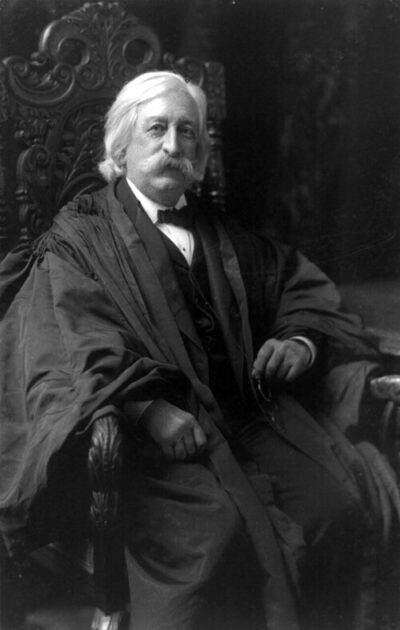
Melville Fuller
Melville Fuller was a chief justice of the United States from 1888 to 1910. Born February 11, 1833, in Augusta. Died July 4, 1910, in Sorrento. Positions held include member of the Illinois House of Representatives and Chief Justice of the United States (1888–1910). Educated at Bowdoin College and Harvard Law School.
Facts
25 facts · 2 confirmed by two sources · 2 cited · 21 from one source
Where this comes from
Papalocal keeps its own record. It started from these sources; what each one said is kept here as it was copied, so a change on their side never changes this page by itself. Tap one to read its version.
What Wikidata says · copied November 16, 2026 · revision 2552207732
- Described as
- chief justice of the United States from 1888 to 1910
- Other names
- Melville W. Fuller, Melville Weston Fuller
- Born
- February 11, 1833 · 3 references
- Died
- July 4, 1910 · 3 references
- Born in
- Augusta
- Died in
- Sorrento
- Buried in
- Graceland Cemetery · 1 reference
- Cause of death
- myocardial infarction
- Citizen of
- United States
- Occupation
- lawyer; judge; politician
- Positions held
- member of the Illinois House of Representatives; Chief Justice of the United States (1888–1910)
- Political party
- Democratic Party
- Education
- Bowdoin College; Harvard Law School; Harvard University
- Member of
- American Academy of Arts and Sciences; Phi Beta Kappa Society
- Spouse
- Calista Ophelia Reynolds; Mary Ellen Coolbaugh
- Children
- Mildred Fuller; Grace Weston Fuller
- Father
- Frederick Augustus Fuller · 1 reference
- Mother
- Catherine Martin Weston
- Religion
- Episcopal Church
- Wikipedias with a page
- 23
Wikidata item Q943046 (wikidata.org/wiki/Q943046), public domain (CC0). Copied November 16, 2026.
What Wikipedia says · copied November 16, 2026 · revision 1383147790
Melville Weston Fuller (February 11, 1833 – July 4, 1910) was an American politician, attorney, and jurist who served as the eighth chief justice of the United States from 1888 until his death in 1910. Staunch conservatism marked his tenure on the Supreme Court, exhibited by his tendency to support unfettered free enterprise and to oppose broad federal power. He wrote major opinions on the federal income tax, the Commerce Clause, and citizenship law, and he took part in important decisions about racial segregation and the liberty of contract. The rulings faced criticism during and after Fuller's tenure, and many were later overruled or abrogated. The legal academy has generally viewed Fuller negatively, although a revisionist minority has taken a more favorable view of his jurisprudence.
Born in Augusta, Maine, Fuller established a legal practice in Chicago after graduating from Bowdoin College. A Democrat, he became involved in politics and campaigned for Stephen A. Douglas in the 1860 presidential election. During the Civil War, he served a single term in the Illinois House of Representatives, where he opposed the policies of President Abraham Lincoln. Fuller became a prominent attorney in Chicago and was a delegate to several Democratic National Conventions. He declined three separate appointments offered by President Grover Cleveland before accepting Cleveland's nomination to succeed Morrison Waite as chief justice in 1888. Despite some voicing objections over his political past, Fuller was confirmed by the Senate. He served as chief justice until his death in 1910, gaining a reputation for collegiality and able administration.
Fuller's jurisprudence was conservative, focusing strongly on states' rights, limited federal power, and economic liberty. His majority opinion in Pollock v. Farmers' Loan & Trust Co. (1895) ruled a federal income tax to be unconstitutional; the Sixteenth Amendment later superseded the decision. Fuller's opinion in United States v. E. C. Knight Co. (1895) narrowly interpreted Congress's authority under the Commerce Clause, limiting the reach of the Sherman Act and making government prosecution of antitrust cases more difficult. In Lochner v. New York (1905), Fuller agreed with the majority that the Constitution forbade states from enforcing wage-and-hour restrictions on businesses, contending that the Due Process Clause prevents government infringement on one's liberty to control one's property and business affairs. Fuller joined the majority in Plessy v. Ferguson (1896), in which the Court articulated the doctrine of separate but equal and upheld Jim Crow laws. He argued in the Insular Cases that residents of the territories are entitled to constitutional rights, but he dissented when, in United States v. Wong Kim Ark (1898), the majority ruled in favor of birthright citizenship.
Many of Fuller's decisions did not stand the test of time. His views on economic liberty were squarely rejected by the Court during the New Deal era, and the Plessy opinion was unanimously reversed in Brown v. Board of Education (1954). Fuller's historical reputation has been generally unfavorable, with many scholars arguing that he was overly deferential to corporations and the wealthy. While a resurgence of conservative legal thought has brought Fuller new defenders, an increase in racial awareness has also led to new scrutiny of his vote in Plessy. In 2021, Kennebec County (Maine) commissioners voted unanimously to remove a statue of Fuller from public land with the aim of dissociating the county from racial segregation.
- Born, in its opening lines
- February 11, 1833
- Died, in its opening lines
- July 4, 1910
From the Wikipedia article “Melville Fuller” (en.wikipedia.org/wiki/Melville_Fuller), by its contributors, under CC BY-SA 4.0 (creativecommons.org/licenses/by-sa/4.0/). Copied November 16, 2026; not changed.
Confirmed Two sources agree. Cited One source, and it names where it got it. One source One source, without a reference of its own. Sources disagree The sources disagree. We show the best-supported value and keep theirs below.
