
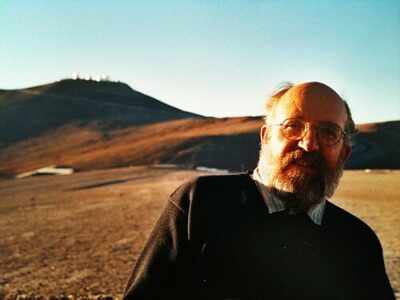
Michel Mayor
Michel Mayor is a Swiss astrophysicist & Nobel laureate of Physics. Born January 12, 1942, in Lausanne. Positions held include director (1998–2004). Educated at University of Geneva and University of Lausanne. Awards include Prix Jules Janssen, Balzan Prize and Gold Medal of the Royal Astronomical Society.
Facts
37 facts · 1 confirmed by two sources · 22 cited · 14 from one source
Where this comes from
Papalocal keeps its own record. It started from these sources; what each one said is kept here as it was copied, so a change on their side never changes this page by itself. Tap one to read its version.
What Wikidata says · copied November 16, 2026 · revision 2568815192
- Described as
- Swiss astrophysicist & Nobel laureate of Physics
- Other names
- Michel G. E. Mayor, Michel Gustave Mayor, Michel Gustave E. Mayor, M. G. E. Mayor, M. G. Mayor, M. Mayor, Michel Gustave Édouard Mayor
- Born
- January 12, 1942 · 4 references
- Born in
- Lausanne · 2 references
- Name at birth
- Michel Gustave Édouard Mayor
- Citizen of
- Switzerland · 1 reference
- Occupation
- university teacher; astrophysicist; astronomer · 1 reference; physicist; researcher
- Positions held
- director (1998–2004)
- Worked for
- Observatory of Geneva (1984–2007); University of Geneva · 1 reference
- Education
- University of Geneva; University of Lausanne
- Member of
- French Academy of Sciences (2002–) · 1 reference; American Academy of Arts and Sciences (2010–) · 1 reference; National Academy of Sciences (2010–) · 1 reference; Academy of Sciences of Turin (2021–) · 1 reference; International Astronomical Union (1973–) · 1 reference; European Academy of Sciences (2003–) · 1 reference
- Awards
- Prix Jules Janssen (1998) · 1 reference; Balzan Prize (2000) · 1 reference; Gold Medal of the Royal Astronomical Society (2015) · 1 reference; Karl Schwarzschild Medal (2010) · 1 reference; Wolf Prize in Physics (2017) · 2 references; Knight of the Legion of Honour (2004); Kyoto Prize in Basic Sciences (2015) · 2 references; Marcel Benoist Prize (1997) · 1 reference; BBVA Foundation Frontiers of Knowledge Award (2011) · 1 reference; Albert Einstein Medal (2004) · 1 reference; The Shaw Prize in Astronomy (2005) · 2 references; Nobel Prize in Physics (2019) · 2 references; Officer of the Legion of Honour (2017) · 1 reference; Viktor Ambartsumian International Prize (2010) · 3 references; Nature's 10 (2013) · 1 reference
- Field
- astrophysics
- Website
- https://exoplanets.ch/team/faculty-members/michel-mayor/ · 1 reference
- Wikipedias with a page
- 69
Wikidata item Q123975 (wikidata.org/wiki/Q123975), public domain (CC0). Copied November 16, 2026.
What Wikipedia says · copied November 16, 2026 · revision 1385614369
Michel Gustave Édouard Mayor (French pronunciation: [miʃɛl majɔʁ]; born 12 January 1942) is a Swiss astrophysicist and professor emeritus at the University of Geneva's Department of Astronomy. He formally retired in 2007, but remains active as a researcher at the Observatory of Geneva. He is co-laureate of the 2019 Nobel Prize in Physics along with Jim Peebles and Didier Queloz, and the winner of the 2010 Viktor Ambartsumian International Prize and the 2015 Kyoto Prize.
Together with Didier Queloz in 1995, he discovered 51 Pegasi b, the first extrasolar planet orbiting a sun-like star, 51 Pegasi. For this achievement, they were awarded the 2019 Nobel Prize in Physics "for the discovery of an exoplanet orbiting a solar-type star" resulting in "contributions to our understanding of the evolution of the universe and Earth's place in the cosmos".
Related to the discovery, Mayor noted that humans will never migrate to such exoplanets since they are "much, much too far away ... [and would take] hundreds of millions of days using the means we have available today". However, due to discoveries by Mayor, searching for extraterrestrial communications from exoplanets may now be a more practical consideration than thought earlier.
- Born, in its opening lines
- January 12, 1942
From the Wikipedia article “Michel Mayor” (en.wikipedia.org/wiki/Michel_Mayor), by its contributors, under CC BY-SA 4.0 (creativecommons.org/licenses/by-sa/4.0/). Copied November 16, 2026; not changed.
Confirmed Two sources agree. Cited One source, and it names where it got it. One source One source, without a reference of its own. Sources disagree The sources disagree. We show the best-supported value and keep theirs below.
