
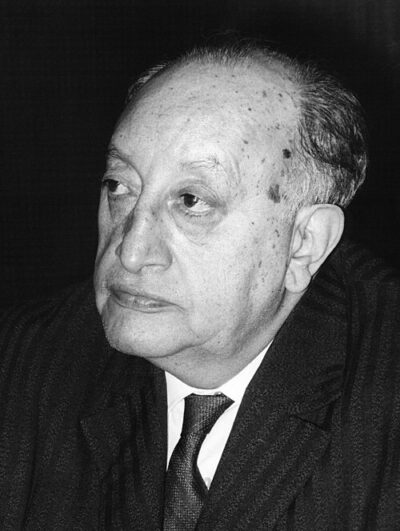
Miguel Ángel Asturias
Miguel Ángel Asturias was a Guatemalan writer and diplomat. Born October 19, 1899, in Guatemala City. Died June 9, 1974, in Madrid. Positions held include Member of the Congress of Guatemala, President of the Jury at the Cannes Festival (1970) and ambassador of Guatemala to Mexico. Known for Leyendas de Guatemala and Mulata de tal. Educated at University of Paris and Universidad de San Carlos de Guatemala. Awards include Nobel Prize in Literature, Order of Augusto César Sandino and Medalla Yucatán.
Facts
36 facts · 2 confirmed by two sources · 9 cited · 25 from one source
Where this comes from
Papalocal keeps its own record. It started from these sources; what each one said is kept here as it was copied, so a change on their side never changes this page by itself. Tap one to read its version.
What Wikidata says · copied November 16, 2026 · revision 2568392096
- Described as
- Guatemalan writer and diplomat (1899–1974)
- Other names
- Miguel Ángel Asturias Rosales pachan, Miguel Asturias, Miguel Angel Asturias, Miguel Ángel Asturias Rosales
- Born
- October 19, 1899 · 13 references
- Died
- June 9, 1974 · 16 references
- Born in
- Guatemala City · 3 references
- Died in
- Madrid · 1 reference
- Buried in
- Centro Cultural Miguel Ángel Asturias (2026–) · 1 reference
- Name at birth
- Miguel Ángel Tejada Peñuela
- Citizen of
- Guatemala
- Occupation
- poet; writer · 1 reference; diplomat; journalist; politician; poet lawyer; translator; lawyer · 1 reference
- Positions held
- Member of the Congress of Guatemala; President of the Jury at the Cannes Festival (1970); ambassador of Guatemala to Mexico; ambassador of Guatemala to El Salvador; ambassador of Guatemala to France
- Education
- University of Paris; Universidad de San Carlos de Guatemala
- Member of
- Generación del 20; Geographical and Historical Academy of Guatemala
- Known for
- Leyendas de Guatemala; Mulata de tal
- Awards
- Nobel Prize in Literature (1967) · 2 references; Order of Augusto César Sandino; Medalla Yucatán; Lenin Peace Prize; honorary doctorate of the University of Reims (1972) · 1 reference; honorary doctor of the University of Western Brittany (1972) · 1 reference
- Spouse
- Clemencia Amado; Blanca Mora y Araujo
- Children
- Rodrigo Asturias · 1 reference
- Religion
- Catholicism · 4 references
- Wikipedias with a page
- 103
Wikidata item Q75603 (wikidata.org/wiki/Q75603), public domain (CC0). Copied November 16, 2026.
What Wikipedia says · copied November 16, 2026 · revision 1385559276
Miguel Ángel Asturias Rosales (Spanish: [mi(ˈ)ɣel ˈaŋxel asˈtuɾjas]; 19 October 1899 – 9 June 1974) was a Guatemalan poet-diplomat, novelist, playwright and journalist. Winning the Nobel Prize in Literature in 1967, his work helped bring attention to the importance of indigenous cultures, especially those of his native Guatemala.
Asturias was born and raised in Guatemala though he lived a significant part of his adult life abroad. He first lived in Paris in the 1920s where he studied ethnology. Some scholars view him as the first Latin American novelist to show how the study of anthropology and linguistics could affect the writing of literature. While in Paris, Asturias also associated with the Surrealist movement, and he is credited with introducing many features of modernist style such as magical realism into Latin American letters. In this way, he is an important precursor of the Latin American Boom of the 1960s and 1970s.
One of Asturias' most famous novels, El Señor Presidente, describes life under a ruthless dictator. It influenced later Latin American novelists in its mixture of realism and fantasy. Asturias' very public opposition to dictatorial rule led to him spending much of his later life in exile, both in South America and in Europe. The book that is sometimes described as his masterpiece, Hombres de maíz (Men of Maize), is a defense of Mayan culture and customs. Asturias combined his extensive knowledge of Mayan beliefs with his political convictions, channeling them into a life of commitment and solidarity. His work is often identified with the social and moral aspirations of the Guatemalan people.
After decades of exile and marginalization, Asturias finally received broad recognition in the 1960s. In 1966, he won the Soviet Union's Lenin Peace Prize. The following year he was awarded the Nobel Prize for Literature, becoming the second Latin American author to receive this honor (Gabriela Mistral had won it in 1945). Asturias spent his final years in Madrid, where he died at the age of 74. He was buried in the Père Lachaise Cemetery in Paris until his remains were transferred to Guatemala in 2026.
- Born, in its opening lines
- October 19, 1899
- Died, in its opening lines
- June 9, 1974
From the Wikipedia article “Miguel Ángel Asturias” (en.wikipedia.org/wiki/Miguel_Ángel_Asturias), by its contributors, under CC BY-SA 4.0 (creativecommons.org/licenses/by-sa/4.0/). Copied November 16, 2026; not changed.
Confirmed Two sources agree. Cited One source, and it names where it got it. One source One source, without a reference of its own. Sources disagree The sources disagree. We show the best-supported value and keep theirs below.
