
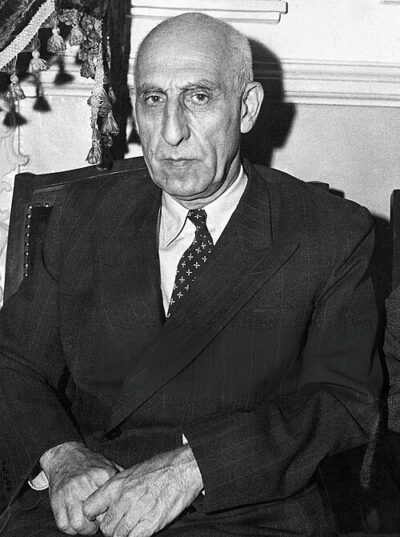
Mohammad Mosaddegh
Mohammad Mosaddegh was a former Prime Minister of Iran. Born June 16, 1882, in Tehran. Died March 5, 1967, in Ahmadabad-e Mosaddeq. Positions held include Member of the National Consultative Assembly (2 times) (1950–1953), Prime Minister of Iran (1951–1953) and Foreign Affairs Minister of Iran (2 times) (1921–1923). Educated at Paris Institute of Political Studies and University of Paris.
Facts
22 facts · 2 confirmed by two sources · 5 cited · 15 from one source
Where this comes from
Papalocal keeps its own record. It started from these sources; what each one said is kept here as it was copied, so a change on their side never changes this page by itself. Tap one to read its version.
What Wikidata says · copied November 16, 2026 · revision 2565544927
- Described as
- former Prime Minister of Iran (1882–1967)
- Born
- June 16, 1882
- Died
- March 5, 1967 · 3 references
- Born in
- Tehran · 1 reference
- Died in
- Ahmadabad-e Mosaddeq
- Citizen of
- Pahlavi Iran
- Occupation
- politician · 1 reference; diplomat; writer
- Positions held
- Member of the National Consultative Assembly (2 times) (1950–1953); Prime Minister of Iran (1951–1953); Foreign Affairs Minister of Iran (2 times) (1921–1923); wali; Minister of Economic Affairs and Finance (1921–1922)
- Political party
- National Front
- Education
- Paris Institute of Political Studies; University of Paris; University of Neuchâtel · 1 reference
- Spouse
- Zahra Emami (Zia os-Saltaneh)
- Children
- Gholamhossein Mossadegh · 1 reference
- Father
- Mirza Hedayatollah
- Mother
- Najm al-Saltaneh · 1 reference
- Religion
- Shia Islam
- Wikipedias with a page
- 69
Wikidata item Q123037 (wikidata.org/wiki/Q123037), public domain (CC0). Copied November 16, 2026.
What Wikipedia says · copied November 16, 2026 · revision 1385701039
Mohammad Mosaddegh (16 June 1882 – 5 March 1967) was an Iranian politician, author and lawyer who served as the prime minister of Iran from 1951 to 1953, elected by the 16th Majlis. He was elected to the Iranian parliament in 1923 and served through a contentious 1952 election into the 17th Iranian Majlis, until his government was overthrown in the 1953 Iranian coup d'état aided by the intelligence agencies of the United Kingdom (MI6) and the United States (CIA), led by Kermit Roosevelt Jr. As prime minister, he implemented policies that came to be known as Mosaddeghism.
Despite its historical role in the nationalization of Iran's oil industry, the Mosaddeghist movement faced internal political and organizational divisions among its constituent groups. Disagreements within the National Front leadership, the loss of support from certain political and religious allies, and controversial decisions concerning the administration of the country and relations with the Majlis (Iranian Parliament) contributed to the weakening of the movement's cohesion. These factors, alongside foreign pressure and the activities of domestic opposition groups, contributed to the growing vulnerability of Mosaddegh's government in the months leading up to the 1953 Iranian coup d'état (28 Mordad 1332).
Before its removal from power, his administration introduced a range of social and political measures such as social security, land reforms and higher taxes including the introduction of taxation on the rent of land. His time as prime minister was marked by the clash with the British government, known as the Abadan Crisis, following the nationalisation of the Iranian oil industry, which had been built by the British on Persian lands since 1913 through the Anglo-Persian Oil Company (APOC/AIOC), later known as British Petroleum (BP).
In the aftermath of the overthrow, Mohammad Reza Pahlavi consolidated power and negotiated the Consortium Agreement of 1954 with the British, which gave split ownership of Iranian oil production between Iran and Western companies until 1979. Mosaddegh's National Front was accordingly suppressed in the undemocratically manipulated 1954 general election and he was subsequently charged with treason, imprisoned for three years, then put under house arrest until his death and was buried in his own home in order to prevent a political furor.
In 2013, during the presidency of Barack Obama, the United States government formally acknowledged its role in the coup as being a part of its foreign policy initiatives, including paying protesters and bribing officials.
- Born, in its opening lines
- June 16, 1882
- Died, in its opening lines
- March 5, 1967
From the Wikipedia article “Mohammad Mosaddegh” (en.wikipedia.org/wiki/Mohammad_Mosaddegh), by its contributors, under CC BY-SA 4.0 (creativecommons.org/licenses/by-sa/4.0/). Copied November 16, 2026; not changed.
Confirmed Two sources agree. Cited One source, and it names where it got it. One source One source, without a reference of its own. Sources disagree The sources disagree. We show the best-supported value and keep theirs below.
