
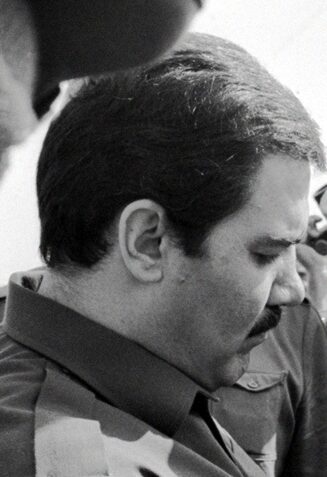
Mohammad Najibullah
Mohammad Najibullah was the 4th General Secretary of the People's Democratic Party of Afghanistan. Born August 6, 1947, in Gardez. Died September 27, 1996, in Kabul. Positions held include President of Afghanistan (1987–1992), Chairman of the Revolutionary Council of Afghanistan (1987) and ambassador. Educated at Kabul University and St Joseph’s Higher Secondary School, (Baramulla). Awards include Order of friendship of peoples, Order of the Red Banner and Order of the Saur Revolution.
Facts
31 facts · 2 confirmed by two sources · 2 cited · 26 from one source · 1 where the sources disagree
What’s different
- Buried in: we show Paktia Province (Sources disagree). Wikidata also lists Gardez
Where this comes from
Papalocal keeps its own record. It started from these sources; what each one said is kept here as it was copied, so a change on their side never changes this page by itself. Tap one to read its version.
What Wikidata says · copied November 16, 2026 · revision 2563042426
- Described as
- 4th General Secretary of the People's Democratic Party of Afghanistan
- Other names
- Dr. Najib, Mohammad Najibullah Ahmadzai, Mohamed Najibullah
- Born
- August 6, 1947
- Died
- September 27, 1996 · 4 references
- Born in
- Gardez · 1 reference
- Died in
- Kabul · 1 reference
- Buried in
- Gardez; Paktia Province · 1 reference
- Cause of death
- hanging to death
- Citizen of
- Afghanistan
- Occupation
- politician; diplomat; physician; gynecologist
- Positions held
- President of Afghanistan (1987–1992); Chairman of the Revolutionary Council of Afghanistan (1987); ambassador
- Political party
- People’s Democratic Party of Afghanistan
- Worked for
- KHAD
- Education
- Kabul University; St Joseph’s Higher Secondary School, (Baramulla); Habibia High School
- Awards
- Order of friendship of peoples · 1 reference; Order of the Red Banner · 1 reference; Order of the Saur Revolution · 1 reference; Order of the Sun of Liberty · 1 reference; Hero of the Democratic Republic of Afghanistan · 1 reference; Order of José Martí · 1 reference; Order of Friendship of Peoples · 1 reference
- Spouse
- Fatana Najib (1974–1996)
- Religion
- Sunni Islam
- Military branch
- Afghan National Army (1965–1992)
- Military rank
- general; lieutenant general · 1 reference
- Wikipedias with a page
- 63
Wikidata item Q207728 (wikidata.org/wiki/Q207728), public domain (CC0). Copied November 16, 2026.
What Wikipedia says · copied November 16, 2026 · revision 1385593703
Mohammad Najibullah Ahmadzai (6 August 1947 – 27 September 1996) was an Afghan military officer and politician who served as the fifth president of Afghanistan from 1987 until his resignation in April 1992, shortly after the Afghan mujahideen's takeover of Kabul. He was also the General Secretary of the People's Democratic Party of Afghanistan (PDPA) from 1986 to 1992. After a failed attempt to flee to India, Najibullah remained in Kabul, and lived in the United Nations headquarters until his assassination during the Taliban's first capture of Kabul in 1996.
A graduate of Kabul University, Najibullah held different careers under the PDPA. Following the Saur Revolution and the establishment of the Democratic Republic of Afghanistan, Najibullah was a low-profile bureaucrat. He was sent into exile as Ambassador to Iran during Hafizullah Amin's rise to power. He returned to Afghanistan following the Soviet intervention which toppled Amin's rule and placed Babrak Karmal as head of the state, the party and the government. During Karmal's rule, Najibullah became head of the KHAD, the Afghan equivalent of the Soviet KGB. He was a member of the Parcham faction led by Karmal. During Najibullah's tenure as KHAD head, it became one of the most brutally efficient governmental organs. Because of this, he gained the attention of several leading Soviet officials, such as Yuri Andropov, Dmitriy Ustinov and Boris Ponomarev. In 1981, Najibullah was appointed to the PDPA Politburo. In 1985, Najibullah stepped down as the state security minister to focus on PDPA politics; he had been appointed to the PDPA Secretariat. Soviet General Secretary Mikhail Gorbachev, also the last Soviet leader, was able to get Karmal to step down as PDPA General Secretary in 1986, and replace him with Najibullah. For a number of months, Najibullah was locked in a power struggle against Karmal, who still retained his post of Chairman of the Revolutionary Council. Najibullah accused Karmal of trying to wreck his policy of National Reconciliation, a series of efforts by Najibullah to end the conflict.
During his tenure as leader of Afghanistan, the Soviets began their withdrawal, and from 1989 until 1992, his government tried to solve the ongoing civil war without Soviet troops on the ground. While direct Soviet assistance ended with the withdrawal, the Soviet Union still supported Najibullah with economic and military aid, while Pakistan and the United States continued their support for the mujahideen. Throughout his tenure, he tried to build support for his government via the National Reconciliation reforms by distancing from socialism in favour of Afghan nationalism, abolishing the one-party state and letting non-communists join the government. He remained open to dialogue with the mujahideen and other groups, made Islam an official religion, and invited exiled businessmen back to re-take their properties. In the 1990 constitution, all references to communism were removed and Islam became the state religion. For various reasons, such changes did not win Najibullah any significant support. Following the August Coup in Moscow and the dissolution of the Soviet Union in December 1991, Najibullah was left without foreign aid. This, coupled with the internal collapse of his government (following the defection of general Abdul Rashid Dostum), led to his resignation in April 1992. In 1996, he was tortured and killed by the Taliban.
In 2017, the pro-Najibullah Watan Party was created as a continuation of Najibullah's party. Najibullah's legacy remains mixed as supporters laud him for his democratic efforts while critics cite the various human rights abuses during his tenure as head of the KHAD as well as alleged corruption under his government.
- Born, in its opening lines
- August 6, 1947
- Died, in its opening lines
- September 27, 1996
From the Wikipedia article “Mohammad Najibullah” (en.wikipedia.org/wiki/Mohammad_Najibullah), by its contributors, under CC BY-SA 4.0 (creativecommons.org/licenses/by-sa/4.0/). Copied November 16, 2026; not changed.
Confirmed Two sources agree. Cited One source, and it names where it got it. One source One source, without a reference of its own. Sources disagree The sources disagree. We show the best-supported value and keep theirs below.
