
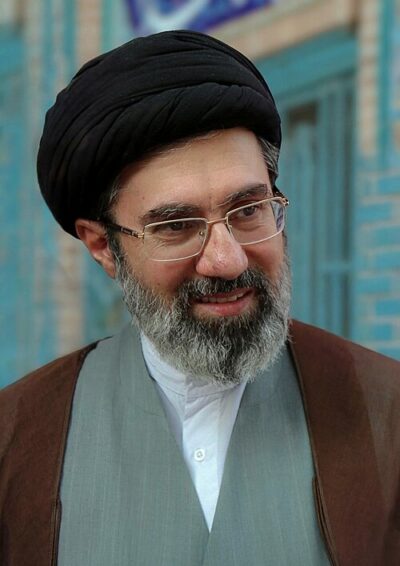
Mojtaba Khamenei
Mojtaba Khamenei is the 3rd Supreme Leader of Iran since 2026. Born September 8, 1969, in Mashhad. Positions held include Supreme Leader of Iran (2026–) and Commander-in-Chief of the Iranian Armed Forces (2026–). Educated at Alavi Madrasa and Qom Hawza.

Facts
28 facts · 0 confirmed by two sources · 6 cited · 21 from one source · 1 where the sources disagree
What’s different
- Born: we show September 8, 1969 (Sources disagree). Wikipedia says February 20, 1970
Where this comes from
Papalocal keeps its own record. It started from these sources; what each one said is kept here as it was copied, so a change on their side never changes this page by itself. Tap one to read its version.
What Wikidata says · copied November 16, 2026 · revision 2564780090
- Described as
- 3rd Supreme Leader of Iran since 2026
- Other names
- Mojtaba Hosseini Khamenei, Seyyed Mojtaba Hosseini Khamenei, Ayatollah Mojtaba Khamenei, Ayatollah Seyyed Mojtaba Khamenei, Seyyed Mojtaba Khamenei, Ayatollah Seyyed Mojtaba Hosseini Khamenei, Ayatollah Mojtaba Hosseini Khamenei, Ayatollah Khamenei, Khamenei Jr
- Born
- September 8, 1969 · 1 reference
- Born in
- Mashhad · 2 references
- Citizen of
- Iran
- Occupation
- ulema; Islamic jurist; politician · 1 reference
- Positions held
- Supreme Leader of Iran (2026–) · 2 references; Commander-in-Chief of the Iranian Armed Forces (2026–)
- Political party
- independent politician
- Worked for
- Qom Hawza
- Education
- Alavi Madrasa; Qom Hawza; Ayatollah Mojtahedi Seminary
- Spouse
- Zahra Haddad-Adel (2004–2026) · 1 reference
- Children
- Mohammad-Bagher Khamenei; Fatemeh Khamenei
- Father
- Ali Khamenei · 1 reference
- Mother
- Mansoureh Khojaste Bagherzadeh
- Siblings
- Mostafa Khamenei; Masoud Khamenei; Meysam Khamenei; Boshra Khamenei; Hoda Khamenei
- Religion
- Islam; Twelver Shiism
- Military branch
- Islamic Revolutionary Guard Corps · 1 reference
- Website
- https://rahbar.ir/; http://en.rahbar.ir/
- Wikipedias with a page
- 91
Wikidata item Q2919350 (wikidata.org/wiki/Q2919350), public domain (CC0). Copied November 16, 2026.
What Wikipedia says · copied November 16, 2026 · revision 1385559663
Mojtaba Hosseini Khamenei (born c. 20 February 1970 to 20 March 1970) is an Iranian politician and Shia cleric who has served as the supreme leader of Iran since 2026. A member of the Khamenei family and the second son of second supreme leader Ali Khamenei, he previously served as Vakil of the Supreme Leader during his father's rule from 2008 to 2026.
Born in Mashhad, Khamenei was raised in a conservative religious household, and graduated from high school in Tehran. He then studied Islamic theology under the guidance of his father and Mahmoud Hashemi Shahroudi. He joined the Islamic Revolutionary Guard Corps (IRGC) in 1987 and served in the Iran–Iraq War. In 1989, he began studying in Qom to become a cleric, and later joined the Qom Seminary as a theology teacher. He took control of the Basij paramilitary volunteer militia in 2009.
Western analysts long considered Khamenei a likely candidate to replace his father as Supreme Leader, despite some unverified reports that Ali Khamenei had opposed his accession. Following his father's assassination during the 2026 Iran war, Khamenei was elected the third supreme leader by the Assembly of Experts. Khamenei was injured in the airstrike that killed his father and has remained absent from public view since his appointment, causing confusion over his fate. The US has placed a $10 million bounty via the Rewards for Justice Program for information on him.
In political ideology and jurisprudence, Khamenei is considered to be more hardline than his father and has close ties to some of the "most ideologically extremist clerics" according to a report from the Atlantic Council, a pro-NATO think tank.
- Born, in its opening lines
- February 20, 1970
From the Wikipedia article “Mojtaba Khamenei” (en.wikipedia.org/wiki/Mojtaba_Khamenei), by its contributors, under CC BY-SA 4.0 (creativecommons.org/licenses/by-sa/4.0/). Copied November 16, 2026; not changed.
Confirmed Two sources agree. Cited One source, and it names where it got it. One source One source, without a reference of its own. Sources disagree The sources disagree. We show the best-supported value and keep theirs below.
