
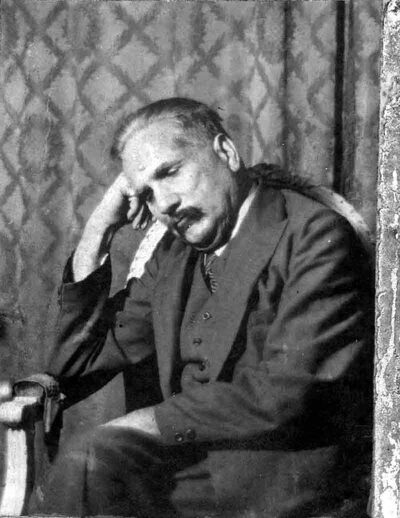
Muhammad Iqbal
Muhammad Iqbal was a British-Indian Islamic philosopher, poet and politician. Born November 9, 1877, in Sialkot. Died April 21, 1938, in Lahore. Known for Ilm Al-Iqtisad, The Development of Metaphysics in Persia and The Reconstruction of Religious Thought in Islam. Educated at Murray College and University of Cambridge. Awards include Sir and Knight Bachelor.
Facts
44 facts · 2 confirmed by two sources · 11 cited · 31 from one source
Where this comes from
Papalocal keeps its own record. It started from these sources; what each one said is kept here as it was copied, so a change on their side never changes this page by itself. Tap one to read its version.
What Wikidata says · copied November 16, 2026 · revision 2570029975
- Described as
- British-Indian Islamic philosopher, poet and politician (1877-1938)
- Other names
- Muhammed İkbal, Sir Allama Muhammad Iqbal, Allama Muhammad Iqbal, Allama Iqbal, Sir Muhammad Iqbal
- Born
- November 9, 1877 · 9 references
- Died
- April 21, 1938 · 10 references
- Born in
- Sialkot
- Died in
- Lahore · 1 reference
- Buried in
- Lahore Fort
- Citizen of
- British Raj · 1 reference
- Occupation
- philosopher · 1 reference; poet · 2 references; children's writer; politician · 1 reference; lawyer; jurist · 1 reference; writer · 1 reference
- Education
- Murray College (1893–1895); University of Cambridge (1905–1907); Trinity College (1905–1908); LMU Munich (1907); Government College University (1895–1899); Heidelberg University
- Known for
- Ilm Al-Iqtisad (1903) · 1 reference; The Development of Metaphysics in Persia (1907); The Reconstruction of Religious Thought in Islam (1930); The Secrets of the Self (1915); The Mysteries of Selflessness (1918); Message from the East (1923); The Call of the Marching Bell; Persian Psalms; Javid Nama; Gabriel's Wing
- Awards
- Sir (1923–1938); Knight Bachelor
- Field
- poetry · 1 reference; philosophy · 1 reference; politics · 1 reference
- Spouse
- Karim Bibi; Mukhtar Begum; Sardar Begum
- Children
- Javid Iqbal · 1 reference
- Father
- Sheikh Noor Muhammad · 1 reference
- Mother
- Imam Bibi · 1 reference
- Religion
- Islam
- Lived in
- Lahore (1908–1938); Sialkot (1877–1897)
- Website
- http://www.allamaiqbal.com
- Wikipedias with a page
- 110
Wikidata item Q484141 (wikidata.org/wiki/Q484141), public domain (CC0). Copied November 16, 2026.
What Wikipedia says · copied November 16, 2026 · revision 1385925761
Sir Muhammad Iqbal (9 November 1877 – 21 April 1938) was an Islamic philosopher and poet. He is regarded as one of the most influential Urdu poets of the 20th century and his vision of a cultural and political ideal for the Muslims of British India is widely regarded as having animated the impulse behind the Pakistan Movement. The honorific commonly refers to him as Allama and is widely considered one of the most important and influential Muslim thinkers and Islamic religious philosophers of the 20th century.
Iqbal was born and raised in Sialkot, Punjab, British India and studied at Scotch Mission College in Sialkot and Government College University in Lahore. He taught Arabic at the Oriental College, Lahore, from 1899 until 1903, during which time he wrote prolifically. Notable among his Urdu poems from this period are "Parinde Ki Faryad" ("A Bird's Prayer"), an early contemplation on animal rights, and "Tarana-e-Hindi" ("Anthem of the Indians"), a patriotic poem—both composed for children. In 1905, he departed from India to pursue further education in Europe, first in England and later in Germany. In England, he earned a second BA at Trinity College, Cambridge, and subsequently qualified as a barrister at Lincoln's Inn. In Germany, he obtained a PhD in philosophy at the Ludwig-Maximilians-Universität München (LMU), with his thesis focusing on "The Development of Metaphysics in Persia" in 1908. Upon his return to Lahore in 1908, Iqbal established a law practice but primarily focused on producing scholarly works on politics, economics, history, philosophy, and religion. He is most renowned for his poetic compositions, including "Asrar-e-Khudi", "Rumuz-e-Bekhudi", and "Bang-e-Dara". His literary works in the Persian language garnered him recognition in Iran.
An ardent proponent of the political and spiritual revival of the Muslim world, particularly of the Muslims in the Indian subcontinent, the series of lectures Iqbal delivered to this effect were published as The Reconstruction of Religious Thought in Islam in 1930. He was elected to the Punjab Legislative Council in 1927 and held several positions in the All-India Muslim League. In his Allahabad Address, delivered at the League's annual assembly in 1930, he formulated a political framework for the Muslim-majority regions spanning northwestern India, spurring the League's pursuit of the two-nation theory.
In August 1947, nine years after Iqbal's death, the partition of India gave way to the establishment of Pakistan, a newly independent nation state in which Iqbal was honoured as the national poet. He is also known in Pakistani society as Hakim ul-Ummat (lit. 'The Wise Man of the Ummah') and as Mufakkir-e-Pakistan (lit. 'The Thinker of Pakistan'). The anniversary of his birth (Yaum-e Wiladat-e Muḥammad Iqbal), 9 November, is observed as a public holiday in Pakistan.
- Born, in its opening lines
- November 9, 1877
- Died, in its opening lines
- April 21, 1938
From the Wikipedia article “Muhammad Iqbal” (en.wikipedia.org/wiki/Muhammad_Iqbal), by its contributors, under CC BY-SA 4.0 (creativecommons.org/licenses/by-sa/4.0/). Copied November 16, 2026; not changed.
Confirmed Two sources agree. Cited One source, and it names where it got it. One source One source, without a reference of its own. Sources disagree The sources disagree. We show the best-supported value and keep theirs below.
