
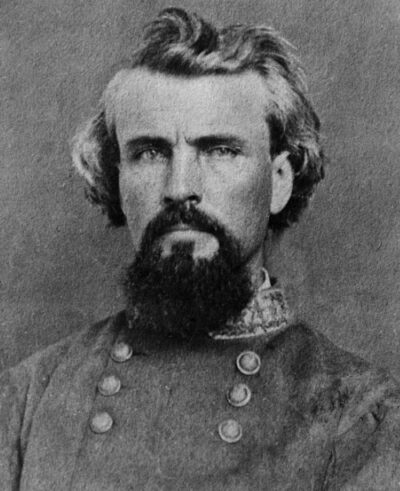
Nathan Bedford Forrest
Nathan Bedford Forrest was a Confederate States Army general. Born July 13, 1821, in Chapel Hill. Died October 29, 1877, in Memphis. Positions held include Grand Wizard (1867–).
Facts
23 facts · 2 confirmed by two sources · 8 cited · 13 from one source
Where this comes from
Papalocal keeps its own record. It started from these sources; what each one said is kept here as it was copied, so a change on their side never changes this page by itself. Tap one to read its version.
What Wikidata says · copied November 15, 2026 · revision 2567055735
- Described as
- Confederate States Army general (1821–1877)
- Other names
- Nathan B. Forrest, N. B. Forrest, Nathan Forrest, Bedford Forrest
- Born
- July 13, 1821 · 4 references
- Died
- October 29, 1877 · 4 references
- Born in
- Chapel Hill
- Died in
- Memphis · 1 reference
- Buried in
- Columbia · 1 reference
- Cause of death
- complications of diabetes mellitus
- Citizen of
- United States
- Occupation
- slave trader (1853–1862) · 2 references; planter (1860) · 1 reference; army officer (1861–1865) · 1 reference; railway executive (1870) · 1 reference
- Positions held
- Grand Wizard (1867–)
- Political party
- Democratic Party
- Member of
- Freemasonry; Ku Klux Klan · 1 reference
- Field
- agriculture · 1 reference; business · 1 reference
- Children
- William M. Forrest · 2 references
- Military branch
- Provisional Army of the Confederate States (1861–1865)
- Military rank
- major general (1863–1865) · 1 reference; lieutenant general (1865) · 1 reference
- Lived in
- DeSoto County (1850) · 1 reference; Memphis (2 times) (1860, 1870) · 1 reference
- Wikipedias with a page
- 37
Wikidata item Q366102 (wikidata.org/wiki/Q366102), public domain (CC0). Copied November 15, 2026.
What Wikipedia says · copied November 15, 2026 · revision 1384778071
Nathan Bedford Forrest (July 13, 1821 – October 29, 1877) was a Confederate general, noted for his aggressive cavalry tactics and rapid rise from private to general during the American Civil War. After the war, Forrest was inaugurated as the first Grand Wizard of the Reconstruction-era Ku Klux Klan.
Born into a poor family, as a young man Forrest would amass substantial wealth as a horse and cattle trader, real estate broker, and cotton plantation owner, and was also directly involved in the interstate slave trade, including operating a slave jail in Memphis. In June 1861, shortly after the Civil War began with the splitting of the United States into the Union and the Confederacy, Forrest enlisted in the Confederate Army. Forrest became one of the few soldiers during the war to enlist as a private and be promoted to general without previous military training. An expert cavalry leader, Forrest was given command of a cavalry corps and established new doctrines for mobile forces, earning him the nickname "The Wizard of the Saddle". He used his cavalry troops as mounted infantry and often deployed artillery as the lead in battle, thus helping to "revolutionize cavalry tactics".
In April 1864, at the Battle of Fort Pillow, Confederate forces under Forrest's command killed a large number of Union troops after the fort had effectively ceased resistance, most of them black soldiers. Contemporary Northern newspapers and congressional investigations held Forrest responsible, while later historians have differed over whether the killings resulted from explicit orders, loss of control during the assault, or racialized battlefield practices within the Confederate army.
Forrest joined the Ku Klux Klan in the fall of 1866, and was elected its first Grand Wizard in the spring of 1867. The group was a secretive network of dens across the post-war South, where politically active black people and their allies were threatened, assaulted and murdered. During Forrest's tenure as Grand Wizard, Klan organizations across the South used violence and intimidation to suppress Black political participation in the elections of 1868, although historians disagree about the extent of Forrest's direct control over local operations. In 1869, Forrest expressed disillusionment with what historians have described as the Klan's campaign of racial terror and its lack of centralized discipline, and issued a letter ordering the dissolution of the Ku Klux Klan as well as the destruction of its costumes; he then withdrew from the organization. Forrest later denied being a Klan member, and in the 1870s twice made statements in support of racial harmony and black dignity. During the last years of his life, he served on the board of a railroad and farmed President's Island using convict labor. Forrest died of illness in 1877, at the age of 56.
- Born, in its opening lines
- July 13, 1821
- Died, in its opening lines
- October 29, 1877
From the Wikipedia article “Nathan Bedford Forrest” (en.wikipedia.org/wiki/Nathan_Bedford_Forrest), by its contributors, under CC BY-SA 4.0 (creativecommons.org/licenses/by-sa/4.0/). Copied November 15, 2026; not changed.
Confirmed Two sources agree. Cited One source, and it names where it got it. One source One source, without a reference of its own. Sources disagree The sources disagree. We show the best-supported value and keep theirs below.
