
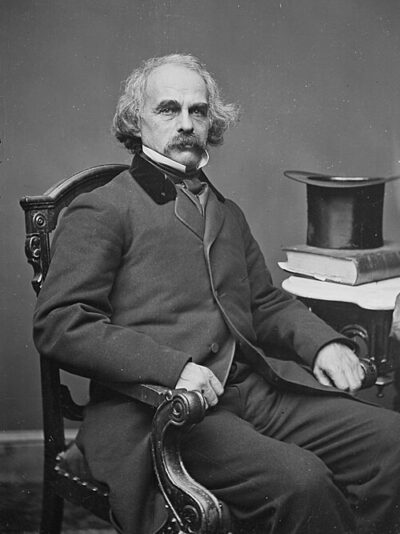
Nathaniel Hawthorne
Nathaniel Hawthorne was an American writer. Born July 4, 1804, in Salem. Died May 19, 1864, in Plymouth. Positions held include ambassador (1853–1857). Known for The Scarlet Letter, Little Daffydowndilly, and other stories and The House of the Seven Gables. Educated at Bowdoin College.
Facts
36 facts · 2 confirmed by two sources · 12 cited · 22 from one source
Where this comes from
Papalocal keeps its own record. It started from these sources; what each one said is kept here as it was copied, so a change on their side never changes this page by itself. Tap one to read its version.
What Wikidata says · copied November 13, 2026 · revision 2567657373
- Described as
- American writer (1804–1864)
- Other names
- Nathaniel Hathorne, Nathaniel Ingersoll Hawthorne, Nathanael Hawthorne, Hawthorne, N. H., Monsieur de l'Aubépine
- Born
- July 4, 1804 · 16 references
- Died
- May 19, 1864 · 9 references
- Born in
- Salem · 1 reference
- Died in
- Plymouth
- Buried in
- Sleepy Hollow Cemetery · 1 reference
- Name at birth
- Nathaniel Hathorne
- Citizen of
- United States
- Occupation
- novelist; writer · 2 references; diplomat · 1 reference; children's writer (1840–) · 1 reference; science fiction writer · 1 reference; short story writer; consul · 1 reference
- Positions held
- ambassador (1853–1857) · 1 reference
- Political party
- Democratic Party · 1 reference
- Education
- Bowdoin College (–1825) · 1 reference
- Member of
- Phi Beta Kappa Society (1824) · 1 reference
- Genre
- Gothic literature; novella · 1 reference
- Known for
- The Scarlet Letter; Little Daffydowndilly, and other stories; The House of the Seven Gables; A Wonder-Book for Girls and Boys; Tales of the White Hills, and sketches; The whole history of grandfather's chair; Biographical stories; The Snow‐Image: A Childish Miracle
- Spouse
- Sophia Hawthorne · 1 reference
- Children
- Julian Hawthorne · 1 reference; Mother Mary Alphonsa · 1 reference
- Father
- Nathaniel Hathorne · 1 reference
- Mother
- Elizabeth Clarke Hathorne · 1 reference
- Siblings
- Elizabeth Hawthorne; Maria Louisa Hawthorne
- Religion
- Unitarianism
- Wikipedias with a page
- 117
Wikidata item Q69339 (wikidata.org/wiki/Q69339), public domain (CC0). Copied November 13, 2026.
What Wikipedia says · copied November 13, 2026 · revision 1383312013
Nathaniel Hawthorne (né Hathorne; July 4, 1804 – May 19, 1864) was an American novelist and short story writer. His works often focus on history, morality, and religion.
He was born in 1804 in Salem, Massachusetts, from a family long associated with the town. Hawthorne entered Bowdoin College in 1821, was elected to Phi Beta Kappa in 1824, and graduated in 1825. He published his first work in 1828, the novel Fanshawe; he later tried to suppress it, feeling that it was not equal to the standard of his later work.
He published several short stories in periodicals, which he collected in 1837 as Twice-Told Tales. The following year, he became engaged to Sophia Peabody. He worked at the Boston Custom House and joined Brook Farm, a transcendentalist community, before marrying Peabody in 1842. The couple moved to The Old Manse in Concord, Massachusetts, later moving to Salem, the Berkshires, then to The Wayside in Concord. The Scarlet Letter was published in 1850, followed by a succession of other novels. A political appointment as consul took Hawthorne and family to Europe before their return to Concord in 1860. Hawthorne died on May 19, 1864.
Much of Hawthorne's writing centers on New England, and many works feature moral metaphors with an anti-Puritan inspiration. His fiction works are considered part of the Romantic movement and, more specifically, dark romanticism. His themes often center on the inherent evil and sin of humanity, and his works often have moral messages and deep psychological complexity. His published works include novels, short stories, and a biography of his college friend Franklin Pierce, written for his 1852 campaign for President of the United States, which Pierce won, becoming the 14th president.
- Born, in its opening lines
- July 4, 1804
- Died, in its opening lines
- May 19, 1864
From the Wikipedia article “Nathaniel Hawthorne” (en.wikipedia.org/wiki/Nathaniel_Hawthorne), by its contributors, under CC BY-SA 4.0 (creativecommons.org/licenses/by-sa/4.0/). Copied November 13, 2026; not changed.
Confirmed Two sources agree. Cited One source, and it names where it got it. One source One source, without a reference of its own. Sources disagree The sources disagree. We show the best-supported value and keep theirs below.
