
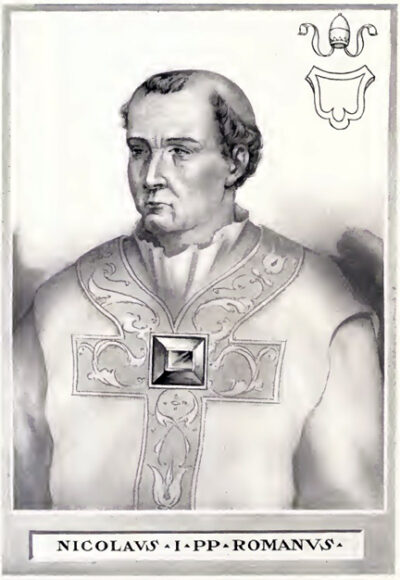
Nicholas I
Nicholas I was a pope. Born 820, in Rome. Died November 13, 867, in Rome. Positions held include Pope (858–867) and cardinal (853–).
Facts
12 facts · 1 confirmed by two sources · 5 cited · 5 from one source · 1 where the sources disagree
What’s different
- Born: we show 820 (Sources disagree). Wikipedia says c. 800
Where this comes from
Papalocal keeps its own record. It started from these sources; what each one said is kept here as it was copied, so a change on their side never changes this page by itself. Tap one to read its version.
What Wikidata says · copied November 16, 2026 · revision 2567483643
- Described as
- pope
- Other names
- Nicholas, Pope Nicholas, Pope Nicholas I, Pope Saint Nicholas, Saint Nicholas the Great, St. Nicholas the Great, Pope St. Nicholas, St. Nicholas I
- Born
- 820 · 1 reference
- Died
- November 13, 867 · 2 references
- Born in
- Rome · 1 reference
- Died in
- Rome · 1 reference
- Buried in
- St. Peter's Basilica
- Citizen of
- Papal States · 1 reference
- Occupation
- Catholic priest; writer · 1 reference
- Positions held
- Pope (858–867); cardinal (853–) · 1 reference
- Religion
- Catholic Church · 1 reference
- Lived in
- Rome
- Wikipedias with a page
- 76
Wikidata item Q170503 (wikidata.org/wiki/Q170503), public domain (CC0). Copied November 16, 2026.
What Wikipedia says · copied November 16, 2026 · revision 1373024867
Pope Nicholas I (Latin: Nicolaus I; c. 800 – 13 November 867), also known as Nicholas the Great, was the bishop of Rome and leader of the Papal States from 24 April 858 until his death on 13 November 867. He is the last of the three popes listed in the Annuario Pontificio with the title "the Great", alongside Leo I and Gregory I.
Nicholas is remembered as a consolidator of papal authority, exerting decisive influence on the historical development of the papacy and its position among the Christian nations of Western Europe. Nicholas I asserted that the pope should have suzerainty over all Christians, even royalty, in matters of faith and morals.
Nicholas refused King Lothair II of Lotharingia's request for an annulment of his marriage to Teutberga. When a council pronounced in favor of annulment, Nicholas I declared the council deposed, its messengers excommunicated, and its decisions invalid. Despite pressure from the Carolingians, who laid siege to Rome, his decision held. During his reign, relations with the Byzantine Empire soured because of his support for Patriarch Ignatios of Constantinople, who had been removed from his post in favor of Photius I.
Since the seventeenth century, Nicholas has been venerated as a saint in the Catholic Church, with his feast on 13 November.
His claims of supremacy over territories outside his jurisdiction, the incorporation of the filioque in the Constantinopolitan Nicene creed, and his pressure on Bulgaria to remain under Roman rule, provoked tensions between Rome and Constantinople, leading to his excommunication by the Greeks at the fourth Council of Constantinople.
- Born, in its opening lines
- c. 800
- Died, in its opening lines
- November 13, 867
From the Wikipedia article “Pope Nicholas I” (en.wikipedia.org/wiki/Pope_Nicholas_I), by its contributors, under CC BY-SA 4.0 (creativecommons.org/licenses/by-sa/4.0/). Copied November 16, 2026; not changed.
Confirmed Two sources agree. Cited One source, and it names where it got it. One source One source, without a reference of its own. Sources disagree The sources disagree. We show the best-supported value and keep theirs below.
