
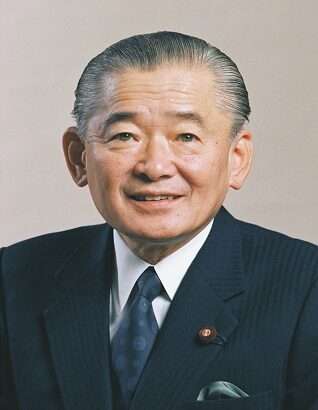
Noboru Takeshita
Noboru Takeshita was the 74th Prime Minister of Japan. Born February 26, 1924, in Kakeya. Died June 19, 2000, in Kitasato Institute Hospital. Positions held include Minister of Construction (1976), Chief Cabinet Secretary (1971–1972) and Prime Minister of Japan (1987–1989). Educated at Waseda University. Awards include Grand Cordon of the Supreme Order of the Chrysanthemum, honorary doctor of the Renmin University of China and Order of the Chrysanthemum.
Facts
28 facts · 2 confirmed by two sources · 3 cited · 22 from one source · 1 where the sources disagree
What’s different
- Cause of death: we show respiratory failure (Sources disagree). Wikidata also lists pancreatic cancer
Where this comes from
Papalocal keeps its own record. It started from these sources; what each one said is kept here as it was copied, so a change on their side never changes this page by itself. Tap one to read its version.
What Wikidata says · copied November 16, 2026 · revision 2568232987
- Described as
- 74th Prime Minister of Japan (1924-2000)
- Other names
- Takeshita Noboru
- Born
- February 26, 1924 · 3 references
- Died
- June 19, 2000 · 3 references
- Born in
- Kakeya
- Died in
- Kitasato Institute Hospital
- Cause of death
- respiratory failure; pancreatic cancer
- Citizen of
- Japan
- Occupation
- politician · 1 reference; head of government · 1 reference
- Positions held
- Minister of Construction (1976); Chief Cabinet Secretary (1971–1972); Prime Minister of Japan (1987–1989); member of the House of Representatives of Japan (1958–2000); member of the Shimane Prefectural Assembly
- Political party
- Liberal Democratic Party
- Worked for
- Unnan City Kakeya Junior High School
- Education
- Waseda University
- Member of
- Soseikai; Heisei Kenkyūkai; Sanpokai
- Awards
- Grand Cordon of the Supreme Order of the Chrysanthemum; honorary doctor of the Renmin University of China (1994) · 1 reference; Order of the Chrysanthemum · 1 reference
- Spouse
- Naoko Takeshita (1946–)
- Children
- Kazuko Takeshita; Maruko Takeshita
- Father
- Yūzō Takeshita
- Siblings
- Wataru Takeshita
- Religion
- Buddhism
- Wikipedias with a page
- 50
Wikidata item Q315561 (wikidata.org/wiki/Q315561), public domain (CC0). Copied November 16, 2026.
What Wikipedia says · copied November 16, 2026 · revision 1378199275
Noboru Takeshita (竹下 登, Takeshita Noboru; 26 February 1924 – 19 June 2000) was a Japanese politician who served as prime minister of Japan from 1987 to 1989.
Born in Shimane Prefecture, Takeshita attended Waseda University and was drafted into the army during the Pacific War. He was first elected to the National Diet in 1958, and served as chief cabinet secretary in 1971–1972 and in 1974, and as finance minister from 1979–1980, 1982–1986, and in 1988, during which he signed the Plaza Accord in 1985. In 1987, Takeshita became head of the Liberal Democratic Party and succeeded Yasuhiro Nakasone as prime minister. He inherited the powerful LDP faction of Kakuei Tanaka, and was dubbed the "last shadow shogun" for his behind-the-scenes influence in politics. Takeshita was forced to resign in 1989 after being implicated in the Recruit scandal, but continued to lead the largest LDP faction until his death in 2000. He was the last prime minister to serve during the rule of Emperor Shōwa.
- Born, in its opening lines
- February 26, 1924
- Died, in its opening lines
- June 19, 2000
From the Wikipedia article “Noboru Takeshita” (en.wikipedia.org/wiki/Noboru_Takeshita), by its contributors, under CC BY-SA 4.0 (creativecommons.org/licenses/by-sa/4.0/). Copied November 16, 2026; not changed.
Confirmed Two sources agree. Cited One source, and it names where it got it. One source One source, without a reference of its own. Sources disagree The sources disagree. We show the best-supported value and keep theirs below.
