
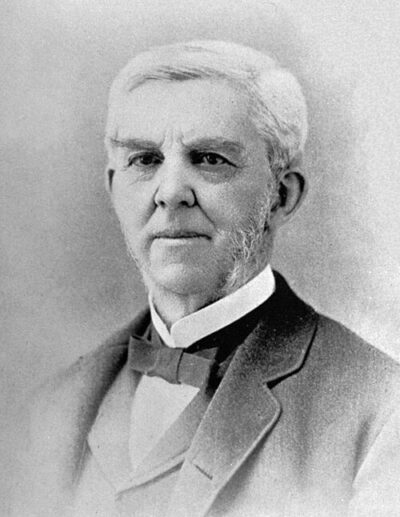
Oliver Wendell Holmes
Oliver Wendell Holmes was an American poet and physician. Born August 29, 1809, in Cambridge. Died October 7, 1894, in Boston. Positions held include professor. Known for The Autocrat of the Breakfast-Table, Ode for Washington’s Birthday and Angel of Peace. Educated at Harvard Medical School and Phillips Academy. Awards include Fellow of the American Academy of Arts and Sciences.
Facts
36 facts · 2 confirmed by two sources · 8 cited · 26 from one source
Where this comes from
Papalocal keeps its own record. It started from these sources; what each one said is kept here as it was copied, so a change on their side never changes this page by itself. Tap one to read its version.
What Wikidata says · copied November 13, 2026 · revision 2565495458
- Described as
- American poet and physician (1809–1894)
- Other names
- Oliver Wendell Holmes Sr.
- Born
- August 29, 1809 · 14 references
- Died
- October 7, 1894 · 13 references
- Born in
- Cambridge · 1 reference
- Died in
- Boston · 1 reference
- Buried in
- Mount Auburn Cemetery · 1 reference
- Citizen of
- United States · 2 references
- Occupation
- physician · 2 references; poet · 2 references; physician writer; university teacher; novelist; medical author · 1 reference; writer · 1 reference
- Positions held
- professor
- Worked for
- Harvard University
- Education
- Harvard Medical School; Phillips Academy · 1 reference; Harvard College
- Member of
- American Academy of Arts and Sciences; Phi Beta Kappa Society; American Philosophical Society (1880–)
- Known for
- The Autocrat of the Breakfast-Table; Ode for Washington’s Birthday; Angel of Peace; A Ballad of the Boston Tea Party; Lord of All Being; Old Ironsides; The Flower of Liberty; The Katydid; The Sweet Little Man
- Awards
- Fellow of the American Academy of Arts and Sciences
- Spouse
- Amelia Lee Jackson
- Children
- Oliver Wendell Holmes; Edward Jackson Holmes, Sr. · 1 reference
- Father
- Abiel Holmes
- Mother
- Sarah Wendell
- Wikipedias with a page
- 63
Wikidata item Q319829 (wikidata.org/wiki/Q319829), public domain (CC0). Copied November 13, 2026.
What Wikipedia says · copied November 13, 2026 · revision 1383734462
Oliver Wendell Holmes Sr. (; August 29, 1809 – October 7, 1894) was an American physician, poet, and polymath based in Boston. Grouped among the fireside poets, he was acclaimed by his peers as one of the best writers of the day. His most famous prose works are the "Breakfast-Table" series, which began with The Autocrat of the Breakfast-Table (1858). He was also an important medical reformer. In addition to being an author and a poet, Holmes was also a physician, professor, lecturer, and inventor.
Born in Cambridge, Massachusetts, Holmes was educated at Phillips Academy and Harvard College. After graduating from Harvard in 1829, he briefly studied law before turning to the medical profession. He began writing poetry at an early age; one of his most famous works, "Old Ironsides", was published in 1830 and was influential in the eventual preservation of the USS Constitution. Following training at the prestigious medical schools of Paris, Holmes was granted his Doctor of Medicine degree from Harvard Medical School in 1836. He taught at Dartmouth Medical School before returning to teach at Harvard and, for a time, served as dean there. During his long professorship, he became an advocate for various medical reforms and notably posited the then-controversial idea that doctors were capable of carrying puerperal fever from patient to patient. Holmes retired from Harvard in 1882 and continued writing poetry, novels and essays until his death in 1894.
Surrounded by Boston's literary elite—which included friends such as Ralph Waldo Emerson, Henry Wadsworth Longfellow, and James Russell Lowell—Holmes made an indelible imprint on the literary world of the 19th century. Many of his works were published in The Atlantic Monthly, a magazine that he named. For his literary achievements and other accomplishments, he was awarded numerous honorary degrees from universities around the world. Holmes's writing often commemorated his native Boston area, and much of it was meant to be humorous or conversational. Some of his medical writings, notably his 1843 essay "The Contagiousness of Puerperal Fever", were considered innovative for their time. He was often called upon to issue occasional poetry, or poems written specifically for an event, including many occasions at Harvard. Holmes also popularized several terms, including "Boston Brahmin" and anesthesia. He was the father of Oliver Wendell Holmes Jr., who would become a justice on the Supreme Court of the United States.
- Born, in its opening lines
- August 29, 1809
- Died, in its opening lines
- October 7, 1894
From the Wikipedia article “Oliver Wendell Holmes Sr.” (en.wikipedia.org/wiki/Oliver_Wendell_Holmes_Sr.), by its contributors, under CC BY-SA 4.0 (creativecommons.org/licenses/by-sa/4.0/). Copied November 13, 2026; not changed.
Confirmed Two sources agree. Cited One source, and it names where it got it. One source One source, without a reference of its own. Sources disagree The sources disagree. We show the best-supported value and keep theirs below.
