
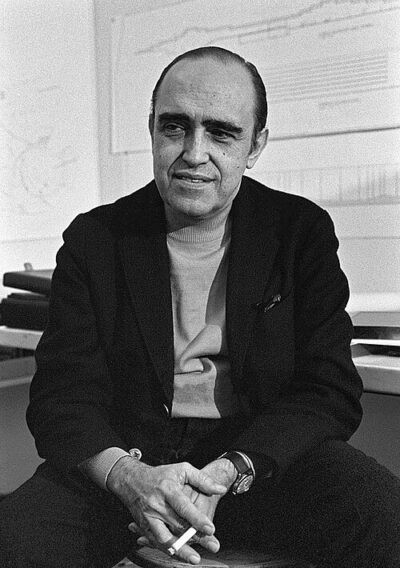
Oscar Niemeyer
Oscar Niemeyer was a Brazilian architect. Born December 15, 1907, in Rio de Janeiro. Died December 5, 2012, in Rio de Janeiro. Known for Cathedral of Brasília, Brasilia Digital TV Tower and Ibirapuera Auditorium. Educated at Escola Nacional de Belas Artes. Awards include Commander of the Legion of Honour, Knight Commander of the Order of St. Gregory the Great and Royal Gold Medal.
Facts
51 facts · 2 confirmed by two sources · 11 cited · 38 from one source
Where this comes from
Papalocal keeps its own record. It started from these sources; what each one said is kept here as it was copied, so a change on their side never changes this page by itself. Tap one to read its version.
What Wikidata says · copied November 16, 2026 · revision 2569065192
- Described as
- Brazilian architect (1907–2012)
- Other names
- Oscar Niemeyer Soares, Ribeiro de Almeida Soares, Oscar Niemeyer Soares Filho, Oscard Niemeyer, Filho, Oscar Niemeyer Soares, Oskar Nimeĭer, Oscar Ribeiro de Almeida Niemeyer Soares Filho
- Born
- December 15, 1907 · 17 references
- Died
- December 5, 2012 · 14 references
- Born in
- Rio de Janeiro · 4 references
- Died in
- Rio de Janeiro · 2 references
- Buried in
- Cemitério de São João Batista · 1 reference
- Cause of death
- cardiac arrest
- Name at birth
- Oscar Ribeiro de Almeida Niemeyer Soares Filho
- Citizen of
- Brazil · 2 references
- Occupation
- architect · 5 references; designer; university teacher; writer · 1 reference; politician; urban planner
- Political party
- Brazilian Communist Party
- Worked for
- Federal University of Rio de Janeiro
- Education
- Escola Nacional de Belas Artes
- Member of
- American Academy of Arts and Sciences; National Academy of Fine Arts (Argentina); Accademia delle Arti del Disegno
- Known for
- Cathedral of Brasília; Brasilia Digital TV Tower; Ibirapuera Auditorium; Niterói Contemporary Art Museum; National Congress Palace; Palácio do Planalto; Palácio da Alvorada; Supremo Tribunal Federal building; Headquarters of the French Communist Party; Pampulha Modern Ensemble
- Awards
- Commander of the Legion of Honour (2007); Knight Commander of the Order of St. Gregory the Great; Royal Gold Medal (1998) · 1 reference; Princess of Asturias Award for the Arts (1989); Praemium Imperiale (2004) · 1 reference; Grand Cross of the National Order of Scientific Merit; Commander of the Order of Prince Henry · 1 reference; Order of Friendship of Peoples; Order of Friendship; Pritzker Architecture Prize (1988); Lenin Peace Prize (1963); Order of Cultural Merit (Brazil) (2007); Commandeur des Arts et des Lettres · 1 reference; honorary citizen of New York (1939) · 1 reference; Grand Cross of the Military Order of Saint James of the Sword · 1 reference
- Field
- architecture · 1 reference
- Spouse
- Annita Baldo (1928–2004); Vera Lúcia Cabreira (2006–)
- Children
- Anna Maria Niemeyer
- Religion
- atheism
- Website
- http://www.niemeyer.org.br
- Wikipedias with a page
- 98
Wikidata item Q134165 (wikidata.org/wiki/Q134165), public domain (CC0). Copied November 16, 2026.
What Wikipedia says · copied November 16, 2026 · revision 1381840879
Oscar Ribeiro de Almeida Niemeyer Soares Filho (15 December 1907 – 5 December 2012), known as Oscar Niemeyer (Brazilian Portuguese: [ˈoskaʁ ni.eˈmajeʁ]), was a Brazilian architect considered to be one of the key figures in the development of modern architecture. Niemeyer was best known for his design of civic buildings for Brasília, a planned city that became Brazil's capital in 1960, as well as his collaboration with other architects on the headquarters of the United Nations in New York. His exploration of the aesthetic possibilities of reinforced concrete was highly influential in the late 20th and early 21st centuries.
Both lauded and criticized for being a "sculptor of monuments", Niemeyer was hailed as a great artist and one of the greatest architects of his generation by his supporters. He said his architecture was strongly influenced by Le Corbusier, but in an interview, assured that this "didn't prevent [his] architecture from going in a different direction". Niemeyer was most famous for his use of abstract forms and curves and wrote in his memoirs:I am not attracted to straight angles or to the straight line, hard and inflexible, created by man. I am attracted to free-flowing, sensual curves. The curves that I find in the mountains of my country, in the sinuousness of its rivers, in the waves of the ocean, and on the body of the beloved woman. Curves make up the entire Universe, the curved Universe of Einstein.
Niemeyer was educated at the Escola Nacional de Belas Artes at the Federal University of Rio de Janeiro, and after graduating, he worked at his father's typography house and as a draftsman for local architectural firms. In the 1930s, he interned with Lúcio Costa, with the pair collaborating on the design for the Palácio Gustavo Capanema in Rio de Janeiro. Niemeyer's first major project was a series of buildings for Pampulha, a planned suburb north of Belo Horizonte at the invitation of its mayor, Juscelino Kubitschek. His work, especially on the Church of Saint Francis of Assisi, received critical acclaim and drew international attention.
Throughout the 1940s and 1950s, Niemeyer became one of Brazil's most prolific architects, working both domestically and overseas. This included the design of the Edifício Copan (a large residential building in São Paulo) and a collaboration with Le Corbusier (and others) on the United Nations Headquarters, which yielded invitations to teach at Yale University and the Harvard Graduate School of Design.
In 1956, Niemeyer was invited by Brazil's new president, Juscelino Kubitschek, to design the civic buildings for Brazil's new capital, Brasília. His designs for the National Congress of Brazil, the Cathedral of Brasília, the Palácio da Alvorada, the Palácio do Planalto, and the Supreme Federal Court, all designed by 1960, were experimental and linked by common design elements. This work led to his appointment as inaugural head of architecture at the University of Brasília, as well as honorary membership of the American Institute of Architects.
Due to his largely left-wing ideology and involvement with the Brazilian Communist Party (PCB), Niemeyer left the country after the 1964 military coup and opened an office in Paris. He returned to Brazil in 1985, and was awarded the prestigious Pritzker Architecture Prize in 1988. A socialist and atheist from an early age, Niemeyer had spent time in both Cuba and the Soviet Union during his exile, and on his return served as the PCB's president from 1992 to 1996.
Niemeyer continued working at the end of the 20th and early 21st century, notably designing the Niterói Contemporary Art Museum (1996) and the Oscar Niemeyer Museum (2002). Over a career of 78 years he designed approximately 600 projects. Niemeyer died in Rio de Janeiro on 5 December 2012 at the age of 104.
- Born, in its opening lines
- December 15, 1907
- Died, in its opening lines
- December 5, 2012
From the Wikipedia article “Oscar Niemeyer” (en.wikipedia.org/wiki/Oscar_Niemeyer), by its contributors, under CC BY-SA 4.0 (creativecommons.org/licenses/by-sa/4.0/). Copied November 16, 2026; not changed.
Confirmed Two sources agree. Cited One source, and it names where it got it. One source One source, without a reference of its own. Sources disagree The sources disagree. We show the best-supported value and keep theirs below.
