
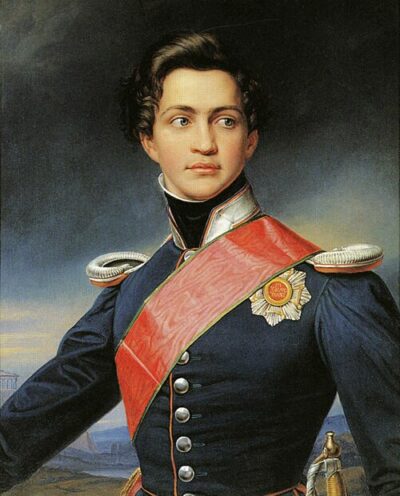
Otto of Greece
Otto of Greece was a King of Greece from 1832 to 1862. Born June 1, 1815, in Mirabell Palace. Died July 26, 1867, in Bamberg. Positions held include King of the Hellenes (1832–1862). Awards include Knight of the Order of the Golden Fleece, Order of St. Andrew and Order of the Redeemer.
Facts
28 facts · 2 confirmed by two sources · 5 cited · 21 from one source
Where this comes from
Papalocal keeps its own record. It started from these sources; what each one said is kept here as it was copied, so a change on their side never changes this page by itself. Tap one to read its version.
What Wikidata says · copied November 16, 2026 · revision 2563996713
- Described as
- King of Greece from 1832 to 1862 (1815–1867)
- Other names
- Otto I Friedrich Ludwig von Bayern, King of the Hellenes, Otto Friedrich Ludwig
- Born
- June 1, 1815 · 9 references
- Died
- July 26, 1867 · 8 references
- Born in
- Mirabell Palace
- Died in
- Bamberg · 3 references
- Buried in
- Theatine Church · 1 reference
- Name at birth
- Otto Friedrich Ludwig von Bayern
- Citizen of
- Kingdom of Bavaria; Kingdom of Greece
- Occupation
- politician; monarch
- Positions held
- King of the Hellenes (1832–1862)
- Awards
- Knight of the Order of the Golden Fleece; Order of St. Andrew; Order of the Redeemer; Order of Saint Stephen of Hungary; Knight Grand Cross in the Order of the Netherlands Lion (1843) · 1 reference; Knight of the Order of the Elephant (1846)
- Spouse
- Amalia of Oldenburg (1836–) · 3 references
- Father
- Ludwig I of Bavaria · 1 reference
- Mother
- Therese of Saxe-Hildburghausen · 1 reference
- Siblings
- Princess Mathilde Caroline of Bavaria; Princess Adelgunde of Bavaria; Princess Hildegard Louise of Bavaria; Princess Alexandra of Bavaria; Luitpold, Prince Regent of Bavaria; Maximilian II of Bavaria; Prince Adalbert of Bavaria
- Religion
- Catholic Church
- Wikipedias with a page
- 60
Wikidata item Q77067 (wikidata.org/wiki/Q77067), public domain (CC0). Copied November 16, 2026.
What Wikipedia says · copied November 16, 2026 · revision 1383326950
Otto (Greek: Όθων, romanized: Óthon; German: Otto Friedrich Ludwig von Wittelsbach; 1 June 1815 – 26 July 1867) was King of Greece from the establishment of the Kingdom on 7 May 1832, under the Convention of London, until he was deposed in October 1862.
The second son of King Ludwig I of Bavaria, Otto ascended the newly created throne of Greece at age 17. His government was initially run by a three-man regency council made up of Bavarian court officials. Upon reaching his majority, Otto removed the regents when they proved unpopular with the people, and he ruled as an absolute monarch. Eventually, his subjects' demands for a constitution proved overwhelming, and in the face of an armed (but bloodless) insurrection, Otto granted a constitution in 1843.
Throughout his reign, Otto tried to make significant reforms to modernize Greece, seeing himself as an Enlightened absolutist. He established educational institutions and several state services but was unable to resolve Greece's major poverty and prevent economic meddling from outside. Greek politics in this era were based on affiliations with the three Great Powers that had guaranteed Greece's independence, Britain, France and Russia, and Otto's ability to maintain the support of these powers was key to his remaining in power. To remain strong, Otto had to play the interests of each of the Great Powers' Greek adherents against the others, while not irritating the Great Powers. When Greece was blockaded by the British Royal Navy in 1850 and again in 1854, to stop Greece from attacking the Ottoman Empire during the Crimean War, Otto's standing amongst Greeks suffered. As a result, there was an assassination attempt on Queen Amalia, and finally, in October 1862, Otto was deposed while in the countryside. He died in exile in Bavaria in 1867.
- Born, in its opening lines
- June 1, 1815
- Died, in its opening lines
- July 26, 1867
From the Wikipedia article “Otto of Greece” (en.wikipedia.org/wiki/Otto_of_Greece), by its contributors, under CC BY-SA 4.0 (creativecommons.org/licenses/by-sa/4.0/). Copied November 16, 2026; not changed.
Confirmed Two sources agree. Cited One source, and it names where it got it. One source One source, without a reference of its own. Sources disagree The sources disagree. We show the best-supported value and keep theirs below.
