
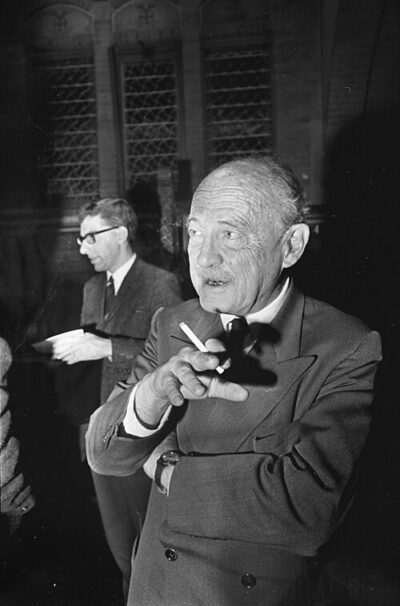
Owen Lattimore
Owen Lattimore was an American scholar of Central Asia. Born July 29, 1900, in Washington, D.C.. Died May 31, 1989, in Providence. Educated at Harvard University and St. Bees School. Awards include Guggenheim Fellowship and Patron’s Medal.
Facts
18 facts · 2 confirmed by two sources · 9 cited · 7 from one source
Where this comes from
Papalocal keeps its own record. It started from these sources; what each one said is kept here as it was copied, so a change on their side never changes this page by itself. Tap one to read its version.
What Wikidata says · copied November 18, 2026 · revision 2551022859
- Described as
- American scholar of Central Asia (1900-1989)
- Born
- July 29, 1900 · 4 references
- Died
- May 31, 1989 · 4 references
- Born in
- Washington, D.C. · 2 references
- Died in
- Providence · 1 reference
- Citizen of
- United States · 2 references
- Occupation
- sinologist · 1 reference; university teacher; diplomat · 1 reference
- Worked for
- University of Leeds
- Education
- Harvard University (1928–1929); St. Bees School · 2 references
- Member of
- American Philosophical Society (1943–)
- Awards
- Guggenheim Fellowship (1930) · 1 reference; Patron’s Medal (1942) · 1 reference
- Spouse
- Eleanor Holgate Lattimore · 1 reference
- Siblings
- Richmond Lattimore; Eleanor Frances Lattimore
- Lived in
- Pawtucket (–1989)
- Wikipedias with a page
- 16
Wikidata item Q1344502 (wikidata.org/wiki/Q1344502), public domain (CC0). Copied November 18, 2026.
What Wikipedia says · copied November 18, 2026 · revision 1384398758
Owen Lattimore (July 29, 1900 – May 31, 1989) was an American Orientalist and writer. He was an influential scholar of China and Central Asia, especially Mongolia. Although he never earned a college degree, in the 1930s he was editor of Pacific Affairs, a journal published by the Institute of Pacific Relations, and taught at Johns Hopkins University from 1938 to 1963. He was director of the Walter Hines Page School of International Relations from 1939 to 1953. During World War II, he was an advisor to Chiang Kai-shek and the American government and contributed extensively to the public debate on U.S. policy toward Asia. From 1963 to 1970, Lattimore was the first Professor of Chinese Studies at the University of Leeds in England.
In the early post-war period of McCarthyism and the Red Scare, American wartime "China Hands" were accused of being agents of the Soviet Union or under the influence of Marxism, especially after the "loss of China" in 1949. In 1950, Senator Joseph McCarthy accused Lattimore in particular of being "the top Russian espionage agent in the United States." The accusations led to years of Congressional hearings that did not substantiate the charge that Lattimore had been a spy. Soviet Venona cables, decoded during WWII and declassified decades later, did not refer to Lattimore as one of the Soviet agents active in the US. The hearings did document Lattimore's sympathetic statements about Stalin and the Soviet Union, however. In 1988 Chen Han-shen, a member of the Sorge spy ring, mentioned in his memoirs that Lattimore placed a request for a Chinese assistant through Comintern channels. Chen's superiors dispatched him to the United States in 1936 to serve as Lattimore's coeditor at Pacific Affairs, a position Chen used to carry out espionage activities in New York, with the help of another agent, Rao Shu-shi. The controversy put an end to Lattimore's role as a consultant of the U.S. State Department and eventually to his academic career. He died in 1989 in Providence, Rhode Island, having resided in his later years in Pawtucket.
William T. Rowe wrote that Lattimore's "lifetime intellectual project was to develop a 'scientific' model of the way human societies form, evolve, grow, decline, mutate and interact with one another along 'frontiers'." He eclectically absorbed and often abandoned influential theories of his day that dealt with the great themes of history. These included the ecological determinism of Ellsworth Huntington; biological racism, though only to the extent of seeing characteristics which grew out of ecology; the economic geography and location theory; and some aspects of Marxist modes of production and stages of history, especially through the influence of Karl August Wittfogel. The most important and lasting influence, however, was Arnold J. Toynbee and his treatment of the great civilizations as organic wholes which were born, matured, grew old, and died. Lattimore's most influential book, The Inner Asian Frontiers of China (1940), used these theories to explain the history of East Asia not as the history of China and its influence on its neighbors, but as the interaction between two types of civilizations, settled farming and pastoral, each of which had its role in changing the other.
- Born, in its opening lines
- July 29, 1900
- Died, in its opening lines
- May 31, 1989
From the Wikipedia article “Owen Lattimore” (en.wikipedia.org/wiki/Owen_Lattimore), by its contributors, under CC BY-SA 4.0 (creativecommons.org/licenses/by-sa/4.0/). Copied November 18, 2026; not changed.
Confirmed Two sources agree. Cited One source, and it names where it got it. One source One source, without a reference of its own. Sources disagree The sources disagree. We show the best-supported value and keep theirs below.
