
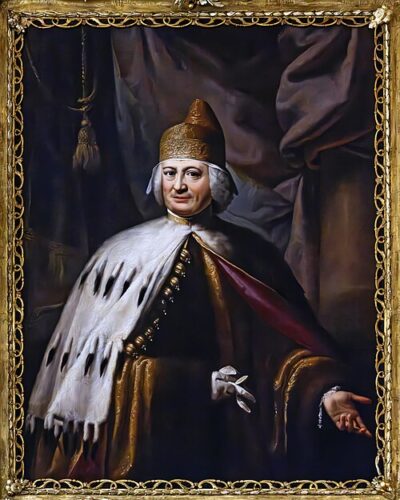
Paolo Renier
Paolo Renier was the 119th, and penultimate, Doge of Venice. Born November 21, 1710, in Venice. Died February 13, 1789, in Venice. Positions held include Doge of Venice (1779–1789) and ambassador.
Facts
12 facts · 2 confirmed by two sources · 1 cited · 9 from one source
Where this comes from
Papalocal keeps its own record. It started from these sources; what each one said is kept here as it was copied, so a change on their side never changes this page by itself. Tap one to read its version.
What Wikidata says · copied November 18, 2026 · revision 2550789389
- Described as
- 119th, and penultimate, Doge of Venice
- Born
- November 21, 1710 · 1 reference
- Died
- February 13, 1789 · 1 reference
- Born in
- Venice
- Died in
- Venice
- Buried in
- Tolentini
- Citizen of
- Republic of Venice
- Occupation
- diplomat; politician; doge · 1 reference
- Positions held
- Doge of Venice (1779–1789); ambassador
- Spouse
- Margherita Delmaz
- Wikipedias with a page
- 21
Wikidata item Q663054 (wikidata.org/wiki/Q663054), public domain (CC0). Copied November 18, 2026.
What Wikipedia says · copied November 18, 2026 · revision 1382390949
Paolo Renier (21 November 1710 – 13 February 1789) was a Venetian statesman, the 119th Doge of Venice, and penultimate, from 1779 until his death. He was a noted orator, and served as ambassador to the Ottoman Empire and to Austria. His election as Doge was unpopular, and he was the subject of numerous menacing letters at the time. Renier was succeeded as Doge by Ludovico Manin, who would be the last Doge of Venice. He married Giustina Donà (d. 1751) in 1733, and Margherita Delmaz (d. 1817) in 1751. Through his brother, Daniele, he is the great-granduncle of Michelangelo Celesia.
- Born, in its opening lines
- November 21, 1710
- Died, in its opening lines
- February 13, 1789
From the Wikipedia article “Paolo Renier” (en.wikipedia.org/wiki/Paolo_Renier), by its contributors, under CC BY-SA 4.0 (creativecommons.org/licenses/by-sa/4.0/). Copied November 18, 2026; not changed.
Confirmed Two sources agree. Cited One source, and it names where it got it. One source One source, without a reference of its own. Sources disagree The sources disagree. We show the best-supported value and keep theirs below.
