
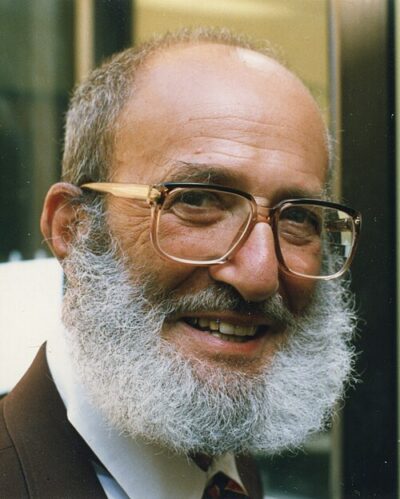
Paul Halmos
Paul Halmos was an American mathematician. Born March 3, 1916, in Budapest. Died October 2, 2006, in Los Gatos. Known for Naive Set Theory. Educated at University of Illinois Urbana-Champaign and Lincoln Park High School. Awards include Guggenheim Fellowship, Paul R. Halmos - Lester R. Ford Awards and Leroy P. Steele Prize.
Facts
38 facts · 2 confirmed by two sources · 24 cited · 12 from one source
Where this comes from
Papalocal keeps its own record. It started from these sources; what each one said is kept here as it was copied, so a change on their side never changes this page by itself. Tap one to read its version.
What Wikidata says · copied November 15, 2026 · revision 2549532453
- Described as
- American mathematician (1916–2006)
- Other names
- Paul R. Halmos, Paul Richard Halmos
- Born
- March 3, 1916 · 4 references
- Died
- October 2, 2006 · 5 references
- Born in
- Budapest
- Died in
- Los Gatos · 1 reference
- Buried in
- St. Luke's Episcopal Church · 1 reference
- Cause of death
- pneumonia · 1 reference
- Name at birth
- Halmos Pál · 1 reference
- Citizen of
- Hungary; United States
- Occupation
- mathematician · 2 references; philosopher; statistician; university teacher · 1 reference
- Worked for
- University of Chicago (1946–1961) · 2 references; Syracuse University (1942–1946) · 2 references; University of Hawaiʻi System (1968–1969) · 2 references; Reed College (1939) · 1 reference; Institute for Advanced Study (1939–1942) · 1 reference; University of Michigan (1961–1968) · 1 reference; Indiana University (1969–1985) · 1 reference; Santa Clara University (1985–) · 1 reference
- Education
- University of Illinois Urbana-Champaign (1931–1938) · 1 reference; Lincoln Park High School (1929–1931) · 1 reference
- Member of
- Royal Society of Edinburgh · 1 reference; Mathematical Association of America · 1 reference
- Known for
- Naive Set Theory
- Awards
- Guggenheim Fellowship (1947) · 1 reference; Paul R. Halmos - Lester R. Ford Awards (1971) · 1 reference; Leroy P. Steele Prize (1983) · 2 references; Chauvenet Prize (1947) · 1 reference; George Pólya Award (1983) · 1 reference
- Field
- algebra; mathematical analysis; functional analysis; probability theory; set theory; mathematical statistics · 1 reference
- Spouse
- Virginia Halmos · 1 reference
- Wikipedias with a page
- 37
Wikidata item Q370085 (wikidata.org/wiki/Q370085), public domain (CC0). Copied November 15, 2026.
What Wikipedia says · copied November 15, 2026 · revision 1372370214
Paul Richard Halmos (Hungarian: Halmos Pál [ˈhɒlmoʃ paːl]; 3 March 1916 – 2 October 2006) was a Hungarian-born American mathematician and probabilist who made fundamental advances in the areas of mathematical logic, probability theory, operator theory, ergodic theory, and functional analysis (in particular, Hilbert spaces). He was also recognized as a great mathematical expositor. He has been described as one of The Martians.
- Born, in its opening lines
- March 3, 1916
- Died, in its opening lines
- October 2, 2006
From the Wikipedia article “Paul Halmos” (en.wikipedia.org/wiki/Paul_Halmos), by its contributors, under CC BY-SA 4.0 (creativecommons.org/licenses/by-sa/4.0/). Copied November 15, 2026; not changed.
Confirmed Two sources agree. Cited One source, and it names where it got it. One source One source, without a reference of its own. Sources disagree The sources disagree. We show the best-supported value and keep theirs below.
