
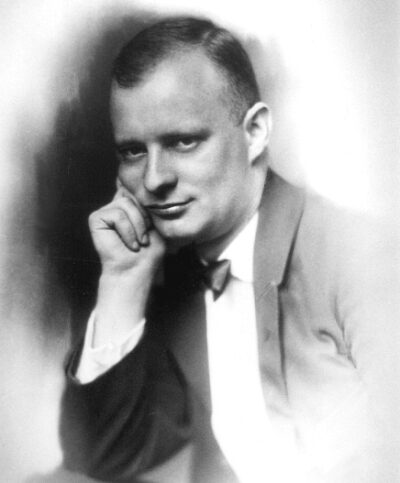
Paul Hindemith
Paul Hindemith was a German composer. Born November 16, 1895, in Hanau. Died December 28, 1963, in Frankfurt. Known for String Quartet No. 2, Symphony in B-flat for Band and Der Schwanendreher. Educated at Hoch Conservatory. Awards include Pour le Mérite for Sciences and Arts order, Bach Prize of the Free and Hanseatic City of Hamburg and Balzan Prize.
Facts
51 facts · 2 confirmed by two sources · 5 cited · 44 from one source
Where this comes from
Papalocal keeps its own record. It started from these sources; what each one said is kept here as it was copied, so a change on their side never changes this page by itself. Tap one to read its version.
What Wikidata says · copied November 13, 2026 · revision 2568282769
- Described as
- German composer (1895–1963)
- Born
- November 16, 1895 · 20 references
- Died
- December 28, 1963 · 20 references
- Born in
- Hanau · 4 references
- Died in
- Frankfurt · 5 references
- Cause of death
- acute pancreatitis
- Citizen of
- Germany; West Germany; United States
- Occupation
- classical composer; conductor · 2 references; professor of music composition; musicologist · 1 reference; music educator; music theorist; viola d'amore player; university teacher
- Worked for
- Harvard University; Berlin University of the Arts (1927–1934); Amar Quartet (1921–1929); Yale University; Hacettepe University Ankara State Conservatory; University of Zurich · 1 reference
- Education
- Hoch Conservatory (1908–)
- Member of
- American Academy of Arts and Letters; American Academy of Arts and Sciences; Bavarian Academy of Fine Arts; American Philosophical Society (1962–)
- Genre
- opera; symphony
- Instrument
- organ; viola; violin
- Known for
- String Quartet No. 2; Symphony in B-flat for Band; Der Schwanendreher; Konzertmusik, Op. 41
- Awards
- Pour le Mérite for Sciences and Arts order; Bach Prize of the Free and Hanseatic City of Hamburg (1951); Balzan Prize (1962); Wihuri Sibelius Prize (1955); Goethe Plaque of the City of Frankfurt (1955); Berliner Kunstpreis (1963); Honorary doctor of the Free University of Berlin (1950); honorary doctorate of the Johann Wolfgang Goethe University Frankfurt (1948); Honorary doctor of the University of Oxford (1954); Pour le Mérite · 1 reference; Honorary Member of the International Society for Contemporary Music
- Spouse
- Johanna Gertrud Hindemith · 1 reference
- Siblings
- Rudolf Hindemith
- Religion
- Lutheranism
- Website
- https://www.hindemith.info
- Wikipedias with a page
- 58
Wikidata item Q57244 (wikidata.org/wiki/Q57244), public domain (CC0). Copied November 13, 2026.
What Wikipedia says · copied November 13, 2026 · revision 1384703562
Paul Hindemith ( POWL HIN-də-mit; German: [ˌpaʊ̯l ˈhɪndəmɪt] ; 16 November 1895 – 28 December 1963) was a German and American composer, music theorist, teacher, violist, and conductor. He founded the Amar Quartet in 1921, touring extensively in Europe. As a composer, he became a major advocate of the Neue Sachlichkeit (New Objectivity) style of music in the 1920s, with compositions such as Kammermusik, including works with viola and viola d'amore as solo instruments in a neo-Bachian spirit. His other notable compositions include the song cycle Das Marienleben (1923), Der Schwanendreher for viola and orchestra (1935), the opera Mathis der Maler (1938) and the symphony Mathis der Maler (1934), the Symphonic Metamorphosis of Themes by Carl Maria von Weber (1943), and the oratorio When Lilacs Last in the Dooryard Bloom'd (1946), a requiem based on Walt Whitman's poem. Hindemith and his wife emigrated to Switzerland and the United States ahead of World War II, after worsening difficulties with the Nazi German regime. In his later years, he conducted and recorded much of his own music.
Most of Hindemith's compositions are anchored by a foundational tone, and use musical forms and counterpoint and cadences typical of the Baroque and Classical traditions. His harmonic language is more modern, freely using all 12 notes of the chromatic scale within his tonal framework, as detailed in his three-volume treatise, The Craft of Musical Composition.
- Born, in its opening lines
- November 16, 1895
- Died, in its opening lines
- December 28, 1963
From the Wikipedia article “Paul Hindemith” (en.wikipedia.org/wiki/Paul_Hindemith), by its contributors, under CC BY-SA 4.0 (creativecommons.org/licenses/by-sa/4.0/). Copied November 13, 2026; not changed.
Confirmed Two sources agree. Cited One source, and it names where it got it. One source One source, without a reference of its own. Sources disagree The sources disagree. We show the best-supported value and keep theirs below.
