
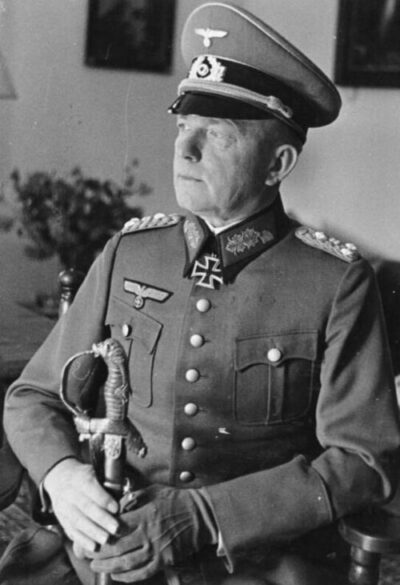
Paul Ludwig Ewald von Kleist
Paul Ludwig Ewald von Kleist was a German field marshal. Born August 8, 1881, in Braunfels. Died November 13, 1954, in Vladimir Central Prison. Awards include Military Merit Cross III. Class, Knight's Cross of the Iron Cross with Oak Leaves and Swords and Order of Michael the Brave.
Facts
26 facts · 2 confirmed by two sources · 2 cited · 22 from one source
What’s different
- Died: we show November 13, 1954 (Confirmed). Wikidata also lists October 6, 1954
Where this comes from
Papalocal keeps its own record. It started from these sources; what each one said is kept here as it was copied, so a change on their side never changes this page by itself. Tap one to read its version.
What Wikidata says · copied November 16, 2026 · revision 2569028577
- Described as
- German field marshal (1881–1954)
- Other names
- Kleist, Ewald
- Born
- August 8, 1881 · 7 references
- Died
- November 13, 1954 · 4 references; October 6, 1954 · 1 reference
- Born in
- Braunfels · 1 reference
- Died in
- Vladimir Central Prison
- Citizen of
- Germany; Russian Empire
- Occupation
- military personnel; military officer; Generalfeldmarschall · 1 reference
- Awards
- Military Merit Cross III. Class; Knight's Cross of the Iron Cross with Oak Leaves and Swords; Order of Michael the Brave; Military Merit Order (Bavaria) · 1 reference; Hanseatic Cross · 1 reference; Clasp to the Iron Cross · 1 reference; Honour Cross of the World War 1914/1918 · 1 reference; Wehrmacht Long Service Award · 1 reference; Eastern Medal · 1 reference; Military Merit Cross · 1 reference; Military Order of Italy · 1 reference; Hungarian Order of Merit · 1 reference
- Father
- Hugo von Kleist
- Military branch
- Imperial German Army · 1 reference; cavalry · 1 reference; armored warfare · 1 reference
- Military rank
- Generalfeldmarschall
- Wikipedias with a page
- 51
Wikidata item Q57137 (wikidata.org/wiki/Q57137), public domain (CC0). Copied November 16, 2026.
What Wikipedia says · copied November 16, 2026 · revision 1382367765
Paul Ludwig Ewald von Kleist (8 August 1881 – 13 November 1954) was a German Generalfeldmarschall (Field Marshal) of the Wehrmacht during World War II. Born into the Prussian noble family von Kleist, Kleist entered the Prussian Army in 1900 and commanded a cavalry squadron during World War I. Kleist joined the Reichswehr of inter-war Germany before being discharged in 1938.
Recalled to active duty at the beginning of World War II, Kleist commanded a motorised corps in the Invasion of Poland. He then became the commander of Panzer Group Kleist (later 1st Panzer Army), the first operational formation of several Panzer corps in the Wehrmacht during the Battle of France, the Battle of Belgium, the Invasion of Yugoslavia and Operation Barbarossa, the invasion of the Soviet Union.
During the Battle of France, units under Kleist's command included Heinz Guderian's armoured corps and spearheaded the "blitzkrieg" attack through the Ardennes forest, outflanking the Maginot Line. His panzer divisions eventually pushed deep into France, resulting in Allied defeat. He then commanded the 1st Panzer Group as it drove deep into Ukraine and the Caucasus during Operation Barbarossa.
Kleist was appointed commander-in-chief of Army Group A during the last days of Case Blue, the 1942 German summer offensive in southern Russia. His disagreements with Hitler over strategic decisions led to his dismissal in March 1944 after the German defeat in right-bank Ukraine.
Following the war, Kleist was extradited to the Soviet Union where he was sentenced to 25 years in prison for war crimes; he died in prison.
- Born, in its opening lines
- August 8, 1881
- Died, in its opening lines
- November 13, 1954
From the Wikipedia article “Paul Ludwig Ewald von Kleist” (en.wikipedia.org/wiki/Paul_Ludwig_Ewald_von_Kleist), by its contributors, under CC BY-SA 4.0 (creativecommons.org/licenses/by-sa/4.0/). Copied November 16, 2026; not changed.
Confirmed Two sources agree. Cited One source, and it names where it got it. One source One source, without a reference of its own. Sources disagree The sources disagree. We show the best-supported value and keep theirs below.
