
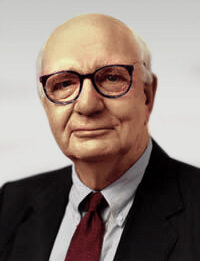
Paul Volcker
Paul Volcker was an American economist. Born September 5, 1927, in Cape May. Died December 8, 2019, in New York City. Positions held include Chair of the Federal Reserve (1979–1987), president of the Federal Reserve Bank of New York (1975–1979) and Under Secretary of the Treasury for International Affairs (1969–1974). Educated at Princeton University and London School of Economics and Political Science. Awards include Arthur S. Flemming Award, Daniel Patrick Moynihan Prize and Francis Boyer Award.
Facts
35 facts · 2 confirmed by two sources · 12 cited · 21 from one source
Where this comes from
Papalocal keeps its own record. It started from these sources; what each one said is kept here as it was copied, so a change on their side never changes this page by itself. Tap one to read its version.
What Wikidata says · copied November 15, 2026 · revision 2549563484
- Described as
- American economist (1927-2019)
- Other names
- Paul A. Volcker, Paul Adolph Volcker, Paul Adolph Volcker, Jr., Paul Adolph Volcker Jr.
- Born
- September 5, 1927 · 4 references
- Died
- December 8, 2019 · 1 reference
- Born in
- Cape May · 1 reference
- Died in
- New York City · 1 reference
- Cause of death
- prostate cancer · 1 reference
- Name at birth
- Paul Adolph Volcker Jr.
- Citizen of
- United States
- Occupation
- economist; banker · 1 reference; politician
- Positions held
- Chair of the Federal Reserve (1979–1987); president of the Federal Reserve Bank of New York (1975–1979); Under Secretary of the Treasury for International Affairs (1969–1974)
- Political party
- Democratic Party
- Education
- Princeton University; London School of Economics and Political Science; John F. Kennedy School of Government; Teaneck High School · 1 reference; Princeton School of Public and International Affairs
- Member of
- American Academy of Arts and Sciences; American Philosophical Society · 1 reference; Group of Thirty · 1 reference
- Awards
- Arthur S. Flemming Award; Daniel Patrick Moynihan Prize (2012); Francis Boyer Award (1987) · 1 reference; doctor honoris causa of Keiō University; Paul A. Volcker Lifetime Achievement Award for Economic Policy (2013); honorary doctor of the Hofstra University; honorary doctor of Syracuse University (2008) · 1 reference; honorary doctor of the University of Miami (1986) · 1 reference; New Jersey Hall of Fame (2021) · 1 reference; Order of the Sacred Treasure, 1st Class (1988)
- Field
- economics · 1 reference; economics of banking · 1 reference
- Religion
- Lutheranism
- Wikipedias with a page
- 33
Wikidata item Q349785 (wikidata.org/wiki/Q349785), public domain (CC0). Copied November 15, 2026.
What Wikipedia says · copied November 15, 2026 · revision 1385503211
Paul Adolph Volcker Jr. (September 5, 1927 – December 8, 2019) was an American economist who served as the 12th chairperson of the Federal Reserve from 1979 to 1987. During his tenure as chairman, Volcker was widely credited with having ended the high levels of inflation seen in the United States throughout the 1970s and early 1980s, with measures known as the "Volcker shock". He previously served as the president of the Federal Reserve Bank of New York from 1975 to 1979.
President Jimmy Carter nominated him to succeed G. William Miller as Fed chairman and President Ronald Reagan renominated him once. Volcker did not seek a third term at the Fed and was succeeded by Alan Greenspan. After his retirement from the Board, he chaired the Economic Recovery Advisory Board under President Barack Obama from 2009 to 2011 during the subprime mortgage crisis.
- Born, in its opening lines
- September 5, 1927
- Died, in its opening lines
- December 8, 2019
From the Wikipedia article “Paul Volcker” (en.wikipedia.org/wiki/Paul_Volcker), by its contributors, under CC BY-SA 4.0 (creativecommons.org/licenses/by-sa/4.0/). Copied November 15, 2026; not changed.
Confirmed Two sources agree. Cited One source, and it names where it got it. One source One source, without a reference of its own. Sources disagree The sources disagree. We show the best-supported value and keep theirs below.
