
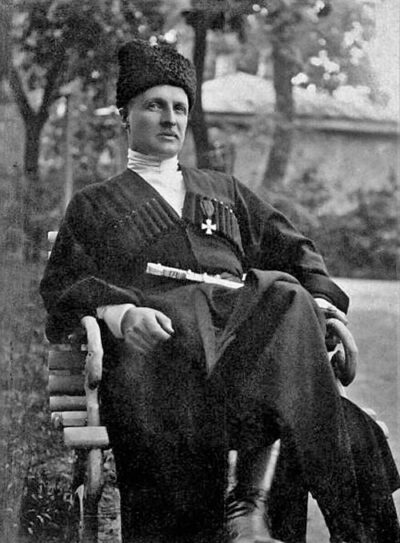
Pavlo Skoropadsky
Pavlo Skoropadsky was an Ukrainian general. Born May 3, 1873, in Wiesbaden. Died April 26, 1945, in Metten. Positions held include Hetman of Ukraine (1918). Educated at Page Corps. Awards include Order of Saint Anna, 2nd class, Order of Saint Anna, 1st class and Order of Saint Anna, 3rd class.
Facts
39 facts · 1 confirmed by two sources · 5 cited · 32 from one source · 1 where the sources disagree
What’s different
- Born: we show May 3, 1873 (Sources disagree). Wikipedia says May 15, 1873
Where this comes from
Papalocal keeps its own record. It started from these sources; what each one said is kept here as it was copied, so a change on their side never changes this page by itself. Tap one to read its version.
What Wikidata says · copied November 16, 2026 · revision 2564980109
- Described as
- Ukrainian general (1873-1945)
- Other names
- Pavlo Skoropadskyi, Pavlo Petrovych Skoropadskyi
- Born
- May 3, 1873
- Died
- April 26, 1945 · 3 references
- Born in
- Wiesbaden · 2 references
- Died in
- Metten · 2 references
- Buried in
- Oberstdorf Forest Cemetery · 1 reference
- Citizen of
- Russian Empire
- Occupation
- military personnel; politician · 1 reference; diplomat; large estate owner · 1 reference
- Positions held
- Hetman of Ukraine (1918)
- Education
- Page Corps
- Awards
- Order of Saint Anna, 2nd class; Order of Saint Anna, 1st class; Order of Saint Anna, 3rd class; Order of Saint Anna, 4th class; Order of Saint Stanislaus, 1st class; Order of Saint Stanislaus, 2nd class; Order of St. Vladimir, 4th class; Order of St. Vladimir, 3rd class; Order of St. Vladimir, 2nd class; Order of St. George, 4th class; Grand Cross of the Order of the Red Eagle; Gold Sword for Bravery; Order of Saint Stanislaus · 1 reference; Medal In memory of Alexander III · 1 reference; Medal In memory of coronation of Nikolay II · 1 reference
- Spouse
- Oleksandra Skoropadska
- Children
- Mariya Skoropadska; Yelyzaveta Skoropadska; Danylo Skoropadskyi; Olena Ott-Skoropadska
- Father
- Petro Skoropadsky
- Religion
- Eastern Orthodox Church; Eastern Orthodoxy
- Military branch
- cavalry; Ukrainian People's Army
- Military rank
- general · 1 reference; lieutenant general
- Wikipedias with a page
- 52
Wikidata item Q435090 (wikidata.org/wiki/Q435090), public domain (CC0). Copied November 16, 2026.
What Wikipedia says · copied November 16, 2026 · revision 1375191836
Pavlo Petrovych Skoropadsky (Ukrainian: Павло Петрович Скоропадський; 15 May [O.S. 3 May] 1873 – 26 April 1945) was a Ukrainian aristocrat, military leader and statesman who served as the hetman of the Ukrainian State throughout 1918 following a coup d'état on 29 April, of the same year. He abdicated on 14 December 1918.
Born the son of a nobleman, he attended the Page Corps from which he came out an officer. After his service in the Russo-Japanese War, he was promoted to the rank of colonel, later in command of the 20th Finnish Dragoon Regiment in 1910. Skoropadsky would be promoted to major general and aide-de-camp of Nicholas II in 1912. During the First World War, he became a lieutenant general in charge of the 34th Army Corps.
After the February Revolution, which saw the emergence of the Central Rada, Skoropadsky began to Ukrainize his 34th Army Corps, later known as the 1st Ukrainian Corps. With the tacit support of the German Empire, Skoropadsky overthrew the Ukrainian People's Republic and established the Ukrainian State. During his rule, he gave the occupying Austrian and German forces greater control over Ukraine while also appealing to the interests of large landowners.
Opposition to his rule grew, particularly among the rural population, due to the forced requisition of grain by the German and Austrian troops, which often acted violently towards the local Ukrainian peasants. After his issue of a controversial statement proclaiming his aim to join a federal union with the White movement, which was unpopular with many Ukrainians, the Anti-Hetman Uprising broke out on 14 November 1918 and removed him from power, re-establishing the earlier Ukrainian People's Republic.
Despite his short tenure as hetman, he is credited with founding the National Academy of Sciences of Ukraine, establishing diplomatic ties internationally and restoring relative peace and order amidst the wider Russian Civil War.
- Born, in its opening lines
- May 15, 1873
- Died, in its opening lines
- April 26, 1945
From the Wikipedia article “Pavlo Skoropadsky” (en.wikipedia.org/wiki/Pavlo_Skoropadsky), by its contributors, under CC BY-SA 4.0 (creativecommons.org/licenses/by-sa/4.0/). Copied November 16, 2026; not changed.
Confirmed Two sources agree. Cited One source, and it names where it got it. One source One source, without a reference of its own. Sources disagree The sources disagree. We show the best-supported value and keep theirs below.
