
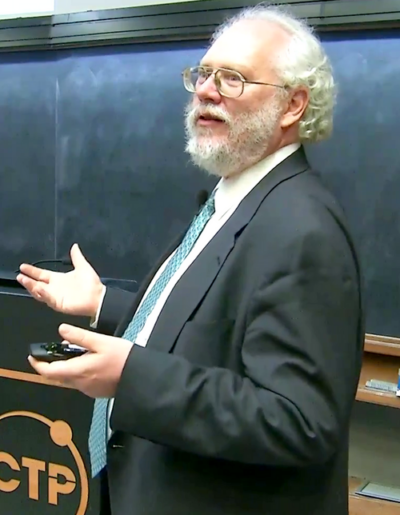
Peter Shor
Peter Shor is an American professor of applied mathematics at MIT. Born August 14, 1959, in New York City. Known for Shor's algorithm, CSS code and SMAWK algorithm. Educated at California Institute of Technology and Massachusetts Institute of Technology. Awards include MacArthur Fellows Program, Gödel Prize and King Faisal Prize in Science.
Facts
34 facts · 1 confirmed by two sources · 7 cited · 26 from one source
Where this comes from
Papalocal keeps its own record. It started from these sources; what each one said is kept here as it was copied, so a change on their side never changes this page by itself. Tap one to read its version.
What Wikidata says · copied November 15, 2026 · revision 2518239647
- Described as
- American professor of applied mathematics at MIT
- Other names
- Peter Williston Shor, Peter W. Shor, P. W. Shor
- Born
- August 14, 1959
- Born in
- New York City
- Citizen of
- United States
- Occupation
- mathematician; computer scientist; university teacher
- Worked for
- Massachusetts Institute of Technology
- Education
- California Institute of Technology; Massachusetts Institute of Technology; Tamalpais High School · 2 references
- Member of
- National Academy of Sciences; American Academy of Arts and Sciences; American Mathematical Society (2021–) · 2 references; Association for Computing Machinery (2019–) · 1 reference
- Known for
- Shor's algorithm; CSS code; SMAWK algorithm; stabilizer code; quantum threshold theorem
- Awards
- MacArthur Fellows Program; Gödel Prize (1999) · 1 reference; King Faisal Prize in Science (2002); Josiah Willard Gibbs Lectureship (2010); IMU Abacus Medal (1998); O'Reilly Open Source Award (1998); Dickson Prize in Science (1999); International Quantum Communication Award (1998); ICTP Dirac Medal (2017) · 1 reference; Fellow of the American Mathematical Society (2022) · 2 references; IEEE Eric E. Sumner Award (2018) · 1 reference; ACM Fellow (2019) · 1 reference
- Field
- computer science
- Father
- Samuel Wendell Williston Shor
- Website
- http://www-math.mit.edu/~shor/
- Wikipedias with a page
- 27
Wikidata item Q370071 (wikidata.org/wiki/Q370071), public domain (CC0). Copied November 15, 2026.
What Wikipedia says · copied November 15, 2026 · revision 1379016824
Peter Williston Shor (born August 14, 1959) is an American theoretical computer scientist known for his work on quantum computation, in particular for devising Shor's algorithm, a quantum algorithm for factoring exponentially faster than the best currently-known algorithm running on a classical computer. He has been a professor of applied mathematics at the Massachusetts Institute of Technology (MIT) since 2003.
- Born, in its opening lines
- August 14, 1959
From the Wikipedia article “Peter Shor” (en.wikipedia.org/wiki/Peter_Shor), by its contributors, under CC BY-SA 4.0 (creativecommons.org/licenses/by-sa/4.0/). Copied November 15, 2026; not changed.
Confirmed Two sources agree. Cited One source, and it names where it got it. One source One source, without a reference of its own. Sources disagree The sources disagree. We show the best-supported value and keep theirs below.
