
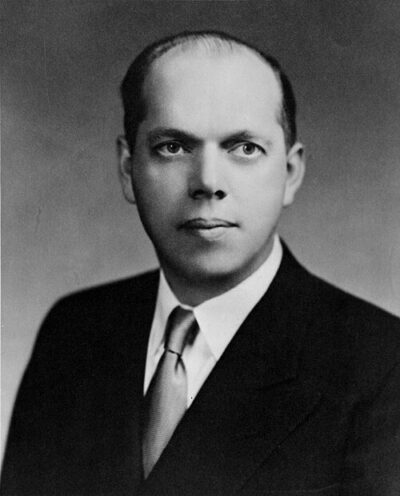
Philip Abelson
Philip Abelson was an US physicist, editor of the journal Science, and director of the Carnegie Institution of Washington's Geophysical Laboratory. Born April 27, 1913, in Tacoma. Died August 1, 2004, in Bethesda. Educated at Washington State University and University of California, Berkeley. Awards include Kalinga Prize, National Medal of Science and Fellow of the American Physical Society.
Facts
36 facts · 2 confirmed by two sources · 14 cited · 20 from one source
Where this comes from
Papalocal keeps its own record. It started from these sources; what each one said is kept here as it was copied, so a change on their side never changes this page by itself. Tap one to read its version.
What Wikidata says · copied November 15, 2026 · revision 2566819823
- Described as
- US physicist, editor of the journal Science, and director of the Carnegie Institution of Washington's Geophysical Laboratory (1913–2004)
- Other names
- Philip Hauge Abelson, Philip H. Abelson
- Born
- April 27, 1913 · 6 references
- Died
- August 1, 2004 · 5 references
- Born in
- Tacoma · 1 reference
- Died in
- Bethesda · 1 reference
- Cause of death
- respiratory failure
- Name at birth
- Philip Hauge Abelson · 1 reference
- Citizen of
- United States
- Occupation
- physicist · 1 reference; chemist · 1 reference; nuclear physicist; writer · 1 reference; molecular biologist · 1 reference; geochemist · 1 reference; publisher · 1 reference; researcher
- Worked for
- Carnegie Mellon University; University of California, Berkeley; Carnegie Institution of Washington (2 times) (1939–); United States Naval Research Laboratory
- Education
- Washington State University; University of California, Berkeley
- Member of
- American Academy of Arts and Sciences; National Academy of Sciences (1959–); American Philosophical Society (1961–)
- Awards
- Kalinga Prize (1972) · 1 reference; National Medal of Science (1987); Fellow of the American Physical Society; NAS Public Welfare Medal (1992) · 1 reference; Fellow of the American Geophysical Union (1962–) · 1 reference; Fellow of the American Academy of Arts and Sciences; Waldo E. Smith Award (1988) · 1 reference; Navy Distinguished Civilian Service Award
- Field
- physics · 1 reference; nuclear physics · 1 reference; chemistry · 1 reference
- Spouse
- Neva Abelson
- Wikipedias with a page
- 37
Wikidata item Q377815 (wikidata.org/wiki/Q377815), public domain (CC0). Copied November 15, 2026.
What Wikipedia says · copied November 15, 2026 · revision 1373429062
Philip Hauge Abelson (April 27, 1913 – August 1, 2004) was an American physicist, scientific editor and science writer. Trained as a nuclear physicist, he co-discovered the element neptunium, worked on isotope separation in the Manhattan Project, and wrote the first study of nuclear marine propulsion for submarines. He later worked on a broad range of scientific topics and related public policy, including organic geochemistry, paleobiology and energy policy.
Abelson served as editor-in-chief of the journal Science from 1962 to 1984, president of the Carnegie Institution of Washington from 1971 to 1978, and president of the American Geophysical Union from 1972 to 1974. His frequent editorials in Science, both during and after his term as editor, became known for their strident and thought-provoking views. A collection of 100 of his editorials was published as a book, entitled Enough of Pessimism. He may have been the original source of the phrase 'extraordinary claims require extraordinary evidence'.
- Born, in its opening lines
- April 27, 1913
- Died, in its opening lines
- August 1, 2004
From the Wikipedia article “Philip Abelson” (en.wikipedia.org/wiki/Philip_Abelson), by its contributors, under CC BY-SA 4.0 (creativecommons.org/licenses/by-sa/4.0/). Copied November 15, 2026; not changed.
Confirmed Two sources agree. Cited One source, and it names where it got it. One source One source, without a reference of its own. Sources disagree The sources disagree. We show the best-supported value and keep theirs below.
