
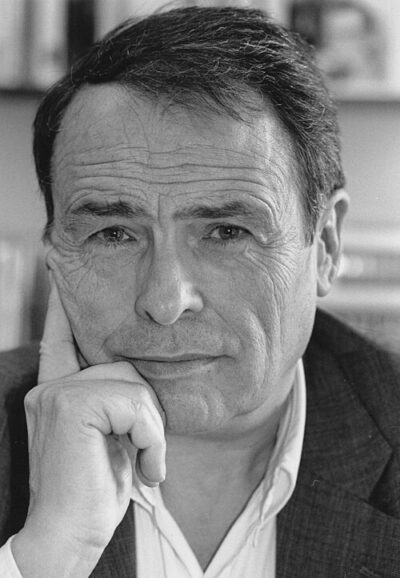
Pierre Bourdieu
Pierre Bourdieu was a French sociologist, anthropologist, and philosopher. Born August 1, 1930, in Denguin. Died January 23, 2002, in 12th arrondissement of Paris. Positions held include president (1992–2002) and director (1985–1998). Known for Distinction, Les Héritiers and Reproduction in Education, Society, and Culture. Educated at École Normale Supérieure and Lycée Louis-Barthou. Awards include CNRS Gold medal, Ernst Bloch Award and Honorary doctor of the Free University of Berlin.
Facts
49 facts · 2 confirmed by two sources · 20 cited · 27 from one source
Where this comes from
Papalocal keeps its own record. It started from these sources; what each one said is kept here as it was copied, so a change on their side never changes this page by itself. Tap one to read its version.
What Wikidata says · copied November 16, 2026 · revision 2569254841
- Described as
- French sociologist, anthropologist, and philosopher (1930–2002)
- Other names
- Bourdieu, Pér Burdé, P. Burdé, Félix Bourdieu, Pierre Félix Bourdieu
- Born
- August 1, 1930 · 14 references
- Died
- January 23, 2002 · 12 references
- Born in
- Denguin · 2 references
- Died in
- 12th arrondissement of Paris · 1 reference
- Buried in
- Père Lachaise Cemetery
- Cause of death
- cancer · 1 reference
- Name at birth
- Pierre Félix Bourdieu · 1 reference
- Citizen of
- France · 1 reference
- Occupation
- philosopher · 1 reference; sociologist · 1 reference; anthropologist; writer; photographer · 1 reference; translator · 1 reference; researcher · 1 reference; university teacher · 1 reference
- Positions held
- president (1992–2002); director (1985–1998) · 1 reference
- Worked for
- School for Advanced Studies in the Social Sciences (1975–); Collège de France (1981–2001) · 2 references; Faculty of Arts of Paris (1960–); Lille University of Science and Technology · 1 reference
- Education
- École Normale Supérieure (1951–); Lycée Louis-Barthou; Lycée Louis-le-Grand (1948–)
- Member of
- European Academy of Sciences and Arts; American Academy of Arts and Sciences; Association de réflexion sur les enseignements supérieurs et la recherche
- Known for
- Distinction · 1 reference; Les Héritiers · 1 reference; Reproduction in Education, Society, and Culture
- Awards
- CNRS Gold medal (1993) · 2 references; Ernst Bloch Award (1997); Honorary doctor of the Free University of Berlin (1989); Lysenko Prize (1998) · 2 references; honorary doctor of the University of Athens (1996); Huxley Memorial Medal (2000) · 1 reference; honorary doctorate of the Johann Wolfgang Goethe University Frankfurt (1996); honorary doctorate (1999) · 1 reference; Goethe Medal (1988) · 1 reference
- Field
- sociology · 2 references; anthropology · 1 reference; sociology of culture · 1 reference
- Spouse
- Marie-Claire Bourdieu · 1 reference
- Children
- Emmanuel Bourdieu · 1 reference; Laurent Bourdieu; Jérôme Bourdieu
- Father
- Albert Bourdieu
- Mother
- Noémie Bourdieu
- Wikipedias with a page
- 87
Wikidata item Q156268 (wikidata.org/wiki/Q156268), public domain (CC0). Copied November 16, 2026.
What Wikipedia says · copied November 16, 2026 · revision 1385801849
Pierre Bourdieu (UK: , US: ; French: [pjɛʁ buʁdjø]; Gascon: Pèir Bordièu; 1 August 1930 – 23 January 2002) was a French sociologist and public intellectual. Bourdieu's contributions to the sociology of education, the theory of sociology, and sociology of aesthetics have achieved wide influence in several related academic fields (e.g. anthropology, media and cultural studies, education, popular culture, and the arts). During his academic career he was primarily associated with the School for Advanced Studies in the Social Sciences in Paris and the Collège de France.
Bourdieu's work was primarily concerned with the dynamics of power in society, especially the diverse and subtle ways in which power is transferred and social order is maintained within and across generations. In conscious opposition to the idealist tradition of much of Western philosophy, his work often emphasized the corporeal nature of social life and stressed the role of practice and embodiment in social dynamics. Building upon and criticizing the theories of Karl Marx, Sigmund Freud, Max Weber, Émile Durkheim, Claude Lévi-Strauss, Erwin Panofsky and Marcel Mauss among others, his research pioneered novel investigative frameworks and methods, and introduced such influential concepts as cultural reproduction, habitus, field or location, and symbolic violence, as well as cultural capital, social capital, and symbolic capital (as distinct from traditionally recognized economic forms of capital). Another notable influence on Bourdieu was Blaise Pascal, after whom Bourdieu titled his Pascalian Meditations.
Bourdieu was a prolific author, producing hundreds of articles and three dozen books, nearly all of which are now available in English. His best-known book is Distinction: A Social Critique of the Judgment of Taste (1979), in which he argues that judgments of taste are acts of social positioning. The argument is put forward by an original combination of social theory and data from quantitative surveys, photographs and interviews, in an attempt to reconcile difficulties such as how to understand the subject within objective structures. In the process, Bourdieu attempts to reconcile the influences of both external social structures and subjective experience on the individual. The book was named "the sixth most important sociological work of the twentieth century" by the International Sociological Association (ISA).
Pierre Bourdieu's work emphasized how social classes, especially the ruling and intellectual classes, preserve their social privileges across generations despite what he called a myth that contemporary post-industrial society boasts equality of opportunity and high social mobility, achieved through formal education.
- Born, in its opening lines
- August 1, 1930
- Died, in its opening lines
- January 23, 2002
From the Wikipedia article “Pierre Bourdieu” (en.wikipedia.org/wiki/Pierre_Bourdieu), by its contributors, under CC BY-SA 4.0 (creativecommons.org/licenses/by-sa/4.0/). Copied November 16, 2026; not changed.
Confirmed Two sources agree. Cited One source, and it names where it got it. One source One source, without a reference of its own. Sources disagree The sources disagree. We show the best-supported value and keep theirs below.
