
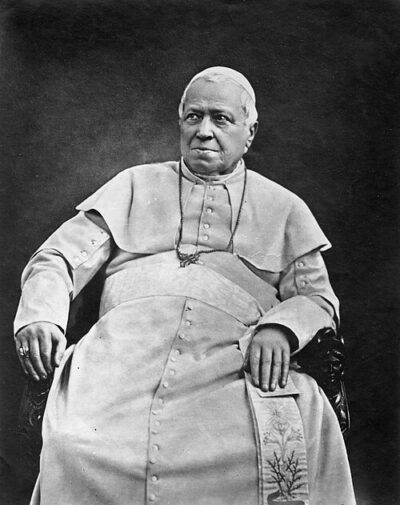
Pius IX
Pius IX was a Pope of the Catholic Church from 1846 to 1878. Born May 13, 1792, in Senigallia. Died February 7, 1878, in Apostolic Palace. Positions held include Pope (1846–1878), cardinal priest (1840–1878) and Archbishop of Spoleto (1827–). Educated at Pontifical Gregorian University.
Facts
23 facts · 2 confirmed by two sources · 9 cited · 12 from one source
Where this comes from
Papalocal keeps its own record. It started from these sources; what each one said is kept here as it was copied, so a change on their side never changes this page by itself. Tap one to read its version.
What Wikidata says · copied November 16, 2026 · revision 2568951503
- Described as
- Pope of the Catholic Church from 1846 to 1878
- Other names
- Pope Pio IX, Giovanni Maria Mastai-Ferretti, Pope Pius IX, Giovanni Maria Mastai Ferretti
- Born
- May 13, 1792 · 11 references
- Died
- February 7, 1878 · 10 references
- Born in
- Senigallia · 1 reference
- Died in
- Apostolic Palace
- Buried in
- Tomb of Pius IX
- Cause of death
- myocardial infarction
- Name at birth
- Giovanni Maria Battista Pietro Pellegrino Isidoro Mastai-Ferretti
- Citizen of
- Kingdom of Italy (1861–); Papal States
- Occupation
- Catholic priest (1819–) · 1 reference; diplomat; Catholic bishop; archbishop · 1 reference
- Positions held
- Pope (1846–1878) · 2 references; cardinal priest (1840–1878) · 1 reference; Archbishop of Spoleto (1827–) · 2 references; Roman Catholic Bishop of Imola (1832–1846) · 2 references; cardinal · 1 reference
- Education
- Pontifical Gregorian University
- Member of
- Accademia Tiberina
- Father
- Conte Girolamo Mastai Ferretti · 1 reference
- Mother
- Caterina Solazzi · 1 reference
- Religion
- Catholic Church · 1 reference
- Wikipedias with a page
- 110
Wikidata item Q43720 (wikidata.org/wiki/Q43720), public domain (CC0). Copied November 16, 2026.
What Wikipedia says · copied November 16, 2026 · revision 1380765278
Pope Pius IX (Italian: Pio IX; born Giovanni Maria Battista Pietro Pellegrino Isidoro Mastai-Ferretti; 13 May 1792 – 7 February 1878) was head of the Catholic Church from 16 June 1846 until his death in February 1878.
His reign of nearly 32 years is the longest verified of any pope in history and second only to Saint Peter according to Catholic tradition. He was notable for convoking the First Vatican Council in 1868, which defined the dogma of papal infallibility before taking a break in the summer of 1870. The council never reconvened. At the same time, France started the Franco-Prussian War and removed the troops that protected the Papal States, which allowed the capture of Rome by the Kingdom of Italy on 20 September 1870. Thereafter, he refused to leave Vatican City, declaring himself a "prisoner in the Vatican".
At the time of his election, he was a liberal reformer, and during his early papacy, he notably eased restrictions on Jewish movement and granted an amnesty to revolutionaries, but his approach changed radically after the Revolutions of 1848. When his prime minister, Pellegrino Rossi, was assassinated and Pius himself was made prisoner in his own palace, he fled Rome and excommunicated all participants in the short-lived Roman Republic. After its suppression by the French army and his return in 1850, his policies and doctrinal pronouncements became increasingly conservative. He was behind the Mortara case, the taking of a six-year-old by force from his Jewish family who went on to become a Catholic priest in his own right and unsuccessfully attempted to convert his Jewish parents.
In his 1849 encyclical Ubi primum, he emphasized Mary's role in salvation. In 1854, he promulgated the dogma of the Immaculate Conception, articulating a long-held Catholic belief that Mary, the Mother of God, was conceived without original sin. His 1864 Syllabus of Errors was a strong condemnation of liberalism, modernism, moral relativism, secularization, separation of church and state, and other Enlightenment ideas.
His appeal for financial support revived global donations known as Peter's Pence. He strengthened the central power of the Holy See and Roman Curia over the worldwide Catholic Church, while also formalizing the pope's ultimate doctrinal authority (the dogma of papal infallibility defined in 1870). Pope John Paul II beatified him in 2000.
- Born, in its opening lines
- May 13, 1792
- Died, in its opening lines
- February 7, 1878
From the Wikipedia article “Pope Pius IX” (en.wikipedia.org/wiki/Pope_Pius_IX), by its contributors, under CC BY-SA 4.0 (creativecommons.org/licenses/by-sa/4.0/). Copied November 16, 2026; not changed.
Confirmed Two sources agree. Cited One source, and it names where it got it. One source One source, without a reference of its own. Sources disagree The sources disagree. We show the best-supported value and keep theirs below.
