
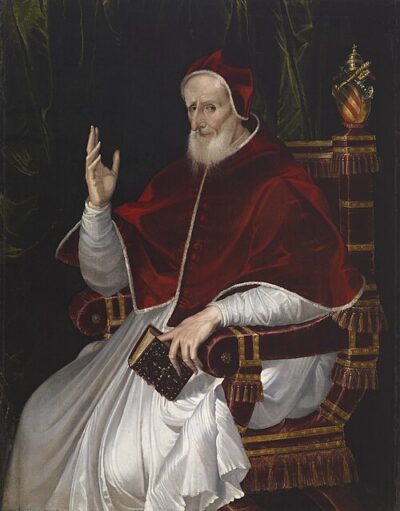
Pius V
Pius V was the 16th‑century Italian pope and Catholic saint, leading Counter‑Reformation reformer. Born January 17, 1504, in Bosco Marengo. Died May 1, 1572, in Rome. Positions held include Pope (1566–1572), Roman Catholic Bishop of Mondovì (1560–) and Roman Catholic Bishop of Nepi and Sutri (1556–). Educated at University of Bologna.
Facts
18 facts · 2 confirmed by two sources · 5 cited · 10 from one source · 1 where the sources disagree
What’s different
- Buried in: we show Basilica di Santa Maria Maggiore (Sources disagree). Wikidata also lists Tomb of Pius V
Where this comes from
Papalocal keeps its own record. It started from these sources; what each one said is kept here as it was copied, so a change on their side never changes this page by itself. Tap one to read its version.
What Wikidata says · copied November 16, 2026 · revision 2569840796
- Described as
- 16th‑century Italian pope and Catholic saint, leading Counter‑Reformation reformer
- Other names
- Pope Saint Pius V, Pope Pius V, Saint Pius V, Pope St. Pius V, Michele Ghislieri, Antonio Ghislieri
- Born
- January 17, 1504 · 3 references
- Died
- May 1, 1572 · 3 references
- Born in
- Bosco Marengo
- Died in
- Rome · 2 references
- Buried in
- Basilica di Santa Maria Maggiore; Tomb of Pius V
- Cause of death
- prostate cancer
- Name at birth
- Antonio Ghislieri
- Citizen of
- Papal States
- Occupation
- Catholic priest (1528–) · 1 reference; Catholic bishop (1556–) · 1 reference
- Positions held
- Pope (1566–1572) · 1 reference; Roman Catholic Bishop of Mondovì (1560–) · 2 references; Roman Catholic Bishop of Nepi and Sutri (1556–) · 2 references; cardinal priest
- Worked for
- University of Bologna; University of Pavia
- Education
- University of Bologna
- Religion
- Catholic Church · 1 reference
- Wikipedias with a page
- 91
Wikidata item Q131945 (wikidata.org/wiki/Q131945), public domain (CC0). Copied November 16, 2026.
What Wikipedia says · copied November 16, 2026 · revision 1384295338
Pope Pius V, OP (Italian: Pio V; 17 January 1504 – 1 May 1572), born Antonio Ghislieri (and from 1518 called Michele Ghislieri), was head of the Catholic Church and leader of the Papal States from 7 January 1566 to his death, in May 1572.
He was an inquisitor and is venerated as a saint of the Catholic Church. He is chiefly notable for his role in the implementation of the Council of Trent, the Counter-Reformation, and the standardization of the Roman Rite within the Latin Church, known as the Tridentine Mass. Pius V declared Thomas Aquinas a Doctor of the Church.
As a cardinal, Ghislieri gained a reputation for putting orthodoxy before personalities, prosecuting eight French bishops for heresy. He also stood firm against nepotism, rebuking his predecessor Pope Pius IV to his face when he wanted to make a 13-year-old member of his family a cardinal and subsidize a nephew from the papal treasury.
By means of the papal bull of 1570, Regnans in Excelsis, Pius V excommunicated Elizabeth I of England for heresy and persecution of English Catholics during her reign. He also arranged the formation of the Holy League, an alliance of Catholic states to combat the advancement of the Ottoman Empire in Eastern Europe. Although outnumbered, the Holy League famously defeated the Ottomans at the Battle of Lepanto in 1571. Pius V attributed the victory to the intercession of the Blessed Virgin Mary and instituted the feast of Our Lady of Victory. Biographers report that as the Battle of Lepanto ended, Pius rose and went over to a window, where he stood gazing toward the East. "...[L]ooking at the sky, he cried out, 'A truce to business; our great task at present is to thank God for the victory which He has just given the Christian army'."
- Born, in its opening lines
- January 17, 1504
- Died, in its opening lines
- May 1, 1572
From the Wikipedia article “Pope Pius V” (en.wikipedia.org/wiki/Pope_Pius_V), by its contributors, under CC BY-SA 4.0 (creativecommons.org/licenses/by-sa/4.0/). Copied November 16, 2026; not changed.
Confirmed Two sources agree. Cited One source, and it names where it got it. One source One source, without a reference of its own. Sources disagree The sources disagree. We show the best-supported value and keep theirs below.
