
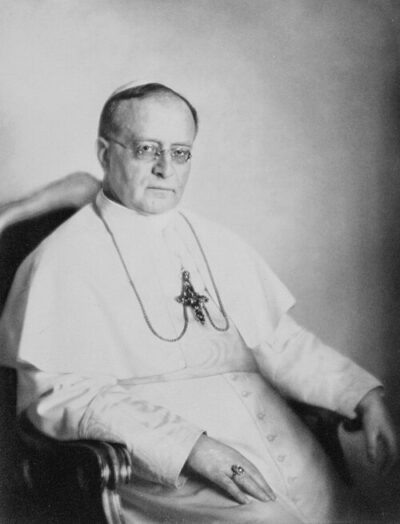
Pius XI
Pius XI was a pope of the Catholic Church from 1922 to 1939. Born May 31, 1857, in Desio. Died February 10, 1939, in Vatican City. Positions held include Pope (1922–1939), Roman Catholic Archbishop of Milan (1921–1922) and cardinal (1921–). Educated at Pontifical Gregorian University and Sapienza University of Rome. Awards include Order of the White Eagle.
Facts
29 facts · 2 confirmed by two sources · 10 cited · 17 from one source
Where this comes from
Papalocal keeps its own record. It started from these sources; what each one said is kept here as it was copied, so a change on their side never changes this page by itself. Tap one to read its version.
What Wikidata says · copied November 16, 2026 · revision 2568883694
- Described as
- pope of the Catholic Church from 1922 to 1939
- Other names
- Papa Pío XI, pape Pie XI, papa Pio XI, Pius XI. Papst, Ambrogio Ratti, paus Pius XI, Pope Pio XI, Pius PP. XI, A. Ratti, Ambrogio Damiano Achille Ratti, Achille Ratti, Pope Pius XI
- Born
- May 31, 1857 · 13 references
- Died
- February 10, 1939 · 14 references
- Born in
- Desio · 1 reference
- Died in
- Vatican City
- Buried in
- Vatican Grotto · 1 reference
- Cause of death
- myocardial infarction
- Name at birth
- Achille Ambrogio Damiano Ratti
- Citizen of
- Kingdom of Italy (1861–); Vatican City (1929–)
- Occupation
- Latin Catholic priest (1879–) · 1 reference; librarian · 2 references; mountaineer; Catholic bishop (1919–); missionary · 1 reference; nuncio · 1 reference
- Positions held
- Pope (1922–1939) · 2 references; Roman Catholic Archbishop of Milan (1921–1922) · 2 references; cardinal (1921–) · 1 reference; titular archbishop of Naupactus (1919–) · 1 reference; titular archbishop (1921–) · 1 reference; Apostolic Nuncio to Poland (1919–) · 1 reference
- Education
- Pontifical Gregorian University; Sapienza University of Rome · 1 reference
- Member of
- Croatia’s Industrious · 1 reference
- Sport
- mountaineering
- Awards
- Order of the White Eagle
- Father
- Francesco Ratti · 1 reference
- Mother
- Teresa Ratti · 1 reference
- Religion
- Catholic Church · 1 reference
- Wikipedias with a page
- 121
Wikidata item Q42323 (wikidata.org/wiki/Q42323), public domain (CC0). Copied November 16, 2026.
What Wikipedia says · copied November 16, 2026 · revision 1385842164
Pope Pius XI (Italian: Pio XI; born Ambrogio Damiano Achille Ratti, Italian: [amˈbrɔːdʒo daˈmjaːno aˈkille ˈratti]; 31 May 1857 – 10 February 1939) was head of the Catholic Church from 6 February 1922 until his death in February 1939. He was also the first sovereign of Vatican City upon its creation on 11 February 1929.
Pius XI issued numerous encyclicals, including Quadragesimo anno on the 40th anniversary of Pope Leo XIII's groundbreaking social encyclical Rerum novarum, highlighting the capitalistic greed of international finance, the dangers of atheistic communism, and social justice issues. He also wrote Quas primas, establishing the feast of Christ the King in response to anti-clericalism. The encyclical Casti connubii promulgated on 31 December 1930 prohibited Catholics from using contraception.
To establish or maintain the position of the Catholic Church, Pius XI concluded a record number of concordats, including the Reichskonkordat with Nazi Germany, and he condemned their betrayals four years later in the encyclical Mit brennender Sorge. During his pontificate, the longstanding hostility with the Italian government over the status of the papacy and the Church in Italy was successfully resolved in the Lateran Treaty of 1929.
He canonized Thomas More, Peter Canisius, Bernadette of Lourdes, and Don Bosco. He beatified and canonized Thérèse de Lisieux, for whom he held special reverence, and gave equivalent canonization to Albertus Magnus, naming him a Doctor of the Church. He took a strong interest in fostering the participation of laypeople throughout the Church, especially in the Catholic Action movement. The end of his pontificate was dominated by his speaking out against Adolf Hitler and Benito Mussolini, and defending the Catholic Church from outside interference. Pius XI died on 10 February 1939 in the Apostolic Palace and was buried in the Papal Grotto of Saint Peter's Basilica.
- Born, in its opening lines
- May 31, 1857
- Died, in its opening lines
- February 10, 1939
From the Wikipedia article “Pope Pius XI” (en.wikipedia.org/wiki/Pope_Pius_XI), by its contributors, under CC BY-SA 4.0 (creativecommons.org/licenses/by-sa/4.0/). Copied November 16, 2026; not changed.
Confirmed Two sources agree. Cited One source, and it names where it got it. One source One source, without a reference of its own. Sources disagree The sources disagree. We show the best-supported value and keep theirs below.
