
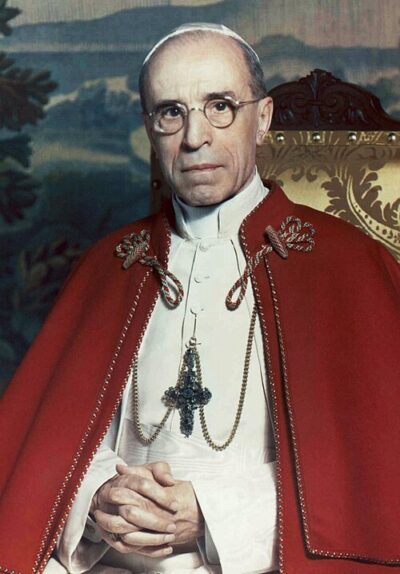
Pius XII
Pius XII was a pope of the Catholic Church from 1939 to 1958. Born March 2, 1876, in Rome. Died October 9, 1958, in Castel Gandolfo. Positions held include Pope (1939–1958), Cardinal Secretary of State (1930–1939) and Chamberlain of the Apostolic Chamber (1935–1939). Educated at L.G.S Ennio Quirino Visconti and Pontifical Gregorian University. Awards include Order of St. Gregory the Great, Order of Pius IX and Order of the Golden Spur.
Facts
40 facts · 2 confirmed by two sources · 17 cited · 21 from one source
Where this comes from
Papalocal keeps its own record. It started from these sources; what each one said is kept here as it was copied, so a change on their side never changes this page by itself. Tap one to read its version.
What Wikidata says · copied November 16, 2026 · revision 2568844821
- Described as
- pope of the Catholic Church from 1939 to 1958
- Other names
- Pope Pio XII, Eugenio Marìa Giuseppe Giovanni Pacelli, Pius PP. XII, Venerable Pius XII, Pope Pius XII, Eugenio Pacelli, Eugenio Maria Giuseppe Giovanni Pacelli
- Born
- March 2, 1876 · 10 references
- Died
- October 9, 1958 · 11 references
- Born in
- Rome · 4 references
- Died in
- Castel Gandolfo · 4 references
- Buried in
- Vatican Grotto
- Cause of death
- heart failure · 1 reference
- Name at birth
- Eugenio Maria Giuseppe Giovanni Pacelli · 1 reference
- Citizen of
- Kingdom of Italy (–1946); Italy (1946–)
- Occupation
- Latin Catholic priest (1899–) · 2 references; Catholic bishop (1917–) · 1 reference
- Positions held
- Pope (1939–1958) · 3 references; Cardinal Secretary of State (1930–1939) · 1 reference; Chamberlain of the Apostolic Chamber (1935–1939); cardinal (1929–) · 1 reference; Camerlengo of the Sacred College of Cardinals (1937–1939) · 1 reference; titular archbishop (1917–) · 1 reference; apostolic nuncio to Germany (1920–1929) · 1 reference; Archpriest of St. Peter's Basilica, Vatican City (1930–1939); Apostolic Nuncio to Bavaria (1917–1925) · 1 reference; Apostolic Nuncio to Prussia (1926–1929) · 1 reference
- Education
- L.G.S Ennio Quirino Visconti · 1 reference; Pontifical Gregorian University (1894–1895) · 1 reference; Sapienza University of Rome (1895–1896) · 1 reference; Pontifical Roman Seminary (–1901) · 1 reference; Almo Collegio Capranica · 1 reference
- Member of
- Pontifical Academy of Sciences · 1 reference; Accademia Tiberina
- Awards
- Order of St. Gregory the Great; Order of Pius IX; Order of the Golden Spur; Knight of the Order of the Most Holy Annunciation · 1 reference; Knight Grand Cross of the Order of Saints Maurice and Lazarus · 1 reference; Knight grand cross of the order of the crown of Italy · 1 reference; Equestrian Order of the Holy Sepulchre · 1 reference; Order of St. Sylvester · 1 reference; Supreme Order of Christ · 1 reference
- Father
- Filippo Pacelli · 1 reference
- Siblings
- Francesco Pacelli · 1 reference
- Religion
- Catholic Church · 1 reference
- Wikipedias with a page
- 122
Wikidata item Q2604 (wikidata.org/wiki/Q2604), public domain (CC0). Copied November 16, 2026.
What Wikipedia says · copied November 16, 2026 · revision 1383991460
Pope Pius XII (Italian: Pio XII; born Eugenio Maria Giuseppe Giovanni Pacelli; 2 March 1876 – 9 October 1958) was head of the Catholic Church and sovereign of the Vatican City from 2 March 1939 until his death in 1958. His pontificate spanned World War II, the Holocaust, and the first years of the Cold War. He is the most recent Pope to take the name Pius.
Born, raised, educated, ordained and resident for most of his life in Rome, prior to his papacy he was secretary of the Vatican's Department of Extraordinary Ecclesiastical Affairs, nuncio to Germany, Camerlengo of the Apostolic Chamber, and Cardinal Secretary of State for the Holy See, in which capacity he was entrusted with negotiating treaties with other sovereign states.
The Vatican was officially neutral during World War II. The Reichskonkordat — the treaty Pacelli had signed with Nazi Germany — and Pius' actions during the war remain the subject of debate, including accusations of public silence and inaction concerning the fate of the Jews. Pius' defenders state that he employed diplomacy to aid the victims of the Nazis and directed the Church to provide discreet aid to Jews and others, thereby saving thousands of lives; that the Nazis viewed him as an Allied sympathizer who had dishonored his policy of Vatican neutrality; and that Pius maintained links to the German resistance and shared intelligence with the Allies. His detractors state that he did not issue any widespread orders to hide or shield Jews, that Church rescue efforts depended instead on the initiatives of local clergy (including those in Vatican City and Rome) and nuncios; and that Pius's generalized public statements about genocide did not specifically mention Jewry and were considered inadequate by the Allies and Polish government-in-exile.
During his papacy, the Catholic Church issued the Decree against Communism, declaring that Catholics who profess the atheistic and materialist doctrines of communism are to be excommunicated as apostates from the Christian faith. He explicitly invoked ex cathedra papal infallibility with the dogma of the Assumption of Mary in his Apostolic constitution Munificentissimus Deus. His forty-one encyclicals include Mystici Corporis Christi, on the Church as the Mystical Body of Christ; Mediator Dei on liturgy reform; and Humani generis, in which he instructed theologians to adhere to episcopal teaching and allowed that the human body might have evolved from earlier forms. He removed, by international cardinal appointments, the Italian majority in the College of Cardinals in 1946.
After he died in 1958, Pius was succeeded by Pope John XXIII. Pius' beatification process was opened in 1965 by Pope Paul VI during the final session of the Second Vatican Council. Upon the opening of the beatification process in 1990, Pius was titled a Servant of God. Pope Benedict XVI declared Pius venerable in 2009.
- Born, in its opening lines
- March 2, 1876
- Died, in its opening lines
- October 9, 1958
From the Wikipedia article “Pope Pius XII” (en.wikipedia.org/wiki/Pope_Pius_XII), by its contributors, under CC BY-SA 4.0 (creativecommons.org/licenses/by-sa/4.0/). Copied November 16, 2026; not changed.
Confirmed Two sources agree. Cited One source, and it names where it got it. One source One source, without a reference of its own. Sources disagree The sources disagree. We show the best-supported value and keep theirs below.
