
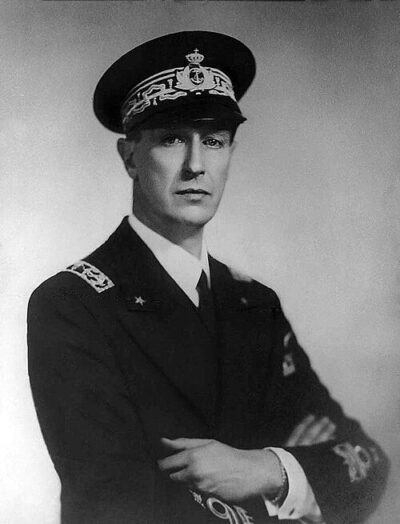
Prince Aimone, 4th Duke of Aosta
Prince Aimone, 4th Duke of Aosta was an Italian prince and navy officer. Born March 9, 1900, in Turin. Died January 29, 1948, in Buenos Aires. Positions held include monarch (1941–1943). Awards include Patron’s Medal, Knight of the Order of the Most Holy Annunciation and Civil Order of Savoy.
Facts
36 facts · 2 confirmed by two sources · 5 cited · 29 from one source
Where this comes from
Papalocal keeps its own record. It started from these sources; what each one said is kept here as it was copied, so a change on their side never changes this page by itself. Tap one to read its version.
What Wikidata says · copied November 16, 2026 · revision 2568219227
- Described as
- Italian prince and navy officer (1900-1948)
- Other names
- Aimoe di Savoia-Aoste, Principe di Savoia, Prince Aimone, Duke of Aosta
- Born
- March 9, 1900 · 3 references
- Died
- January 29, 1948 · 3 references
- Born in
- Turin
- Died in
- Buenos Aires
- Buried in
- Basilica of Superga
- Citizen of
- Italy (1946–); Kingdom of Italy (–1946)
- Occupation
- explorer; politician · 1 reference; mountaineer · 1 reference
- Positions held
- monarch (1941–1943)
- Sport
- mountaineering
- Awards
- Patron’s Medal (1932) · 1 reference; Knight of the Order of the Most Holy Annunciation; Civil Order of Savoy; Sovereign Military Order of Malta; Grand Cross of the Order of Charles III (1928) · 1 reference; Knight Grand Cross of the Order of Saints Maurice and Lazarus; Knight grand cross of the order of the crown of Italy; Knight Grand Cross of the Military Order of Savoy; Silver Medal of Military Valour; Bronze Medal of Military Valour; War Cross for Military Valour; War Merit Cross (Italy); Commemorative Medal for the Italo-Austrian War 1915-1918; Commemorative Medal of the Unity of Italy; Medal of merit for the volunteers of the Italo-Austrian 1915-1918
- Spouse
- Princess Irene, Duchess of Aosta (1939–1948) · 1 reference
- Children
- Prince Amedeo, 5th Duke of Aosta · 1 reference
- Father
- Prince Emanuele Filiberto, 2nd Duke of Aosta · 1 reference
- Mother
- Princess Hélène of Orléans · 1 reference
- Siblings
- Prince Amedeo, 3rd Duke of Aosta
- Religion
- Catholic Church; Catholicism · 1 reference
- Military branch
- Royal Italian Navy · 1 reference
- Military rank
- admiral
- Wikipedias with a page
- 36
Wikidata item Q169902 (wikidata.org/wiki/Q169902), public domain (CC0). Copied November 16, 2026.
What Wikipedia says · copied November 16, 2026 · revision 1358821412
Prince Aimone, 4th Duke of Aosta (Aimone Roberto Margherita Maria Giuseppe Torino; 9 March 1900 – 29 January 1948), was a prince of Italy's reigning House of Savoy and an officer of the Royal Italian Navy. The second son of Prince Emanuele Filiberto, Duke of Aosta, he was granted the title Duke of Spoleto on 22 September 1904. He inherited the title Duke of Aosta on 3 March 1942 following the death of his brother Prince Amedeo in a British prisoner of war camp in Nairobi.
From 18 May 1941 to 31 July 1943, Aimone was designated king of the Independent State of Croatia (Croatian: Nezavisna Država Hrvatska, NDH), even though he never ruled there. He formally accepted the position and took the name Tomislav II, after the first Croatian king. Later, however, he refused to assume the kingship in protest of the Italian annexation of the Dalmatia region, and is therefore referred to in some sources as king designate. Regardless, many sources refer to him as King Tomislav II and the nominal head of the NDH during its first two years (1941–1943).
After the dismissal of Mussolini on 25 July 1943, Aimone abdicated on 31 July as king on the orders of Victor Emmanuel III.
- Born, in its opening lines
- March 9, 1900
- Died, in its opening lines
- January 29, 1948
From the Wikipedia article “Prince Aimone, Duke of Aosta” (en.wikipedia.org/wiki/Prince_Aimone,_Duke_of_Aosta), by its contributors, under CC BY-SA 4.0 (creativecommons.org/licenses/by-sa/4.0/). Copied November 16, 2026; not changed.
Confirmed Two sources agree. Cited One source, and it names where it got it. One source One source, without a reference of its own. Sources disagree The sources disagree. We show the best-supported value and keep theirs below.
