
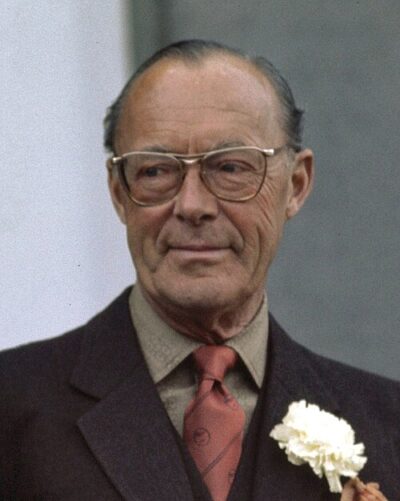
Prince Bernhard of Lippe-Biesterfeld
Prince Bernhard of Lippe-Biesterfeld was a husband of Queen Juliana of the Netherlands (1911-2004); prince consort of the Netherlands. Born June 29, 1911, in Jena. Died December 1, 2004, in University Medical Center Utrecht. Positions held include president (1961–1976), chairperson (1954–1976) and Inspector-General of the Armed Forces (1945–1976). Educated at Arndt-Gymnasium Dahlem and University of Lausanne. Awards include Grand Cross of the Legion of Honour, Bronze Star Medal and Knight Grand Cross of the Order of the Bath.
Facts
59 facts · 2 confirmed by two sources · 13 cited · 44 from one source
Where this comes from
Papalocal keeps its own record. It started from these sources; what each one said is kept here as it was copied, so a change on their side never changes this page by itself. Tap one to read its version.
What Wikidata says · copied November 16, 2026 · revision 2569159238
- Described as
- husband of Queen Juliana of the Netherlands (1911-2004); prince consort of the Netherlands (1911-2004)
- Other names
- Bernhard zur Lippe-Biesterfeld, B. van Lippe Biesterfeld, Z.K.H. Prins Bernhard, Prince Bernhard, Prince Consort of the Netherlands, Bernhard, Prince Consort of the Netherlands, Bernhard of Lippe-Biesterfeld, Prince Bernhard of the Netherlands
- Born
- June 29, 1911 · 6 references
- Died
- December 1, 2004 · 12 references
- Born in
- Jena · 2 references
- Died in
- University Medical Center Utrecht
- Buried in
- Nieuwe Kerk Delft (2004)
- Cause of death
- lung cancer · 1 reference
- Citizen of
- German Empire (–1918); Weimar Republic (1918–1936); Kingdom of the Netherlands (1936–)
- Occupation
- activist; conservationist; lobbyist; aircraft pilot · 1 reference; photographer · 1 reference; military officer · 1 reference; military commander · 1 reference; painter · 1 reference
- Positions held
- president (1961–1976); chairperson (1954–1976); Inspector-General of the Armed Forces (1945–1976); Consort of the Netherlands (1948–1980)
- Political party
- Nazi Party (1933–1936) · 1 reference
- Worked for
- IG Farben (1935–1936)
- Education
- Arndt-Gymnasium Dahlem (1926–1929); University of Lausanne; Frederick William University Berlin
- Awards
- Grand Cross of the Legion of Honour; Bronze Star Medal; Knight Grand Cross of the Order of the Bath; Knight Grand Cross of the Order of the British Empire; Knight Grand Cross of the Royal Victorian Order; Nansen Refugee Award (1967); Honorary Order of the Yellow Star; Knight Grand Cross of the Order of Merit of the Italian Republic; Knight Grand Cross in the Order of the Netherlands Lion; Grand Cross of the Order of the Southern Cross; World War II Victory Medal; Knight Grand Officer of the Order of William (1946); Zilveren Anjer (1990); Grand Cross Special Class of the Order of Merit of the Federal Republic of Germany (1969) · 1 reference; Knight Grand Cross with Collar of the Order of Merit of the Italian Republic
- Field
- military affairs · 1 reference; diplomacy · 1 reference; politics · 1 reference
- Spouse
- Juliana of the Netherlands (1937–2004) · 1 reference
- Children
- Beatrix of the Netherlands; Princess Irene of the Netherlands · 2 references; Princess Margriet of the Netherlands · 1 reference; Princess Christina of the Netherlands · 1 reference; Alicia de Bielefeld · 1 reference; Alexia Grinda · 1 reference
- Father
- Prince Bernhard of Lippe
- Mother
- Armgard of Sierstorpff-Cramm
- Siblings
- Prince Aschwin of Lippe-Biesterfeld
- Religion
- Church of Lippe (–1937); Dutch Reformed Church (1937–)
- Military branch
- Royal Air Force; Schutzstaffel
- Military rank
- Inspector-General of the Armed Forces (1970–1976)
- Wikipedias with a page
- 44
Wikidata item Q57304 (wikidata.org/wiki/Q57304), public domain (CC0). Copied November 16, 2026.
What Wikipedia says · copied November 16, 2026 · revision 1383965263
Prince Bernhard of Lippe-Biesterfeld (later Prince Bernhard of the Netherlands; 29 June 1911 – 1 December 2004) was Prince of the Netherlands from 6 September 1948 to 30 April 1980 as the husband of Queen Juliana. They had four daughters together, including Queen Beatrix of the Netherlands.
Bernhard belonged to the German princely House of Lippe-Biesterfeld and was a nephew of the last sovereign prince of Lippe, Leopold IV. From birth he held the title Count of Biesterfeld; his uncle raised him to princely rank with the style of Serene Highness in 1916. He studied law and worked as an executive secretary at the Paris office of IG Farben. In 1937 he married Princess Juliana of the Netherlands, and was immediately given the title Prince of the Netherlands with the style of Royal Highness. Upon his wife's accession to the throne in 1948, he became prince consort.
Bernhard was an early member of the Nazi Party (NSDAP) as well as the brown shirts or Sturmabteilung (SA), and served as an officer in the Schutzstaffel (SS). He switched his political allegiance to the Allies after the invasion of the Netherlands. Until his death, Bernhard denied being a NSDAP member or holding a NSDAP membership card. He was respected for his performance as a combat pilot and his activities as a liaison officer and personal aide to his mother-in-law, Queen Wilhelmina, during the conflict, and for his work during post-war reconstruction. During the war, he was part of the London-based Allied war planning council, and saw limited active combat service as honorary wing commander in Royal Air Force (RAF), flying both fighter and bomber planes. He was also an honorary general officer in the Dutch army and was an observer in negotiating the terms of surrender of Nazi forces in the Netherlands. Officially for proven bravery, leadership and loyalty during his wartime efforts, he was appointed a Commander of the Military William Order, the Netherlands' oldest and highest honour. After the war he was made honorary air marshal of the RAF by Queen Elizabeth II. In 1969, Bernhard was awarded the Grand Cross (Special Class) of the Order of Merit of the Federal Republic of Germany. He became entangled in the so-called Lockheed bribery scandal in 1976 for having secretly promoted the sale of their airplanes and of Northrop's for money, and was degraded from all his military functions with a lifelong ban on wearing any military uniform.
Bernhard helped found the World Wildlife Fund (WWF, later renamed World Wide Fund for Nature), becoming its first president in 1961. In 1970, along with Prince Philip, Duke of Edinburgh, and other associates, he established the WWF's financial endowment "The 1001: A Nature Trust". In 1954, he was a co-founder of the international Bilderberg Group, which has met annually since then to discuss corporate globalisation and other issues concerning Europe and North America. He was forced to step down from both groups after being involved in the Lockheed bribery scandal.
- Born, in its opening lines
- June 29, 1911
- Died, in its opening lines
- December 1, 2004
From the Wikipedia article “Prince Bernhard of Lippe-Biesterfeld” (en.wikipedia.org/wiki/Prince_Bernhard_of_Lippe-Biesterfeld), by its contributors, under CC BY-SA 4.0 (creativecommons.org/licenses/by-sa/4.0/). Copied November 16, 2026; not changed.
Confirmed Two sources agree. Cited One source, and it names where it got it. One source One source, without a reference of its own. Sources disagree The sources disagree. We show the best-supported value and keep theirs below.
