
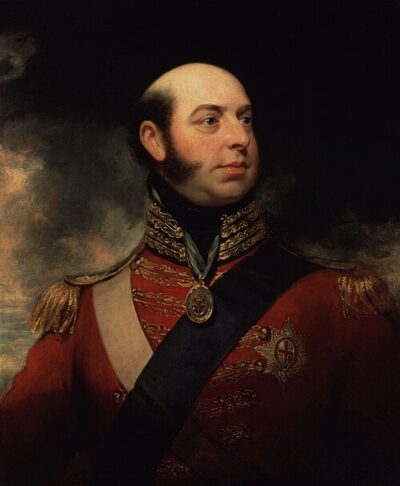
Prince Edward, Duke of Kent and Strathearn
Prince Edward, Duke of Kent and Strathearn was a British prince (1767-1820); fourth son of George III. Born November 2, 1767, in Buckingham Palace. Died January 23, 1820, in Sidmouth. Positions held include Member of the Privy Council of the United Kingdom (1799–1820) and Governor of Gibraltar (1802–1820). Awards include Knight Grand Cross of the Order of the Bath, Knight of the Garter and Order of St Patrick.
Facts
36 facts · 2 confirmed by two sources · 10 cited · 24 from one source
Where this comes from
Papalocal keeps its own record. It started from these sources; what each one said is kept here as it was copied, so a change on their side never changes this page by itself. Tap one to read its version.
What Wikidata says · copied November 16, 2026 · revision 2561188301
- Described as
- British prince (1767-1820); fourth son of George III
- Other names
- Prince Edward Augustus, Duke of Kent and Strathearn, Edward Augustus, Edward, Duke of Kent, Edward Augustus Hanover, Duke of Kent
- Born
- November 2, 1767 · 5 references
- Died
- January 23, 1820 · 5 references
- Born in
- Buckingham Palace
- Died in
- Sidmouth
- Buried in
- St George's Chapel, Windsor
- Cause of death
- pneumonia
- Citizen of
- United Kingdom of Great Britain and Ireland; Kingdom of Great Britain
- Occupation
- military personnel; aristocrat
- Positions held
- Member of the Privy Council of the United Kingdom (1799–1820); Governor of Gibraltar (1802–1820)
- Awards
- Knight Grand Cross of the Order of the Bath (1815); Knight of the Garter (1786); Order of St Patrick (1783); Knight Grand Cross of the Royal Order of the Welfs (1815)
- Spouse
- Princess Victoria of Saxe-Coburg-Saalfeld (1818–1820) · 3 references
- Children
- Victoria · 2 references; Edward Schencker Scheener · 1 reference; Adelaide Dubus · 1 reference
- Father
- George III of Great Britain · 2 references
- Mother
- Charlotte of Mecklenburg-Strelitz · 2 references
- Siblings
- George IV of the United Kingdom · 1 reference; Prince Frederick, Duke of York and Albany · 1 reference; William IV · 1 reference; Charlotte, Princess Royal; Princess Augusta Sophia of the United Kingdom; Princess Elizabeth of the United Kingdom; Ernest Augustus, King of Hanover; Prince Augustus Frederick, Duke of Sussex; Prince Adolphus, Duke of Cambridge; Princess Mary of the United Kingdom · 1 reference
- Religion
- Church of England
- Military branch
- British Army
- Military rank
- field marshal
- Lived in
- Kensington Palace
- Wikipedias with a page
- 42
Wikidata item Q157009 (wikidata.org/wiki/Q157009), public domain (CC0). Copied November 16, 2026.
What Wikipedia says · copied November 16, 2026 · revision 1379810808
Prince Edward, Duke of Kent and Strathearn (Edward Augustus; 2 November 1767 – 23 January 1820), was the fourth son and fifth child of King George III and Queen Charlotte. His only legitimate child, Victoria, became Queen of the United Kingdom 17 years after his death.
Edward lived in Lower Canada and Nova Scotia from 1791 to 1800, where he served as commander-in-chief of British forces in the Maritime Provinces of North America. He was the first British prince to visit the United States following British recognition of its independence in 1783, travelling on foot to Boston from Lower Canada in 1794.
He was created Duke of Kent and Strathearn and Earl of Dublin in 1799, and shortly thereafter appointed a General. In 1802 he became Governor of Gibraltar, a post he nominally held until his death. He was promoted to Field-Marshal of the Forces in 1805.
- Born, in its opening lines
- November 2, 1767
- Died, in its opening lines
- January 23, 1820
From the Wikipedia article “Prince Edward, Duke of Kent and Strathearn” (en.wikipedia.org/wiki/Prince_Edward,_Duke_of_Kent_and_Strathearn), by its contributors, under CC BY-SA 4.0 (creativecommons.org/licenses/by-sa/4.0/). Copied November 16, 2026; not changed.
Confirmed Two sources agree. Cited One source, and it names where it got it. One source One source, without a reference of its own. Sources disagree The sources disagree. We show the best-supported value and keep theirs below.
