
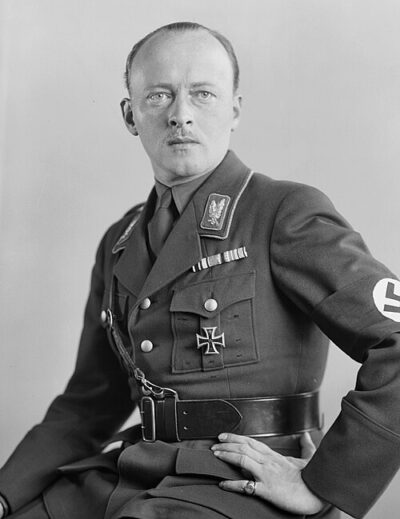
Prince Philipp, Landgrave of Hesse
Prince Philipp, Landgrave of Hesse was a German prince, head of the Electoral House of Hesse and member of the Nazi Party. Born November 6, 1896, in Rumpenheim Castle. Died October 25, 1980, in Rome. Positions held include member of the Reichstag of Nazi Germany. Awards include Golden Party Badge, Sachsen-Meiningen Cross for Merit in War and Iron Cross (1914), 1st class.
Facts
38 facts · 2 confirmed by two sources · 6 cited · 30 from one source
Where this comes from
Papalocal keeps its own record. It started from these sources; what each one said is kept here as it was copied, so a change on their side never changes this page by itself. Tap one to read its version.
What Wikidata says · copied November 17, 2026 · revision 2569857181
- Described as
- German prince, head of the Electoral House of Hesse and member of the Nazi Party (1896-1980)
- Other names
- Philipp Prinz von Hessen, Philipp von Hessen, Philipp de Hesse-Kassel
- Born
- November 6, 1896 · 2 references
- Died
- October 25, 1980 · 2 references
- Born in
- Rumpenheim Castle · 1 reference
- Died in
- Rome · 1 reference
- Buried in
- Kronberg im Taunus · 1 reference
- Citizen of
- Germany
- Occupation
- politician
- Positions held
- member of the Reichstag of Nazi Germany
- Political party
- Nazi Party (1930–1943) · 2 references
- Member of
- Sturmabteilung
- Awards
- Golden Party Badge; Sachsen-Meiningen Cross for Merit in War; Iron Cross (1914), 1st class (1914); Iron Cross (1914), 2nd class (1914); General Honor Decoration; War Merit Cross (Brunswick); Honour Chevron for the Old Guard; War Merit Cross (Italy); Honour Cross of the World War 1914/1918; Nazi Party Long Service Award in Silver; Nazi Party Long Service Award in Bronze; Anschluss Medal; Sudetenland Medal; Knight of the Order of the Most Holy Annunciation (1928); Knight Grand Cross of the Order of Saints Maurice and Lazarus (1928)
- Spouse
- Princess Mafalda of Savoy (1925–) · 1 reference
- Children
- Prince Moritz, Landgrave of Hesse · 1 reference; Prince Heinrich of Hesse and by Rhine · 1 reference; Prince Otto of Hesse and by Rhine · 1 reference; Elisabeth Margarethe Prinzessin von Hessen-Kassel · 1 reference
- Father
- Prince Frederick Charles of Hesse
- Mother
- Princess Margaret of Prussia
- Siblings
- Prince Christoph of Hesse-Kassel; Prince Wolfgang of Hesse; Prince Friedrich Wilhelm of Hesse-Kassel; Prince Maximilian of Hesse-Kassel; Prince Richard of Hesse
- Religion
- Lutheranism
- Wikipedias with a page
- 25
Wikidata item Q60741 (wikidata.org/wiki/Q60741), public domain (CC0). Copied November 17, 2026.
What Wikipedia says · copied November 17, 2026 · revision 1376928132
Philipp, Prince and Landgrave of Hesse (6 November 1896 – 25 October 1980) was head of the Electoral House of Hesse from 1940 to 1980.
Philipp joined the Nazi Party in 1930, and, when they gained power with the appointment of Adolf Hitler as Chancellor in 1933, he became Oberpräsident of the Prussian Province of Hesse-Nassau. However, he later began to fall out of favour with Hitler in the spring of 1943 after delivering an honest assessment of the military situation in Italy. He was arrested in September 1943 on the day Italy surrendered to the western Allies, dismissed in the following year, and was sent to the Flossenbürg concentration camp, then Dachau, where he remained until being transported to Tyrol by the SS, where he was liberated by Wehrmacht forces on 30 April 1945 and then arrested by U.S. forces on 4 May 1945, being interned until 1947.
Philipp was a grandson of Frederick III, German Emperor, and a great-grandson of Queen Victoria, as well as the son-in-law of Victor Emmanuel III of Italy.
- Born, in its opening lines
- November 6, 1896
- Died, in its opening lines
- October 25, 1980
From the Wikipedia article “Philipp, Landgrave of Hesse” (en.wikipedia.org/wiki/Philipp,_Landgrave_of_Hesse), by its contributors, under CC BY-SA 4.0 (creativecommons.org/licenses/by-sa/4.0/). Copied November 17, 2026; not changed.
Confirmed Two sources agree. Cited One source, and it names where it got it. One source One source, without a reference of its own. Sources disagree The sources disagree. We show the best-supported value and keep theirs below.
