
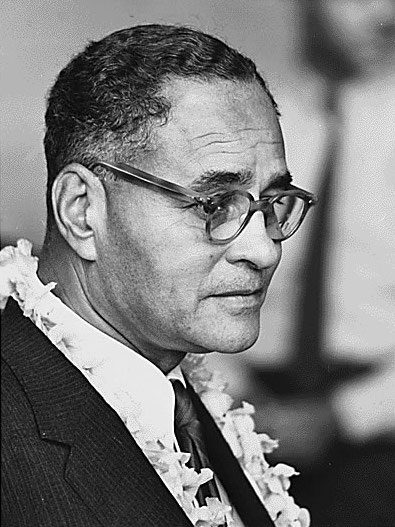
Ralph Bunche
Ralph Bunche was a diplomat, educator, civil rights activist and the first African American Nobel Peace Prize winner. Born August 7, 1904, in Detroit. Died December 9, 1971, in New York City. Positions held include chairperson (1953–1954). Educated at Harvard University (2 times) and University of California, Los Angeles. Awards include Nobel Peace Prize, Spingarn Medal and Presidential Medal of Freedom.
Facts
25 facts · 2 confirmed by two sources · 15 cited · 8 from one source
Where this comes from
Papalocal keeps its own record. It started from these sources; what each one said is kept here as it was copied, so a change on their side never changes this page by itself. Tap one to read its version.
What Wikidata says · copied November 13, 2026 · revision 2567630600
- Described as
- diplomat, educator, civil rights activist and the first African American Nobel Peace Prize winner (1904–1971)
- Other names
- Ralph J. Bunche, Ralph Johnson Bunche
- Born
- August 7, 1904 · 11 references
- Died
- December 9, 1971 · 3 references
- Born in
- Detroit · 3 references
- Died in
- New York City · 2 references
- Buried in
- Woodlawn Cemetery · 1 reference
- Citizen of
- United States
- Occupation
- diplomat · 1 reference; political scientist · 1 reference
- Positions held
- chairperson (1953–1954) · 1 reference
- Worked for
- United Nations; Office of Strategic Services · 1 reference; Howard University; Harvard University · 1 reference
- Education
- Harvard University (2 times) (1928–1934) · 1 reference; University of California, Los Angeles; Jefferson High School (Los Angeles) · 1 reference
- Member of
- American Academy of Arts and Sciences; Phi Beta Kappa Society; New York City Board of Education (1958–1964) · 1 reference; Black Cabinet · 1 reference; American Philosophical Society (1950–)
- Awards
- Nobel Peace Prize (1950) · 2 references; Spingarn Medal (1949) · 1 reference; Presidential Medal of Freedom (1963) · 1 reference
- Lived in
- Ralph Bunche House (1941–1947) · 1 reference
- Wikipedias with a page
- 67
Wikidata item Q213500 (wikidata.org/wiki/Q213500), public domain (CC0). Copied November 13, 2026.
What Wikipedia says · copied November 13, 2026 · revision 1384407007
Ralph Johnson Bunche ( BUNCH; August 7, 1904 – December 9, 1971) was an American political scientist and diplomat who received the 1950 Nobel Peace Prize for his late 1940s mediation in the Arab–Israeli conflict. He was the first Black Nobel laureate. He was also involved in the formation and early administration of the United Nations, serving as the under‑secretary‑general and briefly the acting secretary-general in 1953, and played a major role in both the decolonization process and numerous United Nations peacekeeping operations.
Bunche served on the US delegation to both the Dumbarton Oaks Conference in 1944 and United Nations Conference on International Organization in 1945 that drafted the UN charter. He then served on the American delegation to the first session of the United Nations General Assembly in 1946 and joined the UN as head of the Trusteeship Department, beginning a long series of troubleshooting roles and responsibilities related to decolonization. In 1948, Bunche became an acting mediator for the Middle East, negotiating an armistice between Egypt and Israel. For this success he was awarded the Nobel Peace Prize in 1950.
Bunche continued to serve at the UN, working on crises in the Sinai (1956), the Congo (1960), Yemen (1963), Cyprus (1964) and Bahrain (1970), reporting directly to the UN Secretary-General. He chaired study groups dealing with water resources in the Middle East. In 1957, he was promoted to under-secretary-general for special political affairs, having prime responsibility for peacekeeping roles. In 1965, Bunche supervised the ceasefire following the war between India and Pakistan. He retired from the UN in June 1971, dying six months later.
In 1963, he was awarded the Presidential Medal of Freedom by President John F. Kennedy. At the UN, Bunche gained such fame that Ebony magazine proclaimed him perhaps the most influential African American of the first half of the 20th century and "[f]or nearly a decade, he was the most celebrated African American of his time both [in the US] and abroad."
- Born, in its opening lines
- August 7, 1904
- Died, in its opening lines
- December 9, 1971
From the Wikipedia article “Ralph Bunche” (en.wikipedia.org/wiki/Ralph_Bunche), by its contributors, under CC BY-SA 4.0 (creativecommons.org/licenses/by-sa/4.0/). Copied November 13, 2026; not changed.
Confirmed Two sources agree. Cited One source, and it names where it got it. One source One source, without a reference of its own. Sources disagree The sources disagree. We show the best-supported value and keep theirs below.
