
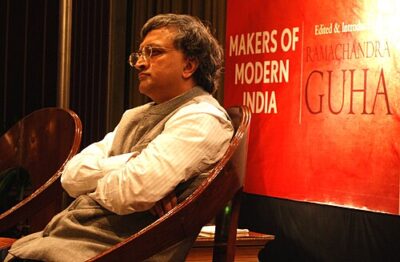
Ramachandra Guha
Ramachandra Guha is a historian and writer from India. Born April 29, 1958, in Dehradun. Known for Gandhi Before India, This Fissured Land and India after Gandhi. Educated at The Doon School and University of Delhi. Awards include Sahitya Akademi Award, Padma Bhushan and Fukuoka Asian Culture Prize.
Facts
28 facts · 1 confirmed by two sources · 8 cited · 19 from one source
Where this comes from
Papalocal keeps its own record. It started from these sources; what each one said is kept here as it was copied, so a change on their side never changes this page by itself. Tap one to read its version.
What Wikidata says · copied November 18, 2026 · revision 2567325648
- Described as
- historian and writer from India
- Other names
- Ramchandra Guha
- Born
- April 29, 1958 · 1 reference
- Born in
- Dehradun · 1 reference
- Citizen of
- India
- Occupation
- historian · 1 reference; teacher; journalist · 2 references; writer; environmentalist; university teacher · 1 reference; cultural studies scholar · 1 reference; author · 1 reference
- Worked for
- London School of Economics and Political Science; Indian Institute of Science, Bengaluru
- Education
- The Doon School; University of Delhi; Indian Institute of Management Calcutta; St. Stephen's College; Delhi School of Economics
- Known for
- Gandhi Before India; This Fissured Land; India after Gandhi
- Awards
- Sahitya Akademi Award (2011) · 1 reference; Padma Bhushan; Fukuoka Asian Culture Prize (2015); honorary doctor of Yale University (2014) · 1 reference
- Spouse
- Sujata Keshavan
- Lived in
- Bengaluru
- Website
- http://ramachandraguha.in/
- Wikipedias with a page
- 23
Wikidata item Q3521662 (wikidata.org/wiki/Q3521662), public domain (CC0). Copied November 18, 2026.
What Wikipedia says · copied November 18, 2026 · revision 1376448189
Ramachandra "Ram" Guha (born 29 April 1958) is an Indian historian, environmentalist, writer and public intellectual whose research interests include social, political, contemporary, environmental and cricket history. He is an important authority on the history of modern India. The American Historical Association (AHA) has conferred its Honorary Foreign Member prize for the year 2019 on Ramchandra Guha. He is the third Indian historian to be recognised by the association.
Covering a wide range of subjects, Guha has produced three major books of modern India's socio-political history. Among them, Gandhi Before India (2013) and Gandhi: The Years That Changed the World (2018), are the two volumes of biography of Mahatma Gandhi, an icon of the Indian independence movement. The other being India After Gandhi (2007), an account of the history of India from 1947 to 2007, which received commercial and critical success.
He was appointed to BCCI's panel of administrators by the Supreme Court of India in January 2017 but stepped down from his position citing personal reasons five months later. A regular contributor to various academic journals, Guha has also written for The Caravan and Outlook magazines. His book India After Gandhi is read by aspirants of the Indian civil services examination. Guha was listed among the 100 most powerful Indians in 2022 by The Indian Express.
- Born, in its opening lines
- April 29, 1958
From the Wikipedia article “Ramachandra Guha” (en.wikipedia.org/wiki/Ramachandra_Guha), by its contributors, under CC BY-SA 4.0 (creativecommons.org/licenses/by-sa/4.0/). Copied November 18, 2026; not changed.
Confirmed Two sources agree. Cited One source, and it names where it got it. One source One source, without a reference of its own. Sources disagree The sources disagree. We show the best-supported value and keep theirs below.
