
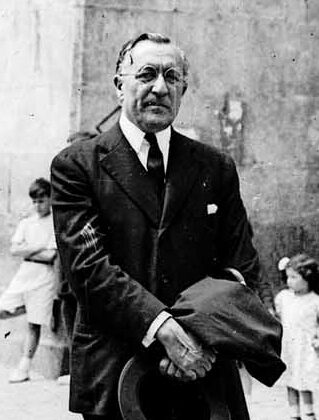
Ramiro de Maeztu
Ramiro de Maeztu was a Spanish political theorist, journalist, and literary critic. Born May 4, 1874, in Vitoria-Gasteiz. Died October 29, 1936, in Aravaca. Positions held include ambassador of Spain to Argentina (1927–1930), Member of the Cortes republicanas (1933–1936) and Member of the Consultative National Assembly (1927–1928). Known for Hacia otra España.
Facts
34 facts · 1 confirmed by two sources · 20 cited · 12 from one source · 1 where the sources disagree
What’s different
- Born: we show May 4, 1874 (Sources disagree). Wikipedia says May 4, 1875
Where this comes from
Papalocal keeps its own record. It started from these sources; what each one said is kept here as it was copied, so a change on their side never changes this page by itself. Tap one to read its version.
What Wikidata says · copied November 17, 2026 · revision 2567377961
- Described as
- Spanish political theorist, journalist, and literary critic (1874–1936)
- Other names
- Ramiro de Maeztu y Whitney, Ramiro de Maeztu Whitney
- Born
- May 4, 1874 · 4 references
- Died
- October 29, 1936 · 2 references
- Born in
- Vitoria-Gasteiz · 4 references
- Died in
- Aravaca · 2 references
- Cause of death
- gunshot wound · 1 reference
- Name at birth
- Ramiro de Maeztu y Whitney
- Citizen of
- Spain · 2 references
- Occupation
- poet; writer · 2 references; diplomat · 1 reference; literary critic · 1 reference; journalist · 1 reference; politician · 2 references
- Positions held
- ambassador of Spain to Argentina (1927–1930) · 2 references; Member of the Cortes republicanas (1933–1936) · 1 reference; Member of the Consultative National Assembly (1927–1928) · 1 reference; Member of the Royal Spanish Academy (1935–1936) · 1 reference; Academic of the Royal Academy of Moral and Political Sciences (1932–1936) · 1 reference
- Political party
- Renovación Española; Spanish Patriotic Union (1927–); Unión Monárquica Nacional
- Member of
- Royal Spanish Academy · 1 reference; Royal Academy of Moral and Political Sciences · 2 references; Acción Española · 1 reference; Sociedad de Amigos de Portugal (1922–) · 1 reference
- Known for
- Hacia otra España · 1 reference
- Children
- Juan Manuel de Maeztu y Hill · 1 reference
- Father
- Manuel de Maeztu Rodríguez
- Mother
- Juana Whitney
- Siblings
- Gustavo de Maeztu · 1 reference; Maria de Maeztu Whitney · 1 reference; Ángela de Maeztu; Miguel de Maeztu
- Religion
- Catholic Church
- Wikipedias with a page
- 25
Wikidata item Q1340223 (wikidata.org/wiki/Q1340223), public domain (CC0). Copied November 17, 2026.
What Wikipedia says · copied November 17, 2026 · revision 1357435141
Ramiro de Maeztu y Whitney, 1st Count of Maeztu (4 May 1875 – 29 October 1936) was a Spanish essayist, journalist and publicist.
Maeztu's early literary work ascribes him to the Generation of '98. Adept of Nietzschean and Social Darwinist ideas in his youth, he became close to Fabian socialism and later to distributism and social corporatism during his spell as correspondent in London from where he chronicled the Great War. During the years of the Primo de Rivera dictatorship he served as Ambassador to Argentina. A staunch militarist, he became at the end of his ideological path one of the most prominent far-right theorists against the Spanish Republic, leading the reactionary voices calling for a military coup. A member of the cultural group Acción Española, he spread the concept of "Hispanidad" (Spanishness). Imprisoned by Republican authorities after the outbreak of the Spanish Civil War, he was killed by leftist militiamen during a saca in the midst of the conflict.
- Born, in its opening lines
- May 4, 1875
- Died, in its opening lines
- October 29, 1936
From the Wikipedia article “Ramiro de Maeztu” (en.wikipedia.org/wiki/Ramiro_de_Maeztu), by its contributors, under CC BY-SA 4.0 (creativecommons.org/licenses/by-sa/4.0/). Copied November 17, 2026; not changed.
Confirmed Two sources agree. Cited One source, and it names where it got it. One source One source, without a reference of its own. Sources disagree The sources disagree. We show the best-supported value and keep theirs below.
