
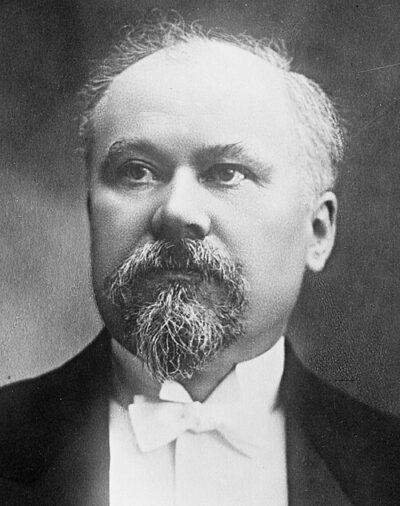
Raymond Poincaré
Raymond Poincaré was a French statesman and lawyer, President of France. Born August 20, 1860, in Bar-le-Duc. Died October 15, 1934, in Paris. Positions held include President of the French Republic (1913–1920), Deputy of the French Third Republic (1887–1903) and member of the general council. Educated at Paris Law Faculty. Awards include Knight of the Order of the Golden Fleece, Order of St. Andrew and Grand Master of the Legion of Honour.
Facts
54 facts · 2 confirmed by two sources · 18 cited · 34 from one source
Where this comes from
Papalocal keeps its own record. It started from these sources; what each one said is kept here as it was copied, so a change on their side never changes this page by itself. Tap one to read its version.
What Wikidata says · copied November 16, 2026 · revision 2565545264
- Described as
- French statesman and lawyer, President of France (1860-1934)
- Other names
- Raymond Nicolas Landry Poincaré, Raymond Poincare
- Born
- August 20, 1860 · 15 references
- Died
- October 15, 1934 · 14 references
- Born in
- Bar-le-Duc · 2 references
- Died in
- Paris · 3 references
- Buried in
- Nubecourt City Cemetery · 2 references
- Cause of death
- pulmonary embolism · 1 reference
- Citizen of
- France · 1 reference
- Occupation
- politician · 2 references; lawyer; journalist; jurist · 1 reference; minister · 1 reference
- Positions held
- President of the French Republic (1913–1920); Deputy of the French Third Republic (1887–1903) · 1 reference; member of the general council; French co-prince of Andorra (1913–1920); President of the Council (3 times) (1912–1929); Minister of the Economy, Finances and Industry (1926–1928); senator of the French Third Republic · 1 reference; Prime Minister of France (1926–1929); Senator of the French Fifth Republic (1920–1934); French Education Minister (1895); bâtonnier (1931); Member of the Académie française (1909–1934) · 1 reference; president · 1 reference; senator · 1 reference
- Political party
- Democratic Republican Alliance
- Worked for
- University of Glasgow
- Education
- Paris Law Faculty
- Member of
- Académie Française (1909–1934) · 1 reference; American Academy of Arts and Sciences; Romanian Academy
- Awards
- Knight of the Order of the Golden Fleece (1913) · 1 reference; Order of St. Andrew; Grand Master of the Legion of Honour; Order of the Star of Anjouan; Grand Cross of the Order of Nichan el Anouar; Order of the Most Holy Annunciation; Knight Grand Cross of the Order of Saints Maurice and Lazarus; Knight grand cross of the order of the crown of Italy; Order of the Royal House of Chakri; Grand cross of the Order of the Dragon of Annam; Grand Cross of the Royal Order of Cambodia; Order of the White Eagle; Cross of Valour; Royal Order of the Seraphim (1913) · 1 reference; Knight of the Order of the Elephant (1914) · 1 reference
- Field
- politics · 1 reference; law · 1 reference
- Spouse
- Henriette Poincaré · 1 reference
- Father
- Antoni Poincaré
- Mother
- Nanine Marie Ficatier
- Siblings
- Lucien Poincaré
- Religion
- Catholic Church
- Wikipedias with a page
- 79
Wikidata item Q191974 (wikidata.org/wiki/Q191974), public domain (CC0). Copied November 16, 2026.
What Wikipedia says · copied November 16, 2026 · revision 1382774078
Raymond Nicolas Landry Poincaré (French: [ʁɛmɔ̃ pwɛ̃kaʁe]; 20 August 1860 – 15 October 1934) was a French statesman who served as President of France from 1913 to 1920, and three times as Prime Minister of France. He was a conservative leader, primarily committed to political and social stability.
Trained in law, Poincaré was elected as a Deputy in 1887 and served in the cabinets of Dupuy and Ribot. In 1902, he co-founded the Democratic Republican Alliance, the most important centre-right party under the Third Republic, becoming prime minister in 1912 and serving as President of the Republic for 1913–1920. Attempting to exercise influence from a traditionally figurehead role, he visited Russia in 1912 and 1914 to repair relations with Russia which had been strained by the Bosnian Crisis of 1908 and the Agadir Crisis of 1911. He likewise played an important role during the July Crisis of 1914 which ultimately led to France's participation in World War I. From 1917 onward, he exercised less influence after his political rival Georges Clemenceau had become prime minister. At the Paris Peace Conference, he favoured Allied occupation of the Rhineland.
In 1922 Poincaré returned to power as prime minister. In 1923 he ordered the Occupation of the Ruhr to enforce payment of German reparations. By this time Poincaré was seen, especially in the English-speaking world, as an aggressive figure (Poincaré-la-Guerre) who had helped to cause the war in 1914 and who now favoured punitive anti-German policies. His government was defeated by the Cartel des Gauches at the elections of 1924. He served a third term as prime minister in 1926–1929.
Poincaré was an International Member of both the American Philosophical Society and the American Academy of Arts and Sciences. Nicknamed Le Lion ("the Lion"), Poincaré is honored as a victorious wartime leader in France.
- Born, in its opening lines
- August 20, 1860
- Died, in its opening lines
- October 15, 1934
From the Wikipedia article “Raymond Poincaré” (en.wikipedia.org/wiki/Raymond_Poincaré), by its contributors, under CC BY-SA 4.0 (creativecommons.org/licenses/by-sa/4.0/). Copied November 16, 2026; not changed.
Confirmed Two sources agree. Cited One source, and it names where it got it. One source One source, without a reference of its own. Sources disagree The sources disagree. We show the best-supported value and keep theirs below.
