
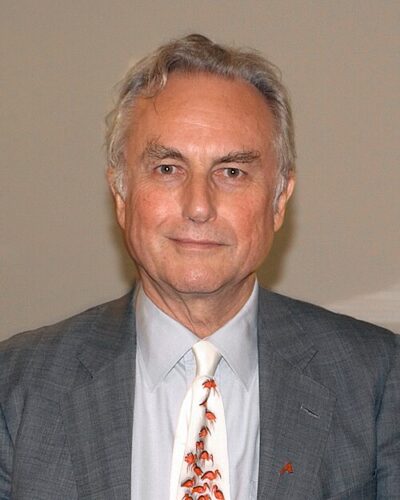
Richard Dawkins
Richard Dawkins is an English ethologist, evolutionary biologist and author. Born March 26, 1941, in Nairobi. Positions held include professor. Known for The Selfish Gene and The Greatest Show on Earth: The Evidence for Evolution. Educated at Balliol College and University of Oxford. Awards include Fellow of the Royal Society, Kistler Prize and Michael Faraday Prize.
Facts
55 facts · 1 confirmed by two sources · 28 cited · 26 from one source
Where this comes from
Papalocal keeps its own record. It started from these sources; what each one said is kept here as it was copied, so a change on their side never changes this page by itself. Tap one to read its version.
What Wikidata says · copied November 16, 2026 · revision 2567703119
- Described as
- English ethologist, evolutionary biologist and author (born 1941)
- Other names
- C. Dawkins, C. Richard Dawkins, Clinton Dawkins, CR Dawkins, Clinton Richard Dawkins, R. Dawkins
- Born
- March 26, 1941 · 9 references
- Born in
- Nairobi · 6 references
- Name at birth
- Clinton Richard Dawkins
- Citizen of
- United Kingdom · 2 references
- Occupation
- evolutionary biologist; ethologist; science writer · 1 reference; science communicator; essayist · 1 reference; theoretical biologist; epistemologist; sociobiologist
- Positions held
- professor
- Worked for
- University of Oxford (1970–2008) · 1 reference; University of California, Berkeley (1967–1969); Northeastern University London (2011–)
- Education
- Balliol College (–1962) · 1 reference; University of Oxford (–1966) · 1 reference; Oundle School (1954–1959); Chafyn Grove School
- Member of
- Royal Society of London (2001–) · 1 reference; Royal Society of Literature (1997–) · 1 reference
- Known for
- The Selfish Gene · 2 references; The Greatest Show on Earth: The Evidence for Evolution
- Awards
- Fellow of the Royal Society (2001) · 1 reference; Kistler Prize (2001) · 1 reference; Michael Faraday Prize (1990) · 1 reference; International Cosmos Prize (1997) · 1 reference; Lewis Thomas Prize (2006) · 1 reference; Shakespeare Prize (2005); Medal of Representation of the President of the Italian Republic (2001); Nierenberg Prize (2009) · 1 reference; Silver Medal of the Zoological Society of London (1988) · 1 reference; honorary doctorate of the Vrije Universiteit Brussel (2005) · 1 reference; honorary doctor of Durham University; Fellow of the Royal Society of Literature (1997) · 1 reference; honorary doctor of the University of Valencia (2009) · 1 reference; Fellow of the Committee for Skeptical Inquiry; Tinbergen Lecture (2000)
- Field
- ethology · 1 reference; evolutionary biology; zoology · 1 reference; biology · 1 reference; religiosity · 1 reference; Christian Church · 1 reference
- Spouse
- Marian Stamp Dawkins (1967–1984) · 2 references; Lalla Ward (1992–) · 2 references; Eve Barham (1984–) · 1 reference
- Father
- Clinton John Dawkins
- Mother
- Jean Mary Vyvyan Ladner · 1 reference
- Religion
- atheism
- Lived in
- Nairobi; Oxford
- Website
- https://www.richarddawkins.net; https://richarddawkins.com/ · 2 references
- Wikipedias with a page
- 136
Wikidata item Q44461 (wikidata.org/wiki/Q44461), public domain (CC0). Copied November 16, 2026.
What Wikipedia says · copied November 16, 2026 · revision 1385424922
Richard Dawkins (born 26 March 1941) is a British evolutionary biologist, zoologist, science communicator, atheist activist, and author. He is an emeritus fellow of New College, Oxford. In 1995 he was named the first Simonyi Professor for the Public Understanding of Science, a position he held until 2008, and is on the advisory board of the University of Austin. Dawkins has won several academic and writing awards, among them the 2005 Shakespeare Prize and the 2006 Lewis Thomas Prize.
Dubbed "Darwin's rottweiller", Dawkins has written a number of popular books explicating evolution. In The Selfish Gene (1976), he espoused the gene-centred view of evolution and coined the word meme. In The Blind Watchmaker (1986), he explains how the cumulative, non-random process of natural selection, coupled with random variation, creates complexity. In Climbing Mount Improbable (1996), he explores how complex adaptations gradually evolve through a series of intermediates. The book grew out of his Royal Institution Christmas Lectures, Growing Up in the Universe. With Yan Wong, he co-authored The Ancestor's Tale (2004), a "Chaucerian pilgrimage to the dawn of life". He considers The Extended Phenotype (1982) his major contribution to biology.
Along with Daniel Dennett, Sam Harris and Christopher Hitchens, he is known as one of the "Four Horsemen of New Atheism". He made the case for atheism in The God Delusion (2006), which The Sunday Times described as one of the 12 most influential books since the Second World War. That year he founded the Richard Dawkins Foundation for Reason and Science. He edited The Oxford Book of Modern Science Writing (2008) and wrote a children's book, The Magic of Reality (2011). He published two collections of essays, Unweaving the Rainbow (1998) and A Devil's Chaplain (2003) and two volumes of memoirs, An Appetite for Wonder (2013) and Brief Candle in the Dark (2015).
- Born, in its opening lines
- March 26, 1941
From the Wikipedia article “Richard Dawkins” (en.wikipedia.org/wiki/Richard_Dawkins), by its contributors, under CC BY-SA 4.0 (creativecommons.org/licenses/by-sa/4.0/). Copied November 16, 2026; not changed.
Confirmed Two sources agree. Cited One source, and it names where it got it. One source One source, without a reference of its own. Sources disagree The sources disagree. We show the best-supported value and keep theirs below.
