
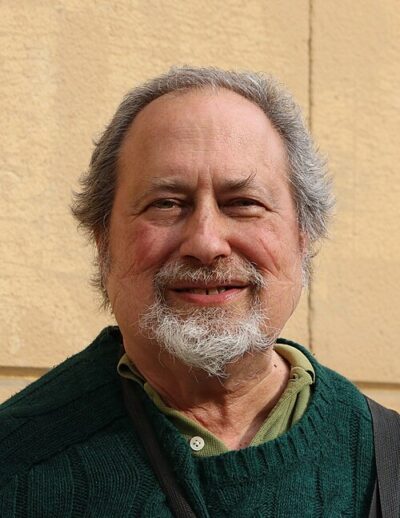
Richard Stallman
Richard Stallman is an American software freedom activist, short story writer and computer programmer, founder of the GNU project. Born March 16, 1953, in Manhattan. Positions held include Chief GNUisance (1984–), president (1985–2019) and Emacs maintainer. Known for GNU, GNU Emacs and Free Software Song. Educated at Harvard University and Massachusetts Institute of Technology. Awards include MacArthur Fellows Program, Grace Murray Hopper Award and EFF Award.
Facts
48 facts · 1 confirmed by two sources · 11 cited · 36 from one source
Where this comes from
Papalocal keeps its own record. It started from these sources; what each one said is kept here as it was copied, so a change on their side never changes this page by itself. Tap one to read its version.
What Wikidata says · copied November 13, 2026 · revision 2562969317
- Described as
- American software freedom activist, short story writer and computer programmer, founder of the GNU project
- Other names
- rms, Richard Matthew Stallman, Richard M. Stallman, R. Stallman, St. IGNUcius, Chief GNUisance, RMS
- Born
- March 16, 1953 · 3 references
- Born in
- Manhattan
- Name at birth
- Richard Matthew Stallman
- Citizen of
- United States
- Occupation
- programmer · 1 reference; blogger; engineer; inventor · 1 reference; activist; computer scientist · 2 references
- Positions held
- Chief GNUisance (1984–); president (1985–2019); Emacs maintainer
- Worked for
- Free Software Foundation; Massachusetts Institute of Technology (–2019)
- Education
- Harvard University; Massachusetts Institute of Technology; Harvard School of Engineering and Applied Sciences · 1 reference
- Member of
- Free Software Foundation; GNU Project; American Academy of Arts and Sciences; National Academy of Engineering
- Known for
- GNU; GNU Emacs; Free Software Song; GNU General Public License; GNU Compiler Collection; GNU Debugger; The Right to Read; Jinnetic Engineering; Made for You; GNU Manifesto
- Awards
- MacArthur Fellows Program (1990) · 1 reference; Grace Murray Hopper Award (1990) · 1 reference; EFF Award (1998) · 1 reference; Takeda Awards (2001) · 1 reference; Internet Hall of Fame (2013) · 1 reference; Yuri Rubinsky Memorial Award (1999); ACM Software System Award (2015) · 1 reference; doctor honoris causa from the Pierre and Marie Curie University (2016) · 1 reference; honorary doctorate of the Vrije Universiteit Brussel (2003) · 1 reference; honorary doctorate of the University of Glasgow (2001); honorary doctor of the National University of Córdoba; honorary doctor of Royal Institute of Technology (1996) · 1 reference
- Field
- free software
- Religion
- atheism
- Lived in
- Boston
- Website
- https://stallman.org/
- Wikipedias with a page
- 140
Wikidata item Q7439 (wikidata.org/wiki/Q7439), public domain (CC0). Copied November 13, 2026.
What Wikipedia says · copied November 13, 2026 · revision 1385414880
Richard Matthew Stallman ( STAWL-mən; born March 16, 1953), also known by his initials rms, is an American free software activist and programmer. He campaigns for software to be distributed in such a manner that its users have the freedom to use, study, distribute, and modify that software. Software which ensures these freedoms is termed free software. Stallman launched the GNU Project, founded the Free Software Foundation (FSF) in October 1985, developed the GNU C Compiler and GNU Emacs, and wrote all versions of the GNU General Public License.
Stallman launched the GNU Project in September 1983 to write a Unix-like computer operating system composed entirely of free software. With that he also launched the free software movement. He has been GNU Project's lead architect and organizer, and developed a number of pieces of widely used GNU software including among others, the GNU Compiler Collection, GNU Debugger, and GNU Emacs.
Stallman pioneered the concept of copyleft, which uses the principles of copyright law to preserve the right to use, modify, and distribute free software. He is the main author of free software licenses which describe those terms, most notably the GNU General Public License (GPL), the most widely used free software license.
In 1989, he co-founded the League for Programming Freedom. Since the mid-1990s, Stallman has spent most of his time advocating for free software, as well as campaigning against software patents, digital rights management (which he refers to as digital restrictions management), software license agreements, non-disclosure agreements, activation keys, software protection dongles, copy restriction, proprietary formats, and closed-source binary executables.
In September 2019, Stallman resigned as president of the FSF and left his visiting scientist role at MIT after making controversial comments about the Jeffrey Epstein sex trafficking scandal related to Marvin Minsky. He remained head of the GNU Project, and in 2021 returned to the FSF board of directors and others.
- Born, in its opening lines
- March 16, 1953
From the Wikipedia article “Richard Stallman” (en.wikipedia.org/wiki/Richard_Stallman), by its contributors, under CC BY-SA 4.0 (creativecommons.org/licenses/by-sa/4.0/). Copied November 13, 2026; not changed.
Confirmed Two sources agree. Cited One source, and it names where it got it. One source One source, without a reference of its own. Sources disagree The sources disagree. We show the best-supported value and keep theirs below.
