
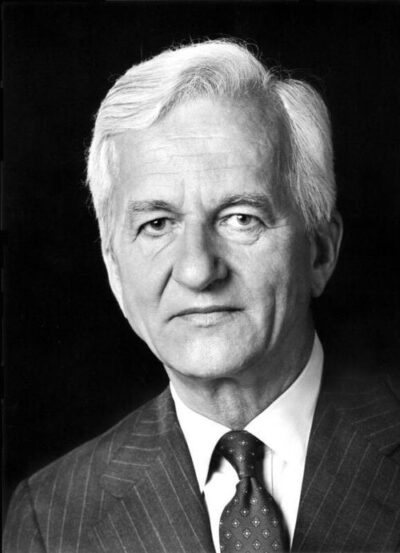
Richard von Weizsäcker
Richard von Weizsäcker was a President of Germany from 1984 to 1994. Born April 15, 1920, in New Palace. Died January 31, 2015, in Berlin. Positions held include president of Germany (1984–1994), Governing Mayor of Berlin (1981–1984) and member of the German Bundestag (1969–1980). Educated at University of Göttingen and Balliol College. Awards include Grand Cross Special Class of the Order of Merit of the Federal Republic of Germany, Schärfste Klinge and Grand Cross with Collar of the Order of the White Rose of Finland.
Facts
65 facts · 2 confirmed by two sources · 19 cited · 44 from one source
Where this comes from
Papalocal keeps its own record. It started from these sources; what each one said is kept here as it was copied, so a change on their side never changes this page by itself. Tap one to read its version.
What Wikidata says · copied November 16, 2026 · revision 2568843962
- Described as
- President of Germany from 1984 to 1994
- Other names
- Richard Karl Freiherr von Weizsäcker
- Born
- April 15, 1920 · 16 references
- Died
- January 31, 2015 · 16 references
- Born in
- New Palace · 1 reference
- Died in
- Berlin · 3 references
- Buried in
- Waldfriedhof Dahlem
- Name at birth
- Richard Karl Freiherr von Weizsäcker
- Citizen of
- Germany
- Occupation
- politician · 2 references; lawyer · 2 references; military personnel; jurist · 1 reference; mayor · 1 reference
- Positions held
- president of Germany (1984–1994) · 1 reference; Governing Mayor of Berlin (1981–1984); member of the German Bundestag (1969–1980) · 1 reference; member of the Abgeordnetenhaus of Berlin; Berlin member of the Bundestag (1980–1981) · 1 reference; President of the DEKT · 1 reference
- Political party
- Christian Democratic Union (1954–)
- Worked for
- Mannesmann (1950–1958); Boehringer Ingelheim (1962–1966)
- Education
- University of Göttingen (1945–1955); Balliol College; University of Oxford
- Member of
- Hitler Youth; Club of Rome; Infantry Regiment 9 Potsdam; National board of the CDU; A Soul for Europe; Humboldt-Viadrina School of Governance; Deutsche Nationalstiftung; Atlantik-Brücke; German Council on Foreign Relations; European Leadership Network
- Awards
- Grand Cross Special Class of the Order of Merit of the Federal Republic of Germany (1984); Schärfste Klinge; Grand Cross with Collar of the Order of the White Rose of Finland (1985) · 1 reference; Order of the Quetzal; Order of Antonio José de Irisarri; Knight Grand Cross in the Order of the Netherlands Lion; Goldene Kamera; German Sports Badge; Grand Cross with Collar of the Order of the Falcon (1988) · 1 reference; Royal Order of the Seraphim (1988); Order of the Elephant (1989); Heinrich Heine Prize (1991) · 1 reference; Royal Victorian Chain (1992); Nansen Refugee Award (1992); Heinz-Galinski-Award
- Spouse
- Marianne von Weizsäcker (1953–) · 1 reference
- Children
- Robert K. von Weizsäcker · 1 reference; Andreas von Weizsäcker · 1 reference; Beatrice von Weizsäcker · 1 reference; Fritz von Weizsäcker · 1 reference
- Father
- Ernst von Weizsäcker · 1 reference
- Mother
- Marianne von Weizsäcker · 1 reference
- Siblings
- Carl Friedrich von Weizsäcker · 1 reference
- Religion
- Lutheranism
- Military branch
- Infantry Regiment 9 Potsdam
- Military rank
- captain
- Lived in
- Basel (1920–1924); Copenhagen (1924–1926); Oslo (1931–1933); Bern (1933–1936); Berlin (1936–)
- Wikipedias with a page
- 86
Wikidata item Q2567 (wikidata.org/wiki/Q2567), public domain (CC0). Copied November 16, 2026.
What Wikipedia says · copied November 16, 2026 · revision 1385022235
Richard Karl Freiherr von Weizsäcker (German: [ˈʁɪçaʁt fɔn ˈvaɪtszɛkɐ] ; 15 April 1920 – 31 January 2015) was a German politician who served as President of Germany from 1984 to 1994. Born into the aristocratic Weizsäcker family, he took his first public offices in the Protestant Church in Germany.
A member of the CDU from 1954, Weizsäcker was elected as a member of parliament at the 1969 elections. He continued to hold a mandate as a member of the Bundestag until he became Governing Mayor of West Berlin, following the 1981 state elections. In 1984, Weizsäcker was elected as President of the Federal Republic of Germany and was re-elected in 1989 for a second term. As yet, he and Theodor Heuss (1949–1959) are the only two Presidents of the Federal Republic of Germany who have served two complete five-year terms. On 3 October 1990, during his second term as president, the reorganised five states of the German Democratic Republic and East Berlin joined the Federal Republic of Germany, making Weizsäcker President of a reunified Germany.
Weizsäcker is considered the most popular of Germany's presidents, held in high regard particularly for his impartiality. His demeanor often saw him at odds with his party colleagues, particularly longtime Chancellor Helmut Kohl. He was famous for his speeches, especially one he delivered at the 40th anniversary of the end of the Second World War in Europe on 8 May 1985. Upon his death, his life and political work were widely praised, with The New York Times calling him "a guardian of his nation's moral conscience".
- Born, in its opening lines
- April 15, 1920
- Died, in its opening lines
- January 31, 2015
From the Wikipedia article “Richard von Weizsäcker” (en.wikipedia.org/wiki/Richard_von_Weizsäcker), by its contributors, under CC BY-SA 4.0 (creativecommons.org/licenses/by-sa/4.0/). Copied November 16, 2026; not changed.
Confirmed Two sources agree. Cited One source, and it names where it got it. One source One source, without a reference of its own. Sources disagree The sources disagree. We show the best-supported value and keep theirs below.
