
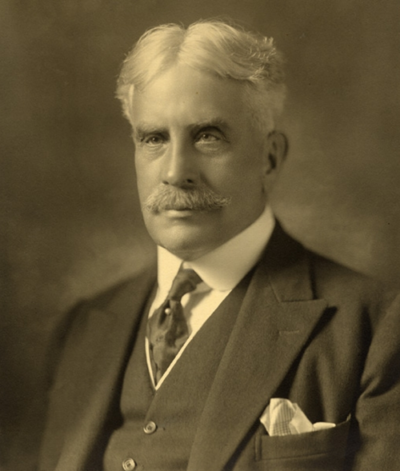
Robert Borden
Robert Borden was the 8th prime minister of Canada. Born June 26, 1854, in Grand-Pré. Died June 10, 1937, in Ottawa. Positions held include Prime Minister of Canada (1911–1920) and member of the House of Commons of Canada (1896–1921). Awards include Knight Grand Cross of the Order of St Michael and St George, Grand Cross of the Legion of Honour and Person of National Historic Significance.
Facts
22 facts · 2 confirmed by two sources · 6 cited · 14 from one source
Where this comes from
Papalocal keeps its own record. It started from these sources; what each one said is kept here as it was copied, so a change on their side never changes this page by itself. Tap one to read its version.
What Wikidata says · copied November 15, 2026 · revision 2569009590
- Described as
- 8th prime minister of Canada (1854–1937)
- Other names
- Sir Robert Laird Borden, Robert L. Borden, Robert Laird Borden
- Born
- June 26, 1854 · 7 references
- Died
- June 10, 1937 · 7 references
- Born in
- Grand-Pré · 1 reference
- Died in
- Ottawa · 1 reference
- Buried in
- Beechwood Cemetery
- Name at birth
- Robert Laird Borden
- Citizen of
- Canada
- Occupation
- politician · 1 reference; lawyer · 1 reference; diplomat
- Positions held
- Prime Minister of Canada (1911–1920); member of the House of Commons of Canada (1896–1921) · 1 reference
- Political party
- Liberal Party of Canada (1867–1891); Conservative Party of Canada (2 times) (1891–1937); Unionist Party (1917–1922)
- Awards
- Knight Grand Cross of the Order of St Michael and St George; Grand Cross of the Legion of Honour; Person of National Historic Significance · 1 reference
- Spouse
- Laura Borden (1889–) · 1 reference
- Father
- Andrew Borden
- Mother
- Eunice Jane Laird
- Religion
- Anglicanism
- Wikipedias with a page
- 38
Wikidata item Q128655 (wikidata.org/wiki/Q128655), public domain (CC0). Copied November 15, 2026.
What Wikipedia says · copied November 15, 2026 · revision 1383614368
Sir Robert Laird Borden (June 26, 1854 – June 10, 1937) was a Canadian lawyer and politician who served as the eighth prime minister of Canada from 1911 to 1920. He is best known for his leadership of Canada during World War I.
Borden was born in Grand-Pré, Nova Scotia. He worked as a schoolteacher for a period and then served his articles of clerkship at a Halifax law firm. He was called to the bar in 1878 and soon became one of Nova Scotia's most prominent barristers. Borden was elected to the House of Commons in the 1896 federal election, representing the Conservative Party. He replaced Charles Tupper as party leader in 1901, but was defeated in two federal elections by Liberal Prime Minister Sir Wilfrid Laurier in 1904 and 1908. However, in the 1911 federal election, Borden led the Conservatives to victory, on the basis that the Liberals' proposed trade reciprocity treaty with the United States would lead to the U.S. influencing Canadian identity and weaken ties with Great Britain.
Borden's early years as prime minister focused on strengthening relations with Britain. Within three years of taking office, World War I broke out. To support the war effort, he established the Canadian Expeditionary Force and enacted the War Measures Act, which granted the government sweeping powers. To finance the conflict, his government issued victory bonds, raised tariffs, and introduced new taxes, including the federal income tax. In 1917, facing what he believed to be a shortage in Canadian soldiers, Borden introduced conscription, which caused significant controversy in French Canada and ignited the Conscription Crisis. Despite this, his Unionist Party, a coalition of Conservatives and pro-conscription Liberals, was elected with an overwhelming majority in the 1917 federal election. After the war, Borden sought to expand the autonomy of Canada and other Dominions at the Paris Peace Conference, including by signing the Treaty of Versailles as independent parties. In doing so, Canada established itself as a founding member of the League of Nations. Domestically, Borden's government dealt with the aftermath of the Halifax Explosion, introduced women's suffrage in federal elections, nationalized railways by establishing the Canadian National Railway, and deployed the North-West Mounted Police to suppress the 1919 Winnipeg general strike.
Borden retired from politics in 1920. In his retirement, he was Chancellor of Queen's University from 1924 to 1930 and was president of two financial institutions, the Barclays Bank of Canada and the Crown Life Insurance Company, from 1928 until his death in 1937. Borden places above-average among historians and the public in rankings of prime ministers of Canada. He was the last prime minister born before Confederation and the last prime minister to be knighted, having accepted a knighthood in 1914.
- Born, in its opening lines
- June 26, 1854
- Died, in its opening lines
- June 10, 1937
From the Wikipedia article “Robert Borden” (en.wikipedia.org/wiki/Robert_Borden), by its contributors, under CC BY-SA 4.0 (creativecommons.org/licenses/by-sa/4.0/). Copied November 15, 2026; not changed.
Confirmed Two sources agree. Cited One source, and it names where it got it. One source One source, without a reference of its own. Sources disagree The sources disagree. We show the best-supported value and keep theirs below.
