
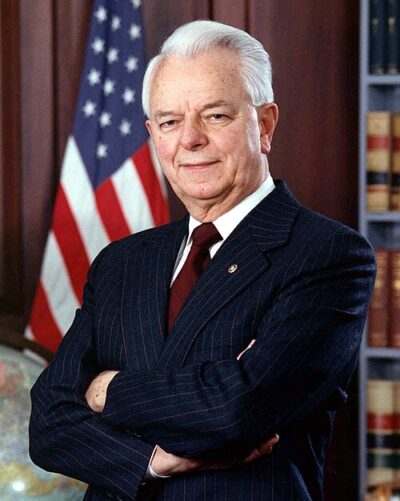
Robert Byrd
Robert Byrd was an American politician. Born November 20, 1917, in North Wilkesboro. Died June 28, 2010, in Merrifield. Positions held include United States representative (1953–1959), member of the State Senate of West Virginia (1951–1952) and Member of the West Virginia House of Delegates (1947–1950). Educated at Marshall University and George Washington University. Awards include Four Freedoms Award – Freedom from Fear, Order of the Cross of Terra Mariana, 1st Class and Commander's Grand Cross of the Order of the Lithuanian Grand Duke Gediminas.
Facts
37 facts · 2 confirmed by two sources · 18 cited · 17 from one source
Where this comes from
Papalocal keeps its own record. It started from these sources; what each one said is kept here as it was copied, so a change on their side never changes this page by itself. Tap one to read its version.
What Wikidata says · copied November 13, 2026 · revision 2564623777
- Described as
- American politician (1917–2010)
- Other names
- Robert Carlyle Byrd, Robert C. Byrd
- Born
- November 20, 1917 · 5 references
- Died
- June 28, 2010 · 6 references
- Born in
- North Wilkesboro
- Died in
- Merrifield
- Buried in
- Columbia Gardens Cemetery · 1 reference
- Name at birth
- Robert Carlyle Byrd
- Citizen of
- United States
- Occupation
- politician · 1 reference; lawyer; historian; fiddler
- Positions held
- United States representative (1953–1959); member of the State Senate of West Virginia (1951–1952) · 1 reference; Member of the West Virginia House of Delegates (1947–1950) · 1 reference; secretary (1967–1971) · 1 reference; whip (1971–1977) · 1 reference; United States senator (1959–2010) · 1 reference; Majority Leader of the United States Senate (2 times) (1977–1989) · 2 references; Minority Leader of the United States Senate (1981–1987) · 2 references; President pro tempore of the United States Senate (3 times) (1989–2010) · 2 references; senator · 1 reference
- Political party
- Democratic Party
- Education
- Marshall University (–1994) · 1 reference; George Washington University; primary school · 1 reference; University of Charleston · 1 reference; George Washington University Law School · 1 reference; Washington College of Law (–1963) · 1 reference
- Member of
- Ku Klux Klan
- Instrument
- fiddle
- Awards
- Four Freedoms Award – Freedom from Fear; Order of the Cross of Terra Mariana, 1st Class (2003); Commander's Grand Cross of the Order of the Lithuanian Grand Duke Gediminas; Friend of History Award (2007) · 1 reference
- Father
- Cornelius Calvin Sale, Sr. · 1 reference
- Mother
- Ada Mae Sale · 1 reference
- Religion
- Baptists
- Wikipedias with a page
- 50
Wikidata item Q276524 (wikidata.org/wiki/Q276524), public domain (CC0). Copied November 13, 2026.
What Wikipedia says · copied November 13, 2026 · revision 1385095392
Robert Carlyle Byrd (born Cornelius Calvin Sale Jr.; November 20, 1917 – June 28, 2010) was an American politician who represented West Virginia in the United States Senate from 1959 until his death in 2010. A member of the Democratic Party, he served as a U.S. Representative from West Virginia's 6th congressional district from 1953 to 1959. Byrd is the longest serving senator in American history, the second longest serving member of Congress, and the only West Virginian to serve in both houses of the West Virginia Legislature and the U.S. Congress.
Raised in southern West Virginia, Byrd's political career spanned more than sixty years. He first entered the political arena by organizing and leading a local chapter of the Ku Klux Klan in the 1940s, an action he later described as "the greatest mistake I ever made". In the time he earned Bachelor of Arts degree at the Marshall University and a Juris Doctor degree at the American University, Byrd served in the West Virginia House of Delegates from 1947 to 1950, and the West Virginia State Senate from 1950 to 1952. He was elected to the United States House of Representatives in 1952, where he served there for six years before being elected to the Senate in 1958. He was re-elected in 1964 and re-elected seven more times.
In the Senate, Byrd rose to become one of the chamber's most powerful members, serving as secretary of the Senate Democratic Caucus from 1967 to 1971 and—after defeating his longtime colleague Ted Kennedy for the job—as Senate Majority Whip from 1971 to 1977. Over the next 12 years, Byrd led the Democratic caucus as Senate Majority Leader and Senate Minority Leader. In 1989, he stepped down, following the pressure to make way for new party leadership. As the longest-serving Democratic senator, Byrd held the position of President pro tempore four times when his party was in the majority. This placed him third in the line of presidential succession, after the vice president and the Speaker of the House of Representatives. Byrd became West Virginia’s Senior Senator in 1985 following the retirement of Jennings Randolph. He served three different tenures as chairman of the United States Senate Committee on Appropriations, which enabled Byrd to steer a great deal of federal money toward projects in West Virginia.
Critics derided his efforts as pork barrel spending, while Byrd argued that the many federal projects he worked to bring to West Virginia represented progress for the people of his state. Notably, Byrd strongly opposed Clinton's 1993 efforts to allow homosexuals to serve in the military and supported efforts to limit same-sex marriage. Although he filibustered against the 1964 Civil Rights Act and supported the Vietnam War earlier in his career, Byrd's views changed considerably over the course of his life; by the early 2000s, he had completely renounced racism and segregation. Byrd was outspoken in his opposition to the Iraq War. Renowned for his knowledge of Senate precedent and parliamentary procedure, Byrd wrote a four-volume history of the Senate in later life. Near the end of his life, Byrd was in declining health and was hospitalized several times. He died in office on June 28, 2010, at the age of 92, and was buried at Columbia Gardens Cemetery in Arlington County, Virginia.
- Born, in its opening lines
- November 20, 1917
- Died, in its opening lines
- June 28, 2010
From the Wikipedia article “Robert Byrd” (en.wikipedia.org/wiki/Robert_Byrd), by its contributors, under CC BY-SA 4.0 (creativecommons.org/licenses/by-sa/4.0/). Copied November 13, 2026; not changed.
Confirmed Two sources agree. Cited One source, and it names where it got it. One source One source, without a reference of its own. Sources disagree The sources disagree. We show the best-supported value and keep theirs below.
