
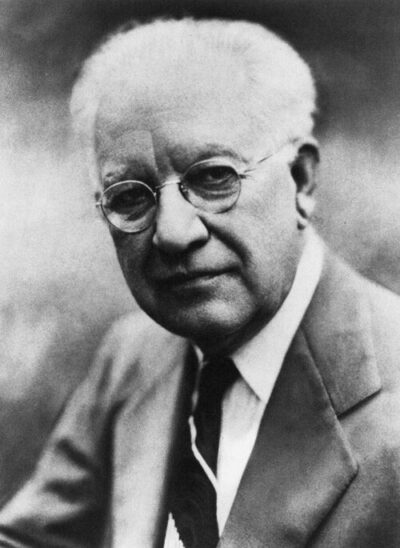
Robert Ezra Park
Robert Ezra Park was an American sociologist. Born February 14, 1864, in Harveyville. Died February 7, 1944, in Nashville. Positions held include President of the American Sociological Association (1925). Educated at Harvard University and University of Michigan.
Facts
24 facts · 2 confirmed by two sources · 4 cited · 18 from one source
Where this comes from
Papalocal keeps its own record. It started from these sources; what each one said is kept here as it was copied, so a change on their side never changes this page by itself. Tap one to read its version.
What Wikidata says · copied November 15, 2026 · revision 2568763643
- Described as
- American sociologist (1864–1944)
- Other names
- Robert E. Park
- Born
- February 14, 1864 · 4 references
- Died
- February 7, 1944 · 3 references
- Born in
- Harveyville · 1 reference
- Died in
- Nashville
- Buried in
- Oakland Cemetery · 1 reference
- Citizen of
- United States
- Occupation
- sociologist · 1 reference; criminologist; writer; university teacher; journalist; ecologist · 1 reference
- Positions held
- President of the American Sociological Association (1925) · 1 reference
- Worked for
- Michigan State University; University of Chicago; Tuskegee University; Fisk University
- Education
- Harvard University; University of Michigan; Heidelberg University (–1904) · 1 reference; University of Strasbourg · 1 reference
- Member of
- American Academy of Arts and Sciences
- Field
- sociology · 1 reference
- Children
- Robert H. Park · 1 reference
- Wikipedias with a page
- 30
Wikidata item Q919081 (wikidata.org/wiki/Q919081), public domain (CC0). Copied November 15, 2026.
What Wikipedia says · copied November 15, 2026 · revision 1358605826
Robert Ezra Park (February 14, 1864 – February 7, 1944) was an American urban sociologist who is considered to be one of the most influential figures in early U.S. sociology. Park was a pioneer in the field of sociology, changing it from a passive philosophical discipline to an active discipline rooted in the study of human behavior. He made significant contributions to the study of urban communities, race relations and the development of empirically grounded research methods, most notably participant observation in the field of criminology. From 1905 to 1914, Park worked with Booker T. Washington at the Tuskegee Institute. After Tuskegee, he taught at the University of Chicago from 1914 to 1933, where he played a leading role in the development of the Chicago School of sociology.
Park is noted for his work in human ecology, race relations, human migration, cultural assimilation, social movements, and social disorganization He played a large role in defining sociology as a natural science and challenged the belief that sociology is a moral science. He saw sociology as "...a point of view and a method for investigating the processes by which individuals are inducted into and induced to cooperate in some sort of permanent corporate existence, society."
- Born, in its opening lines
- February 14, 1864
- Died, in its opening lines
- February 7, 1944
From the Wikipedia article “Robert E. Park” (en.wikipedia.org/wiki/Robert_E._Park), by its contributors, under CC BY-SA 4.0 (creativecommons.org/licenses/by-sa/4.0/). Copied November 15, 2026; not changed.
Confirmed Two sources agree. Cited One source, and it names where it got it. One source One source, without a reference of its own. Sources disagree The sources disagree. We show the best-supported value and keep theirs below.
