
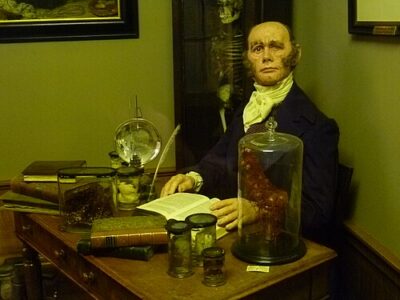
Robert Knox
Robert Knox was a Scottish physician, anatomist, zoologist and ethnologist. Born September 4, 1791, in Edinburgh. Died December 20, 1862, in London. Educated at University of Edinburgh and University of Paris. Awards include Fellow of the Royal Society of Edinburgh and Fellow of the Ethnological Society of London.
Facts
19 facts · 2 confirmed by two sources · 2 cited · 15 from one source
Where this comes from
Papalocal keeps its own record. It started from these sources; what each one said is kept here as it was copied, so a change on their side never changes this page by itself. Tap one to read its version.
What Wikidata says · copied November 16, 2026 · revision 2547253251
- Described as
- Scottish physician, anatomist, zoologist and ethnologist (1791-1862)
- Born
- September 4, 1791 · 5 references
- Died
- December 20, 1862 · 4 references
- Born in
- Edinburgh
- Died in
- London
- Buried in
- Brookwood Cemetery · 1 reference
- Citizen of
- United Kingdom of Great Britain and Ireland
- Occupation
- military physician; surgeon; anatomist; zoologist; physician · 1 reference
- Education
- University of Edinburgh; University of Paris; Royal High School · 1 reference
- Member of
- Royal Society of Edinburgh; Académie Nationale de Médecine
- Awards
- Fellow of the Royal Society of Edinburgh; Fellow of the Ethnological Society of London
- Military branch
- British Army
- Wikipedias with a page
- 28
Wikidata item Q352109 (wikidata.org/wiki/Q352109), public domain (CC0). Copied November 16, 2026.
What Wikipedia says · copied November 16, 2026 · revision 1380254812
Robert Knox (4 September 1791 – 20 December 1862) was a Scottish anatomist and ethnologist best known for his involvement in the Burke and Hare murders. Born in Edinburgh, Scotland, Knox eventually partnered with anatomist and former teacher John Barclay and became a lecturer on anatomy in the city, where he introduced the theory of transcendental anatomy. However, Knox's incautious methods of obtaining cadavers for dissection before the passage of the Anatomy Act 1832 and disagreements with professional colleagues ruined his reputation in Scotland. Following these developments, he moved to London, though this did not revive his career.
Knox's views on humanity gradually shifted over the course of his lifetime, as his initially positive views (influenced by the ideals of Étienne Geoffroy Saint-Hilaire) gave way to a more pessimistic view. Knox also devoted the latter part of his career to studying and theorising on evolution and ethnology; during this period, he also wrote numerous works advocating scientific racism. His work on the latter further harmed his legacy and overshadowed his contributions to evolutionary theory, which he used to account for racial differences.
- Born, in its opening lines
- September 4, 1791
- Died, in its opening lines
- December 20, 1862
From the Wikipedia article “Robert Knox (surgeon)” (en.wikipedia.org/wiki/Robert_Knox_(surgeon)), by its contributors, under CC BY-SA 4.0 (creativecommons.org/licenses/by-sa/4.0/). Copied November 16, 2026; not changed.
Confirmed Two sources agree. Cited One source, and it names where it got it. One source One source, without a reference of its own. Sources disagree The sources disagree. We show the best-supported value and keep theirs below.
