
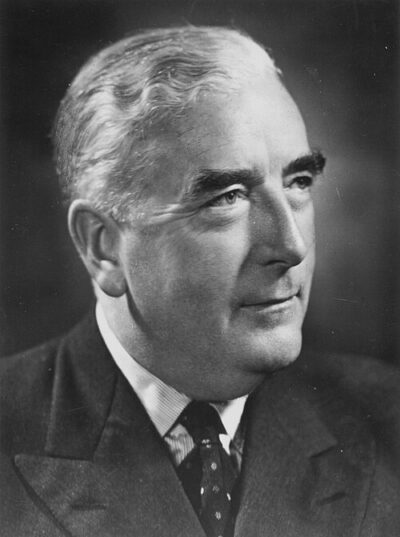
Robert Menzies
Robert Menzies was an Australian politician, 12th Prime Minister of Australia. Born December 20, 1894, in Jeparit. Died May 15, 1978, in Melbourne. Positions held include Prime Minister of Australia (2 times) (1939–1966), Attorney-General for Australia (1934–1939) and member of the Australian House of Representatives (1934–1966). Educated at Grenville College and Melbourne Law School. Awards include Order of the Rising Sun, 1st class, Chief Commander of the Legion of Merit and Legionnaire of Legion of Merit.
Facts
50 facts · 2 confirmed by two sources · 12 cited · 36 from one source
Where this comes from
Papalocal keeps its own record. It started from these sources; what each one said is kept here as it was copied, so a change on their side never changes this page by itself. Tap one to read its version.
What Wikidata says · copied November 16, 2026 · revision 2562941749
- Described as
- Australian politician, 12th Prime Minister of Australia (1894-1978)
- Other names
- Sir Robert Menzies, Robert Gordon Menzies, The Right Honourable Sir Robert Menzies, Sir Robert Gordon Menzies
- Born
- December 20, 1894 · 9 references
- Died
- May 15, 1978 · 8 references
- Born in
- Jeparit · 2 references
- Died in
- Melbourne · 1 reference
- Buried in
- Melbourne General Cemetery
- Cause of death
- myocardial infarction
- Name at birth
- Robert Gordon Menzies
- Citizen of
- Australia
- Occupation
- politician · 1 reference; diplomat; lawyer; preface author
- Positions held
- Prime Minister of Australia (2 times) (1939–1966); Attorney-General for Australia (1934–1939); member of the Australian House of Representatives (1934–1966); Deputy Premier of Victoria (1932–1934); Minister for Foreign Affairs (Australia); Member of the Victorian Legislative Assembly (1929–1934); Member of the Victorian Legislative Council (1928–1929); Treasurer of Australia (1939–1940); Minister for Defence (1939–1941); Lord Warden of the Cinque Ports (1965–1978)
- Political party
- Nationalist Party of Australia; United Australia Party; Liberal Party of Australia
- Education
- Grenville College (1908–1909) · 1 reference; Melbourne Law School; Wesley College
- Member of
- Royal Society of London (1965–); Australian Academy of Science (1958) · 1 reference; Australian Academy of the Humanities (1969) · 1 reference
- Awards
- Order of the Rising Sun, 1st class; Chief Commander of the Legion of Merit; Legionnaire of Legion of Merit; Fellow of the Australian Academy of Science (1958) · 1 reference; Fellow of the Australian Academy of the Humanities (1969) · 1 reference; Order of the Thistle · 1 reference; Companion of Honour · 1 reference; King George V Silver Jubilee Medal · 1 reference; King George VI Coronation Medal · 1 reference; Queen Elizabeth II Coronation Medal · 1 reference; Knight of the Order of Australia (1976) · 1 reference; Honorary Fellow of the Royal College of Surgeons (1965) · 1 reference
- Spouse
- Pattie Menzies (1920–1978)
- Children
- Heather Henderson
- Father
- James Menzies · 1 reference
- Mother
- Kate Sampson · 1 reference
- Siblings
- Frank Menzies
- Religion
- Presbyterianism
- Lived in
- Malvern · 1 reference
- Wikipedias with a page
- 48
Wikidata item Q214438 (wikidata.org/wiki/Q214438), public domain (CC0). Copied November 16, 2026.
What Wikipedia says · copied November 16, 2026 · revision 1385939412
Sir Robert Gordon Menzies (20 December 1894 – 15 May 1978) was the 12th prime minister of Australia, serving from 1939 to 1941 and from 1949 to 1966. He held office as the leader of the United Australia Party (UAP) in his first term, and subsequently as the inaugural leader of the Liberal Party of Australia in his second. He was the member of parliament (MP) for the Victorian division of Kooyong from 1934 to 1966. With a combined term length of 18 years, 163 days, he is the longest-serving prime minister in Australian history.
Menzies studied law at the University of Melbourne and became one of Melbourne's leading lawyers. He was Deputy Premier of Victoria from 1932 to 1934, and then transferred to Federal Parliament, subsequently becoming Attorney-General of Australia and Minister for Industry in the government of Joseph Lyons. In April 1939, following Lyons's death, Menzies was elected leader of the United Australia Party (UAP) and sworn in as prime minister. He authorised Australia's entry into World War II in September 1939, and spent four months in Britain to participate in meetings of Churchill's war cabinet. On his return to Australia in August 1941, Menzies found that he had lost the support of his party and consequently resigned as prime minister. He subsequently helped to create the new Liberal Party, and was elected its inaugural leader in August 1945.
At the 1949 federal election, Menzies led the Liberal–Country coalition to victory and returned as prime minister. His appeal to the home and family, promoted via reassuring radio talks, matched the national zeitgeist as the economy grew and middle-class values prevailed; the Australian Labor Party's support had also been eroded by Cold War scares. After 1955, his government also received support from the Democratic Labor Party, a breakaway group from the Labor Party. Menzies won seven consecutive elections during his second period, eventually retiring as prime minister in January 1966. Despite the failures of his first administration, his government is remembered for its development of Australia's capital city of Canberra, its expanded post-war immigration scheme, emphasis on higher education, and national security policies, which saw Australia contribute troops to the Korean War, the Malayan Emergency, the Indonesia–Malaysia confrontation, and the Vietnam War.
- Born, in its opening lines
- December 20, 1894
- Died, in its opening lines
- May 15, 1978
From the Wikipedia article “Robert Menzies” (en.wikipedia.org/wiki/Robert_Menzies), by its contributors, under CC BY-SA 4.0 (creativecommons.org/licenses/by-sa/4.0/). Copied November 16, 2026; not changed.
Confirmed Two sources agree. Cited One source, and it names where it got it. One source One source, without a reference of its own. Sources disagree The sources disagree. We show the best-supported value and keep theirs below.
